

At Scan N More, we understand the critical importance of data security in government and military organizations.
The Department of Defense (DoD) has established strict standards for hard drive destruction to protect sensitive information from falling into the wrong hands.
In this post, we’ll explore the DoD hard drive destruction standards and what they mean for your organization’s data security practices.
Understanding DoD Hard Drive Destruction Standards
Definition of DoD Standards
The Department of Defense (DoD) has established strict standards for hard drive destruction to protect sensitive information. These standards are essential for government and military organizations to prevent data breaches and safeguard national security.
Evolution of DoD Standards
DoD 5220.22-M Standard
The DoD 5220.22-M standard is used for getting rid of unwanted, sensitive data from storage media. This method involves a data wiping process to securely erase information.
NIST Special Publication 800-88
Currently, the National Institute of Standards and Technology (NIST) Special Publication 800-88 serves as the most up-to-date guideline for media sanitization. This publication assists organizations and system owners in making practical sanitization decisions based on the categorization of confidentiality.
Levels of Data Sanitization
NIST SP 800-88 defines three levels of data sanitization:

- Clear: This basic level overwrites data with new values, which makes it difficult for standard data recovery tools to retrieve information.
- Purge: A more thorough process that renders data recovery infeasible using state-of-the-art laboratory techniques.
- Destroy: The highest level of sanitization, which involves physical destruction of the media to prevent any possible data recovery.
For organizations that handle classified information, the Defense Counterintelligence and Security Agency (DCSA) requires that Controlled Unclassified Information (CUI) must become completely unreadable and irrecoverable.
Compliance and Documentation
Compliance with DoD standards requires meticulous documentation of the destruction process. Organizations must maintain detailed records (including dates, methods used, and verification procedures). This documentation proves essential for demonstrating compliance during audits and inspections.
The next chapter will explore the specific methods of hard drive destruction that comply with these rigorous DoD standards, including both physical and software-based techniques.
Methods of Hard Drive Destruction: Ensuring Data Security
Physical Destruction Techniques
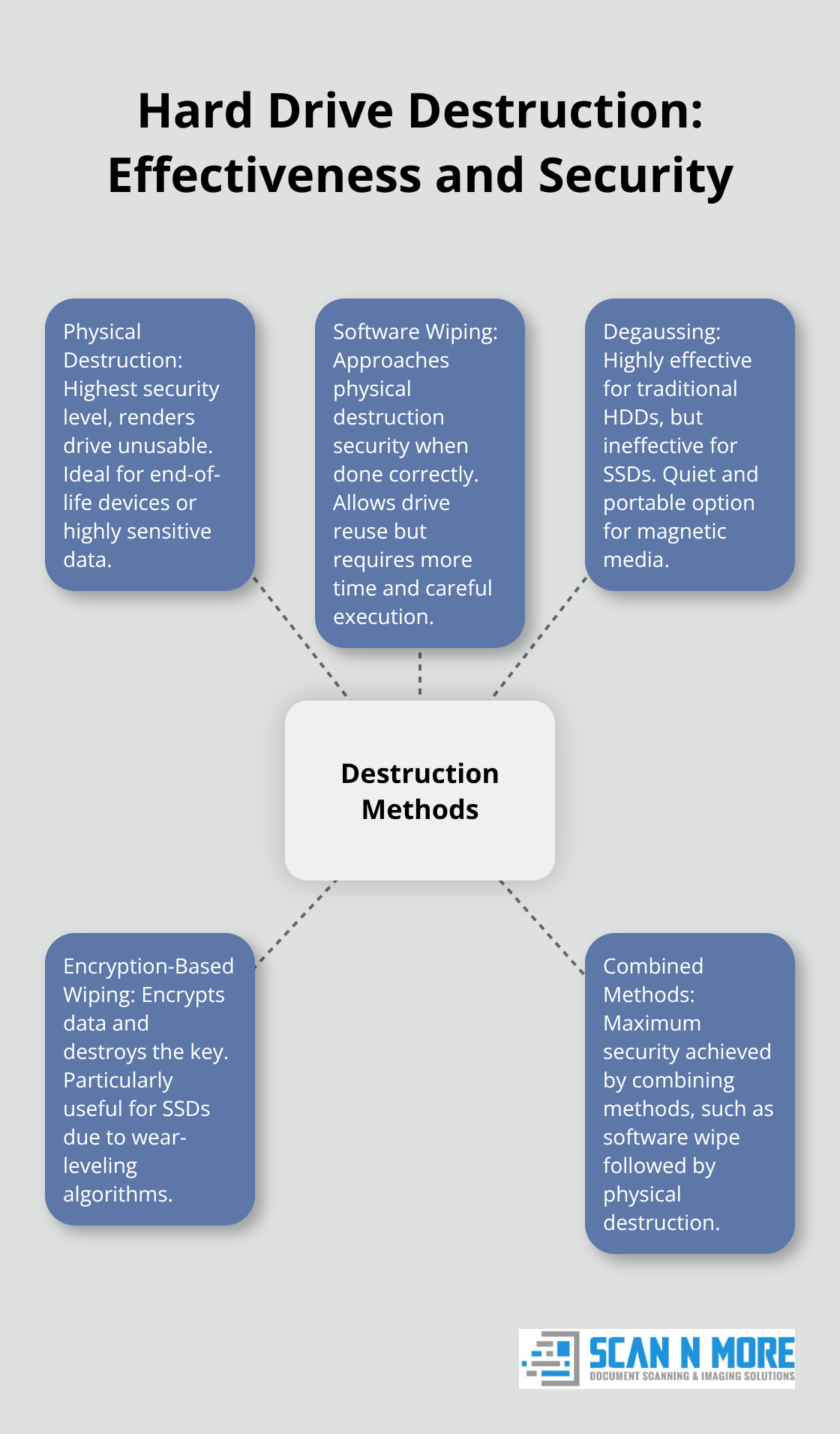
Physical destruction stands as the most definitive method for data elimination. Shredding hard drives into minuscule pieces renders data recovery practically impossible. Industrial-grade shredders accomplish this task with precision and efficiency.
Crushing and puncturing offer alternative physical destruction methods. A hydraulic press flattens a drive, while specialized tools create multiple punctures through the drive’s platters. These techniques, although effective, may not match the thoroughness of shredding for high-security scenarios.
Degaussing employs powerful magnetic fields to scramble data on magnetic media. This method proves highly effective for traditional hard disk drives but fails to impact solid-state drives (SSDs). Degaussers shine at quiet, portable, and 100% secure data erasure.
Software-Based Data Wiping
Organizations seeking to repurpose drives often turn to software-based wiping as a non-destructive option. The DoD 5220.22-M standard, though outdated, remains popular. It overwrites data with patterns of ones and zeros multiple times.
More current standards, such as NIST 800-88, recommend a single overwrite pass for most situations. This method provides faster results and equal effectiveness on modern drives. For SSDs, the ATA Secure Erase command often offers the most efficient option.
Encryption-based wiping has gained traction in recent years. This method encrypts all data on a drive and then destroys the encryption key, rendering the data inaccessible. It proves particularly useful for SSDs, where traditional overwriting may miss some data areas due to wear-leveling algorithms.
Effectiveness and Security Considerations
Physical destruction provides the highest level of security but renders the drive unusable. It suits end-of-life devices or those containing highly sensitive data perfectly.
Software wiping, when executed correctly, approaches the security level of physical destruction. It allows for drive reuse, making it more cost-effective and environmentally friendly. However, it requires more time and careful execution to address all data areas.
For maximum security, experts often recommend combining methods. A software wipe followed by physical destruction ensures data remains unrecoverable even if one method fails.
Verification plays a critical role in any destruction method. Specialized tools confirm that no readable data remains on the drive after sanitization.
The effectiveness of any method hinges on proper execution. Staff training and strict adherence to procedures prove essential. Regular audits of destruction processes help identify and address weaknesses in data security protocols.
As we move forward, implementing DoD-compliant hard drive destruction requires a comprehensive approach. The next section will explore how organizations can develop robust policies, train staff effectively, and partner with certified destruction service providers to ensure compliance and data security.
How to Implement DoD-Compliant Hard Drive Destruction
Develop a Comprehensive Data Destruction Policy
Organizations must create a robust policy that outlines specific procedures for identifying, segregating, and destroying drives with sensitive data. This policy should align with DoD standards and other relevant regulations (e.g., HIPAA, GDPR).
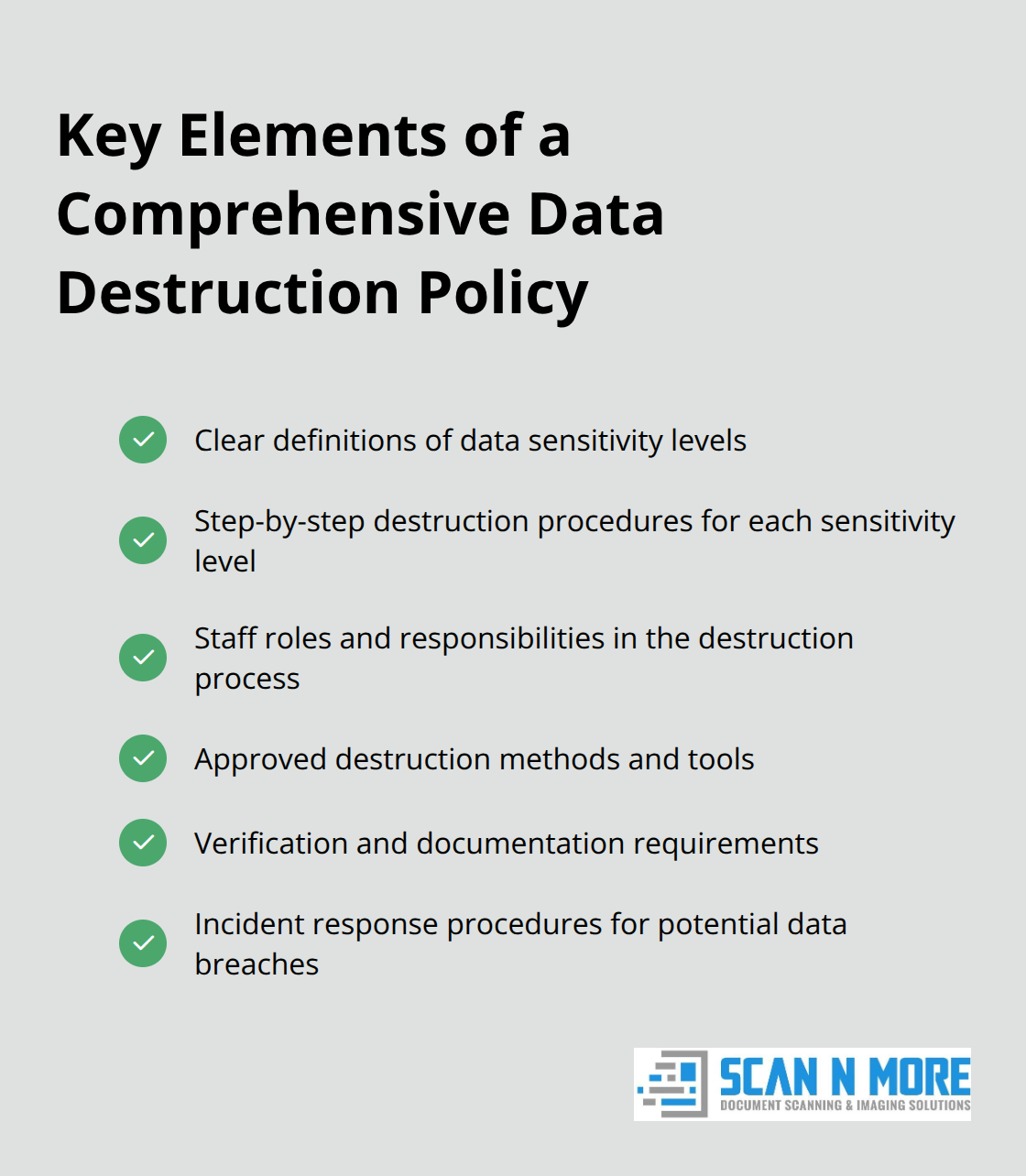
Key policy elements include:
- Clear definitions of data sensitivity levels
- Step-by-step destruction procedures for each level
- Staff roles and responsibilities
- Approved destruction methods and tools
- Verification and documentation requirements
- Incident response procedures for potential data breaches
Organizations should update their policies regularly to reflect changes in technology and regulations.
Implement Rigorous Staff Training
Effective policies require well-trained staff. Organizations should develop a comprehensive training program that covers:
- Data security importance and breach consequences
- Hands-on practice with approved destruction methods
- Proper use of destruction equipment and software
- Documentation and chain-of-custody procedures
- Recognition of sensitive data across various media types
Organizations can consider implementing a certification program for staff members responsible for data destruction.
Establish Thorough Documentation Practices
Meticulous documentation proves essential for both compliance and security. For each destroyed drive, organizations should record:
- Unique identifier (serial number, asset tag)
- Date and time of destruction
- Method used (e.g., degaussing, shredding, software wiping)
- Staff member(s) involved
- Verification method and results
- Final disposition of media
Organizations can invest in asset management software to streamline this process and reduce audit preparation time.
Select Certified Destruction Service Providers
Many organizations find that partnering with a certified destruction service provider offers a secure and cost-effective solution. When selecting a provider, organizations should:
- Verify NAID AAA Certification
- Inquire about specific destruction methods and DoD compliance
- Evaluate chain-of-custody procedures and documentation practices
- Request proof of employee background checks and security training
- Consider on-site destruction services for highly sensitive data
Professional destruction services can significantly reduce data security incidents related to improper media disposal.
Conduct Regular Audits and Assessments
Organizations should perform regular audits of their destruction processes to identify and address potential weaknesses. These audits can include:
- Review of destruction logs and documentation
- Verification of proper equipment maintenance
- Assessment of staff knowledge and adherence to procedures
- Evaluation of physical security measures for storage and destruction areas
- Testing of emergency response procedures
Regular assessments help organizations maintain compliance and improve their data destruction practices over time.
Final Thoughts
DoD hard drive destruction standards protect sensitive information and maintain national security. These protocols ensure data remains unrecoverable, shielding organizations from potential breaches and unauthorized access. Government agencies, military organizations, and contractors demonstrate their commitment to data security and regulatory compliance through adherence to these standards.
Organizations must prioritize thorough implementation of DoD-compliant hard drive destruction methods. The choice between physical destruction techniques and software-based data wiping solutions depends on data sensitivity and the intended fate of storage devices. Companies should develop comprehensive policies, train staff, and maintain meticulous documentation to ensure compliance.
Scan N More understands the importance of secure data handling and destruction. We offer professional document scanning services to help organizations transition to digital solutions while maintaining data security. Our hard drive destruction services (which adhere to DoD standards) provide peace of mind for organizations dealing with sensitive information.