
Courts across the country are drowning in paper. Case files pile up in storage rooms, retrieval takes weeks, and documents deteriorate on shelves while legal staff waste hours searching for records.
At Scan N More, we’ve seen firsthand how court filings digitization transforms these operations. Moving to digital systems cuts processing time dramatically, slashes storage costs, and protects evidence from loss or damage. This blog post walks through how courts can make the transition and what benefits await on the other side.
Why Paper Courts Fail
State courts handle over 100 million cases annually, yet most still rely on manual paper processes that create bottlenecks at every stage. When a document needs to be retrieved, court staff search through filing cabinets and storage rooms, often spending hours locating a single record. Massachusetts State Auditor Suzanne Bump found that electronic filing reduces court processing time. That’s not a minor improvement-that’s the difference between resolving cases in months versus years. Courts that haven’t digitized their systems operate at a severe disadvantage.
The Real Cost of Searching for Documents
Misfiled or misplaced documents don’t just inconvenience staff. They stall hearings for days or weeks, triggering continuances and frustrating citizens waiting for justice. A four-drawer cabinet costs approximately $25,000 to fill and roughly $2,000 annually to maintain. Courts maintaining large paper backlogs spend enormous budgets on physical storage that delivers zero value to case outcomes.
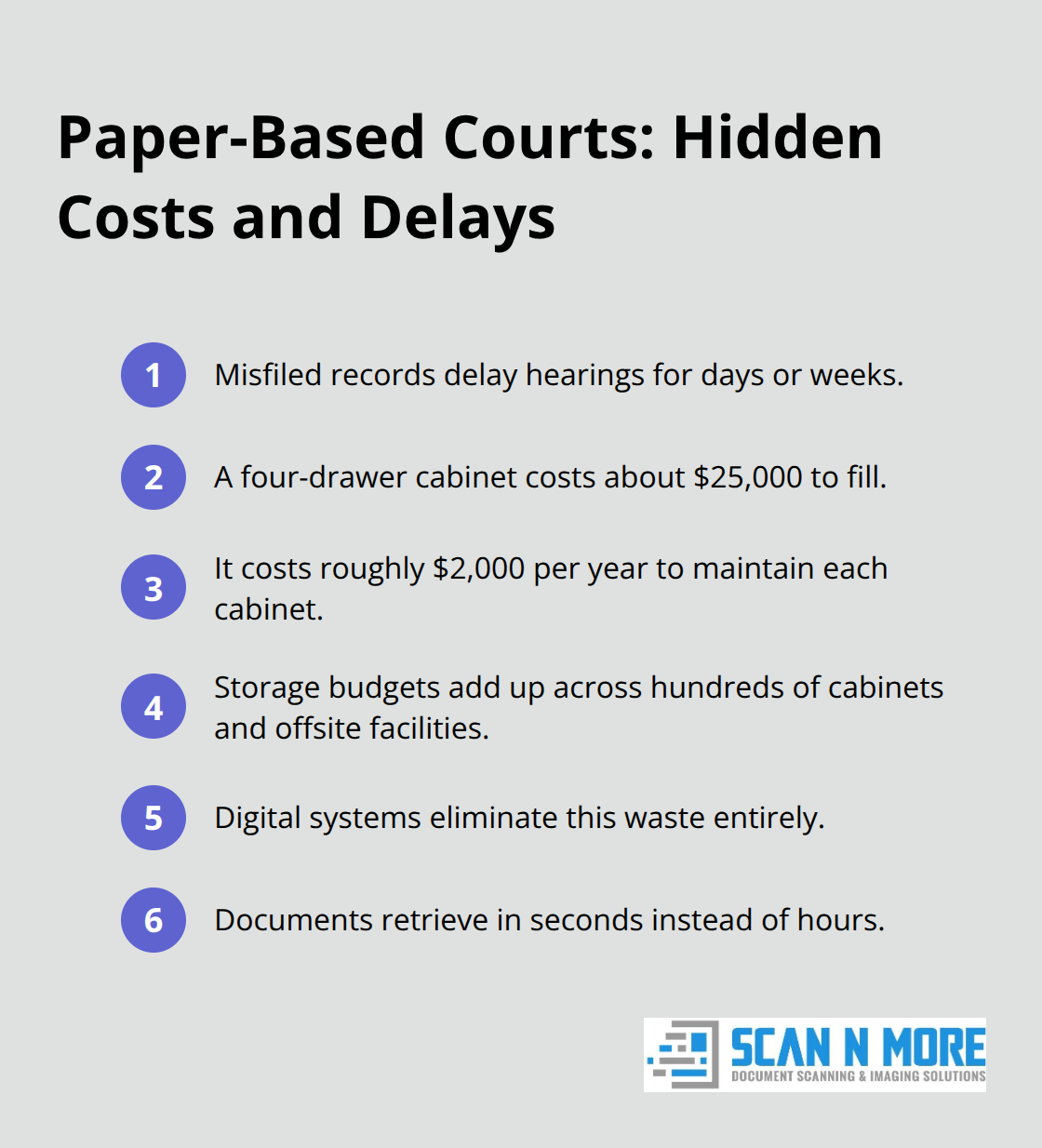
When you multiply this across hundreds of cabinets and offsite storage facilities, the annual expense becomes staggering. Digital systems eliminate this waste entirely. Documents retrieve in seconds instead of hours, and staff spend time on actual legal work instead of file hunting.
Storage Constraints That Strangle Operations
Paper storage isn’t just expensive-it’s unsustainable as case volumes grow. Courts run out of physical space, forcing them to rent offsite storage that increases retrieval times and security risks. This creates a vicious cycle: more cases arrive, paper piles accumulate, storage costs spike, and the system slows further. Moving backlog to digital storage yields substantial cost and space savings, freeing budget for higher-value initiatives. Courts can reclaim entire rooms currently occupied by filing cabinets and redirect that real estate toward courtrooms, legal research areas, or staff workspaces. The space problem alone justifies digitization, but the security issues make it mandatory.
Why Physical Records Are Vulnerable
Physical documents face constant disaster risks. Fires, floods, and simple human error jeopardize continuity and accessibility. A water leak in a storage room can destroy years of case files in hours. Scanned records resist damage or loss and can be protected with role-based access controls. Digital backups exist simultaneously in multiple locations, making total loss virtually impossible. Courts that experience document loss face legal liability, public backlash, and cases that must be retried because evidence vanished. Digital systems eliminate this risk category entirely.
Moving Forward with Digital Solutions
These vulnerabilities expose why courts must transition to digital filing systems. The next section examines how digital filing transforms legal operations and what specific improvements courts can expect once they make the shift.
How Digital Filing Accelerates Case Resolution
Instant Document Retrieval Transforms Case Timelines
Digital filing systems eliminate the retrieval delays that plague paper-based courts. When a judge needs evidence or an attorney requires a motion from six months ago, digital systems deliver it in seconds rather than hours. Ontario’s courts implemented their Digital Transformation initiative, replacing paper procedures with an online platform that provides 24/7 access to court information and enables instant retrieval of documents and schedules. Electronic filing accelerates the entire case lifecycle because documents route automatically to the correct docket and integrate directly with case management systems, eliminating manual sorting and data-entry delays.
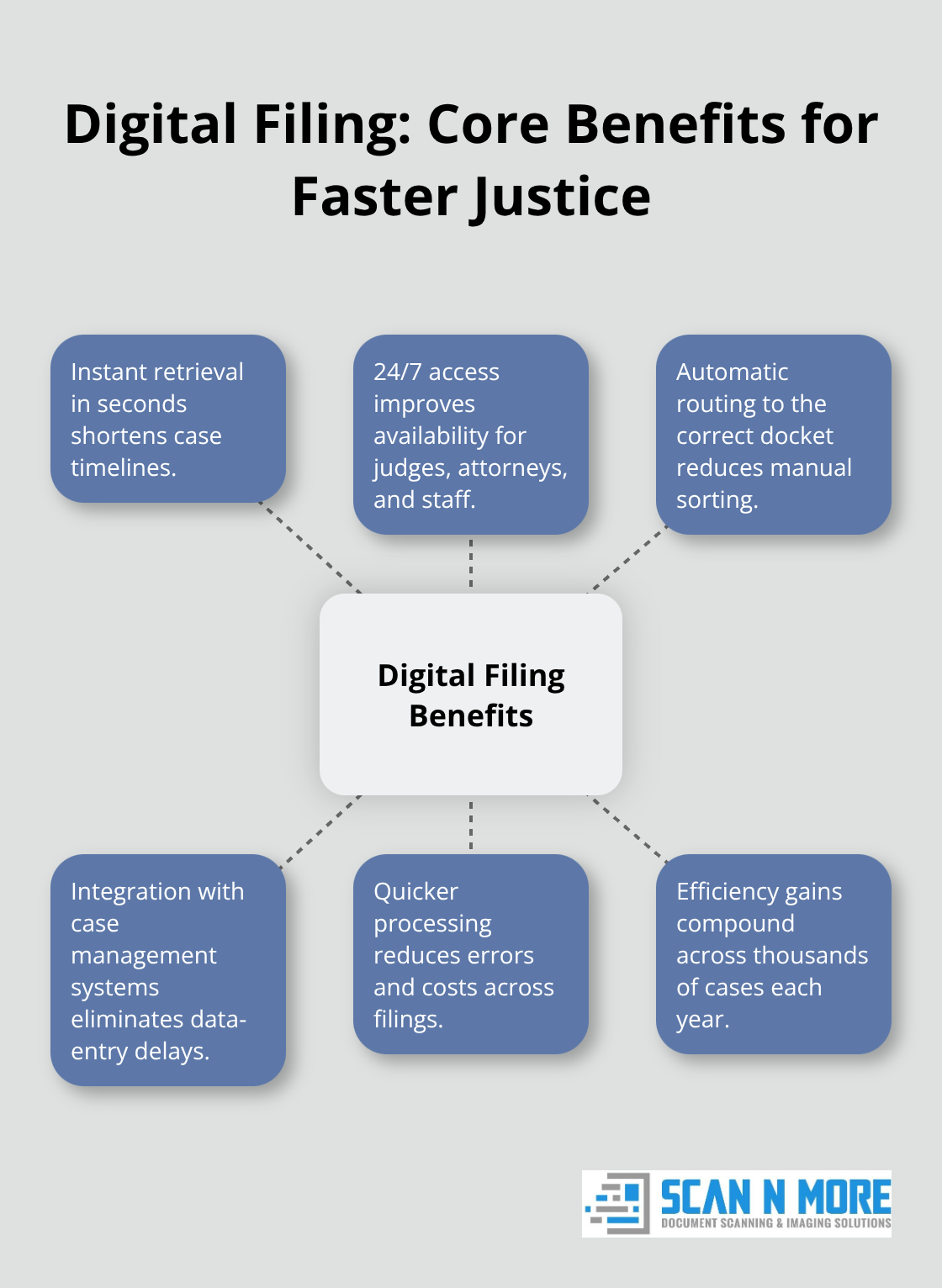
Instant Document Retrieval Transforms Case Timelines delivers quicker processing, reduced errors, and reduced costs. That efficiency gain compounds across thousands of cases annually, meaning courts resolve disputes faster and citizens receive faster justice.
Compliance and Security Standards Paper Cannot Match
Compliance and security improve dramatically with digital systems because they enforce standards that paper cannot match. Electronic filing reduces data-entry errors and misplacement while providing online status updates accessible through filers’ portals, creating transparency that protects both courts and legal professionals. Digital court records use secure, uneditable formats to prevent tampering during review, addressing a critical vulnerability of physical documents. Courts implement role-based access controls that restrict sensitive information to authorized personnel only, meeting regulatory requirements for GDPR, PIPEDA, FIPPA, OHSA, and WHMIS compliance far more effectively than paper filing ever could.
Reallocating Staff Time to Higher-Value Work
Staff spend less time managing documents and more time on substantive legal work because digital workflows eliminate courier runs, phone-based exchanges, and the constant shuffling of papers between departments. Courts that transition to digital systems report substantial staff time reallocation from manual filing to higher-value tasks like legal analysis and case preparation, directly improving service quality and reducing the administrative overhead that currently consumes court budgets. This shift in how courts deploy their workforce represents one of the most tangible benefits of digitization-staff members focus on work that advances justice rather than work that simply moves papers around.
The Path to Sustainable Court Operations
These operational improvements set the stage for implementing digital archiving systems that preserve case files securely and make them accessible for decades to come. The next section examines the specific practices courts should adopt to build archiving systems that protect evidence, maintain compliance, and support long-term case management.
Building Archiving Systems That Courts Can Trust
Digital archiving only delivers value when courts implement it correctly. Courts need three critical elements working together: secure storage that protects evidence from unauthorized access, indexing standards that make documents findable, and staff training that ensures people actually use the system properly. Without all three, courts end up with digitized files that sit in storage, inaccessible and worthless.
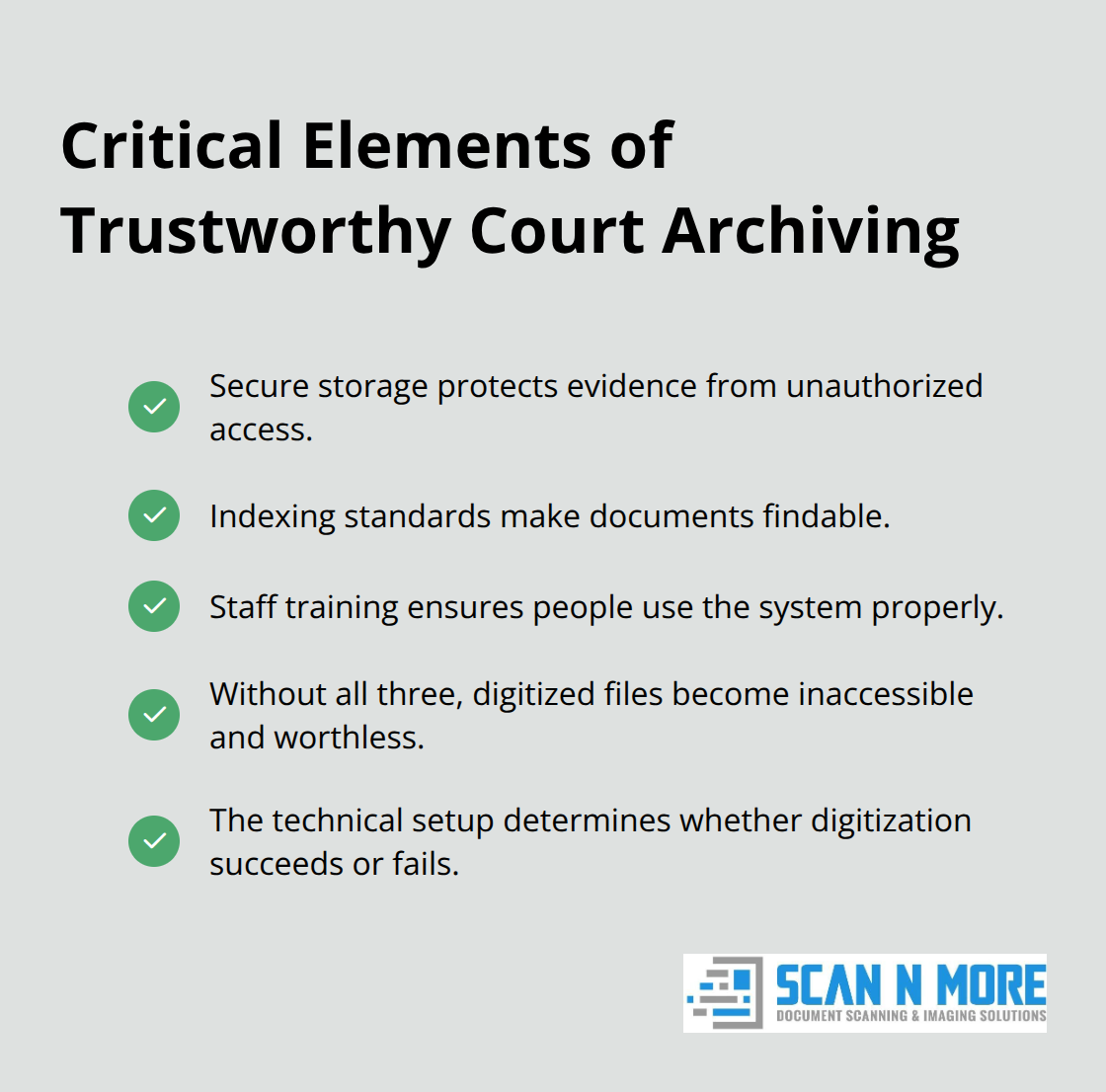
The technical setup determines whether digitization succeeds or fails.
Storage Architecture Determines Long-Term Success
Cloud storage sounds convenient, but courts handling sensitive case files need to think carefully about where data lives. Ontario’s digital court system stores files securely with options ranging from cloud-based solutions to secure local drives, depending on the court’s data security requirements and regulatory environment. Courts should demand secure storage with encryption at rest and in transit, role-based access controls that restrict file viewing to authorized personnel, and audit trails that log every access to sensitive documents. Some courts prefer hybrid approaches where frequently accessed files sit on secure local systems while archived materials move to cloud backup. The choice depends on your jurisdiction’s data residency requirements and compliance mandates.
What matters most is that courts never accept generic cloud storage designed for general business use. Court records demand infrastructure built specifically for legal and regulatory compliance. When evaluating storage partners, courts should verify that systems meet GDPR, PIPEDA, and FIPPA standards explicitly, not just claim general security compliance. The wrong storage choice exposes sensitive case information to unauthorized access and creates liability that no court can afford.
Metadata Standards That Make Discovery Possible
Indexing court documents requires consistent standards or courts end up with thousands of files that nobody can locate. Courts should establish metadata conventions before scanning begins: standardized PDF formats for all documents, consistent naming conventions that include case number and document type, and systematic indexing that enables cross-referencing between related exhibits and motions. When documents use standardized PDFs, file sizes stay manageable, uploads and downloads speed up, and categorization becomes automatic.
Courts that implement searchable PDFs with indexed text can locate specific clauses or case citations in seconds rather than hours. This matters because legal research efficiency directly impacts case resolution timelines. Courts should also establish retention policies that align with state law before archiving begins, ensuring that digital systems preserve documents for the correct timeframes without accumulating unnecessary bulk. Metadata standards seem like administrative overhead until staff members waste weeks searching for a single exhibit because nobody established consistent naming conventions.
Making Staff Adoption Actually Happen
Training court personnel on digital workflows fails when courts treat it as a one-time event rather than ongoing support. Courts should assign staff members as digital workflow champions who become expert users and help colleagues troubleshoot problems daily. New workflows feel awkward initially, and staff members revert to paper processes unless they receive consistent reinforcement and immediate support when frustration strikes.
Courts that succeed at digital transition budget for extended training, provide quick-reference guides at workstations, and celebrate early wins that demonstrate how digital systems save time. Staff need to see the personal benefit: fewer hours searching for files means more time on substantive work that feels rewarding. Courts should measure adoption rates monthly and address resistance directly rather than hoping people eventually accept change. When courts invest in proper training and ongoing support, staff typically become advocates for digital systems because they experience the efficiency gains firsthand.
Final Thoughts
Court filings digitization delivers three concrete outcomes that justify the investment immediately. Courts eliminate the delays that plague case resolution, with documents that took hours to locate now appearing in seconds. Staff members redirect time from document hunting to substantive legal work that advances cases, while courts slash operational costs by eliminating recurring expenses tied to physical storage and maintenance. Digital systems with encryption, role-based access controls, and multiple backup locations protect evidence from loss and deterioration that paper filing cannot prevent.
The financial case for digitization proves overwhelming when courts calculate the true cost of paper operations. A four-drawer cabinet costs $25,000 to fill and $2,000 annually to maintain, yet digital storage eliminates this recurring expense entirely while courts reclaim physical space worth thousands of dollars monthly. Environmental benefits follow automatically through reduced paper consumption and lower transportation costs, but the real payoff remains operational-courts that implement digital filing systems resolve cases faster, serve citizens more effectively, and operate with greater security and compliance.
We at Scan N More provide professional document scanning services that handle all formats with the security and compliance that courts require. Our on-site and off-site scanning options transition your backlog smoothly to digital storage without disrupting daily operations, and we help establish the metadata standards and indexing conventions that keep documents findable for decades. Contact Scan N More today to transform your court filings into a secure, accessible digital archive.