
Law firms still manage thousands of documents manually, wasting hours on filing, retrieval, and organization. At Scan N More, we’ve seen firsthand how law firm imaging solutions transform this chaos into streamlined workflows that save time and reduce errors.
Modern document imaging isn’t just about going digital-it’s about meeting strict compliance requirements while giving your team instant access to case files from anywhere. The firms adopting these systems today are already outpacing competitors stuck in paper-based processes.
Why Law Firms Need Digital Document Management
Paper-Based Systems Drain Time and Money
Paper-based document management costs law firms significantly more than most realize. A typical mid-sized firm spends between $5,000 and $15,000 annually on physical storage space alone, not counting the staff hours lost to filing, searching, and retrieving documents. When a paralegal spends 45 minutes hunting through file cabinets for a single contract instead of working on billable tasks, that’s money walking out the door. The real problem isn’t just the space or the cost-it’s the mistakes that happen when documents get misfiled, lost, or damaged. One misplaced deposition transcript or overlooked contract clause can derail case strategy or create liability exposure.
Client Expectations Demand Faster Access
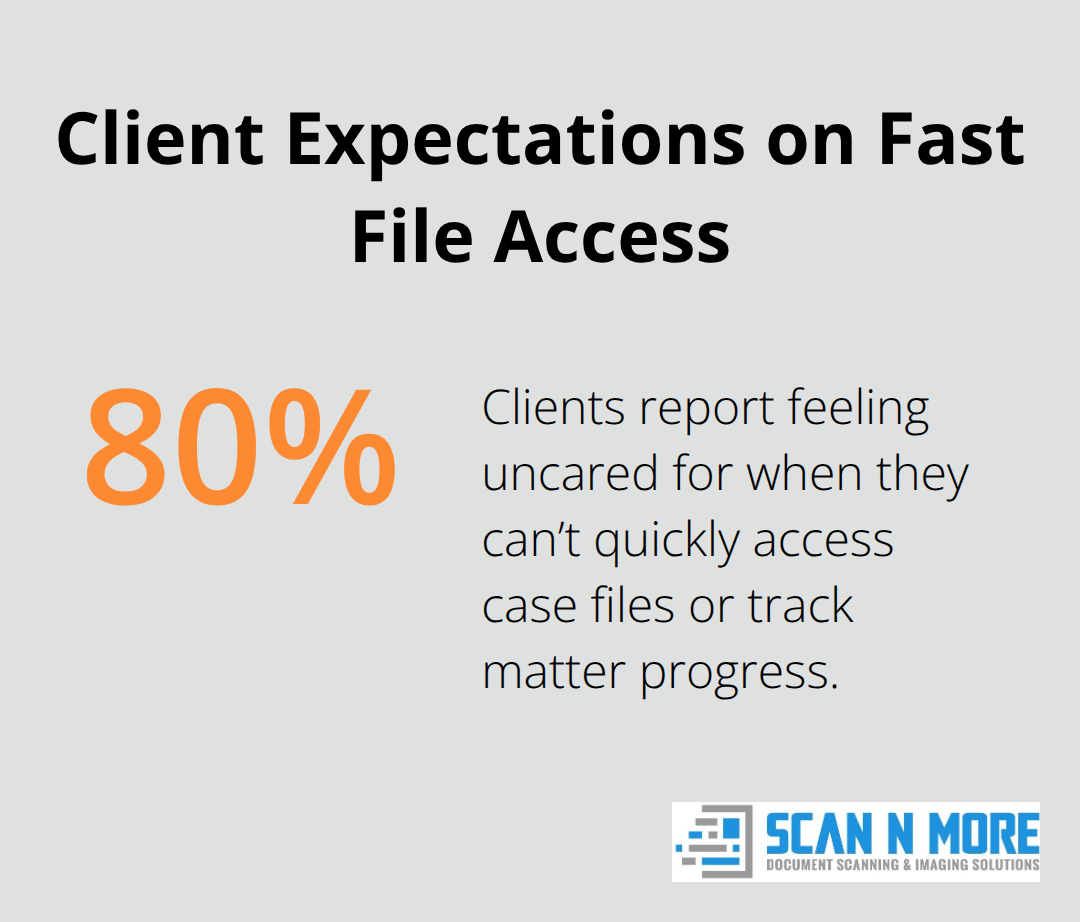
Courts expect faster document production than ever before. The 2025 Legal CX Report found that 80% of law firm clients feel uncared for, largely because they can’t access their case files quickly or track progress on their matters. Digital documents eliminate the need to search through filing cabinets, allowing lawyers to retrieve files instantly from any location.
When clients call repeatedly asking where their documents are or what’s happening with their case, firms waste time answering routine questions instead of doing substantive legal work. This friction damages client relationships and generates negative reviews that harm reputation.
Compliance Requirements Create Legal Risk
Regulatory requirements add another layer of urgency. Law firms must comply with state bar association rules, HIPAA requirements if they handle health information, and increasingly strict cybersecurity standards. Storing sensitive documents in filing cabinets or unencrypted digital folders creates compliance risk. SOC 2 and SOC 3 certified security protocols, along with ISO/IEC 27001:2022 certification standards, demonstrate that a firm has implemented proper controls for data protection and access management. These certifications matter because they show clients and regulators that documents remain protected from unauthorized access, properly encrypted, and backed up against loss or damage.
Audit Trails Protect Against Regulatory Scrutiny
Modern imaging solutions maintain audit trails automatically, so when regulators ask how a firm manages client data or who accessed specific documents, the firm has documentation ready. Without this level of control, firms face potential disciplinary action, malpractice claims, or client exodus when breaches occur. Law firms that implement comprehensive digital document management systems can streamline their legal practice, boost efficiency, and reduce compliance violations. This shift from paper to digital systems addresses all three pressures at once-operational efficiency, client satisfaction, and regulatory compliance-making the transition not optional but essential for competitive survival.
How Document Imaging Cuts Real Costs and Enables Distributed Work
Physical Storage Drains Firm Budgets
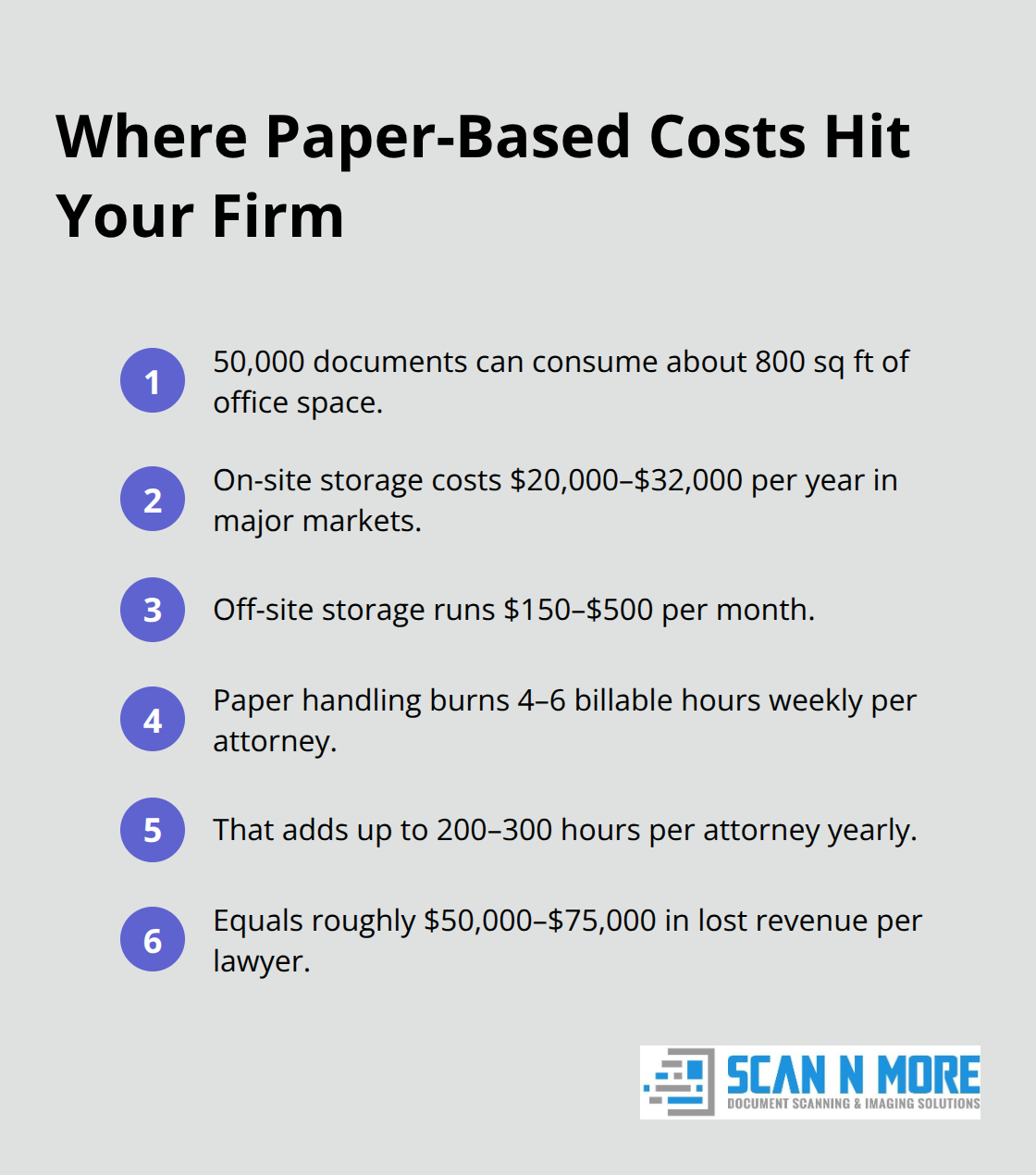
Eliminating physical storage transforms firm economics immediately. A mid-sized law firm storing 50,000 documents in filing cabinets occupies roughly 800 square feet of prime office space. At physical storage drains firm budgets per square foot annually in major markets, that amounts to $20,000 to $32,000 yearly in pure storage overhead before counting staff time spent filing and retrieving documents. Digital imaging eliminates this expense entirely. Firms also stop paying for off-site storage facilities, which run $150 to $500 monthly depending on volume. The financial impact compounds when you factor in the paralegal hours consumed by physical document management. One attorney estimates losing 4 to 6 billable hours weekly to document retrieval and filing tasks. Over a year, that represents 200 to 300 hours per attorney-roughly $50,000 to $75,000 in lost revenue per lawyer.
Speed Transforms Case Preparation and Discovery
Digitized documents eliminate retrieval friction completely. A paralegal retrieves any contract, deposition, or case file in seconds using OCR-enabled searchable archives instead of hunting through filing cabinets. This speed matters enormously for case preparation. When discovery deadlines approach and opposing counsel demands production of documents related to a specific transaction date or client name, digital systems return results in minutes. Paper systems require days or weeks, forcing attorneys to request extensions or risk missing deadlines. Firms using digital imaging report completing discovery processes 40 to 60 percent faster than competitors still managing paper. This acceleration directly improves case outcomes and client satisfaction while reducing malpractice risk from missed deadlines.
Remote Access Reshapes Team Collaboration
Cloud-based digital archives eliminate barriers to distributed work. Attorneys working from home, satellite offices, or courthouses need instant access to case files without VPN latency or slow remote desktop connections. A partner can pull up a client file on their phone while waiting for a court hearing. An associate drafting a motion can reference prior case documents without emailing requests to the office. Teams separated by geography collaborate seamlessly on the same documents without version control headaches. Law firms with distributed workforces report that digital imaging reduced email volume around document requests by 90 percent within weeks of implementation. Fewer emails means faster case work and less administrative overhead.
Security and Accessibility Work Together
Security layers built into modern imaging solutions-encryption, role-based access controls, and audit trails-protect sensitive information even when documents move across devices and networks. Firms no longer face the choice between security and accessibility. They achieve both simultaneously. This combination of speed, cost savings, and secure remote access creates the foundation for the next critical challenge: ensuring that your imaging system meets the strict compliance standards that regulators and clients now demand.
Security Standards That Actually Protect Client Data
Compliance in legal document imaging isn’t theoretical. State bar associations, HIPAA regulators, and courts conduct actual audits of how firms handle sensitive information. Firms that treat compliance as a checkbox exercise instead of an operational priority face disciplinary action, malpractice claims, and client departures when breaches occur. The practical reality is that modern imaging systems must enforce security at every stage, from initial scanning through long-term archival storage.
Third-Party Certifications Validate Your Security Framework
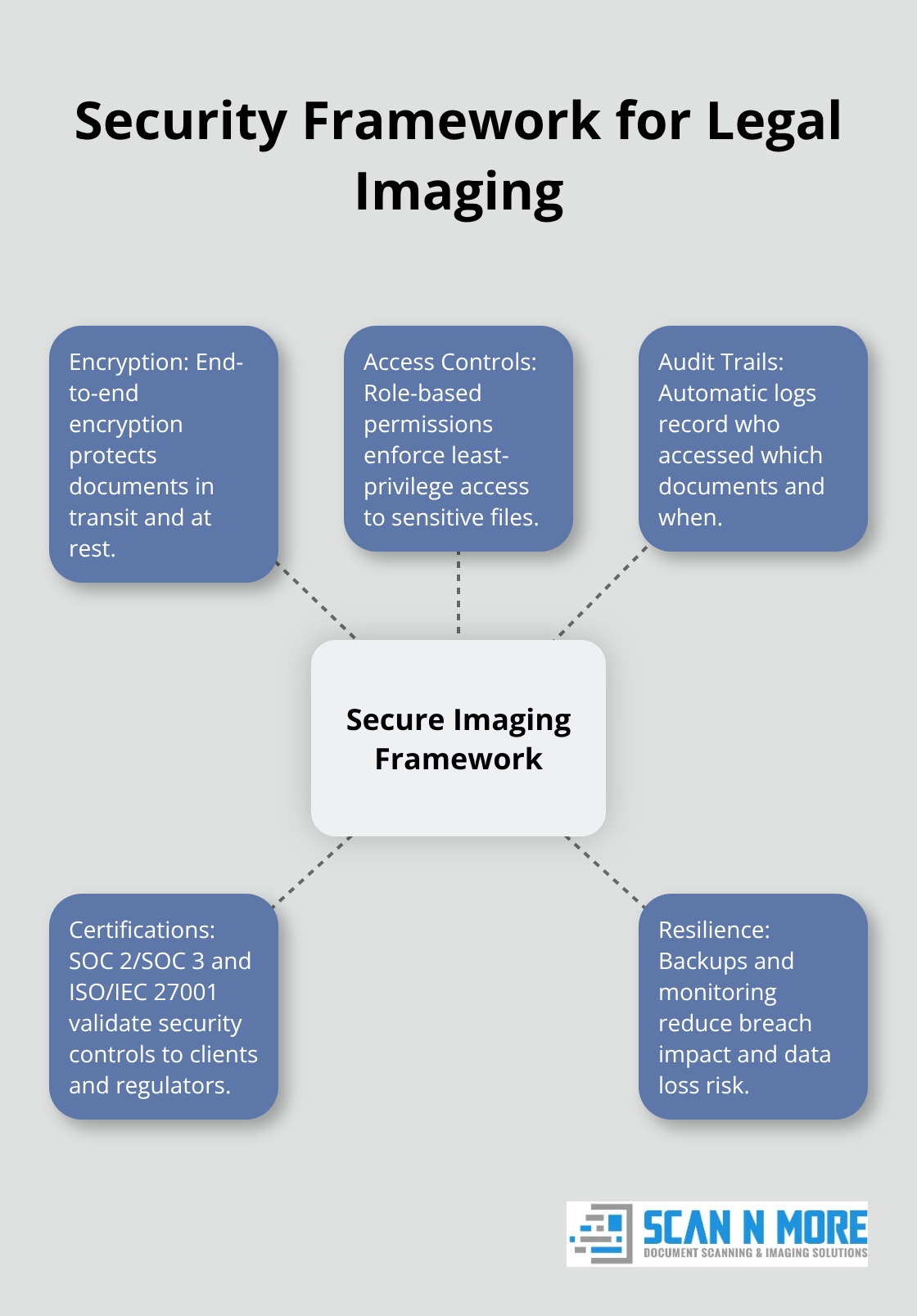
SOC 2 and SOC 3 certified security provides independent third-party validation that your imaging partner implements proper controls for data protection and access management. ISO/IEC 27001:2022 certification demonstrates that an organized information security management system governs scanning processes and data handling. These certifications matter because they prove to clients and regulators that documents remain encrypted, access is restricted to authorized personnel only, and audit trails track every interaction with sensitive files. Firms should demand that their imaging provider holds these certifications before signing contracts. Without them, you’re relying on vendor promises rather than independent verification.
Encryption and Access Controls Stop Unauthorized Access
End-to-end encryption protects documents from intake through archival storage. Data travels encrypted to the imaging vendor, remains encrypted at rest in cloud storage, and stays encrypted during retrieval by authorized users. Role-based access controls restrict specific team members to certain documents. A paralegal handling family law matters cannot access corporate transaction files. A junior associate cannot retrieve partner billing information. Granular permissions prevent accidental exposure of sensitive information and demonstrate to regulators that your firm implements least-privilege access principles.
Firms should configure imaging systems so that access attempts are logged automatically, creating an audit trail that shows who accessed what documents and when. This documentation becomes critical during regulatory inspections or malpractice discovery. When a state bar association investigates a complaint, timestamped access logs prove that only authorized personnel touched relevant files.
Audit Trails Transform Regulatory Compliance into Competitive Advantage
Regulatory inspections now focus heavily on data governance. Auditors ask how firms manage client information, who can access documents, and whether firms can prove that unauthorized access didn’t occur. Modern imaging solutions maintain detailed audit trails automatically, eliminating the need for manual record-keeping. When regulators request documentation of data handling practices, firms with proper imaging systems generate reports within minutes instead of spending weeks reconstructing access patterns.
This capability shifts compliance from a defensive posture to a competitive advantage. Firms demonstrating robust audit trails and access controls satisfy regulators quickly and build client confidence that sensitive information receives institutional-level protection. The combination of encryption, access controls, and audit trails creates a security framework that protects your firm against both external threats and internal compliance violations.
Final Thoughts
The shift from paper-based document management to digital imaging represents a fundamental change in how law firms operate. Firms that implement law firm imaging solutions today eliminate the operational friction that drains time and money while simultaneously building the security infrastructure that regulators and clients now demand. This transformation isn’t optional-it’s a competitive necessity that separates firms gaining market advantage from those falling behind.
Modern imaging systems solve three interconnected problems at once: they slash physical storage costs and staff hours spent on document retrieval, they give distributed teams instant access to case files from anywhere, and they embed security and compliance directly into daily workflows through encryption, access controls, and audit trails. The firms gaining competitive advantage aren’t those debating whether to digitize-they’re those already operating with digital-first document management, responding faster to discovery requests, satisfying clients with transparent case access, and demonstrating to regulators that they’ve implemented institutional-level data protection. When you partner with Scan N More for your document imaging needs, you gain access to scanning expertise that handles the technical complexity so your firm can focus on client work.