

Your business address matters. It shapes how clients perceive you, influences where mail lands, and affects your operational flexibility.
At Scan N More, we’ve helped thousands of companies streamline their mail management through extended mail forwarding services. Whether you’re running a remote team, scaling an e-commerce operation, or managing a consulting practice, the right mail solution removes friction from your workflow and cuts unnecessary overhead.
How Mail Forwarding Services Work
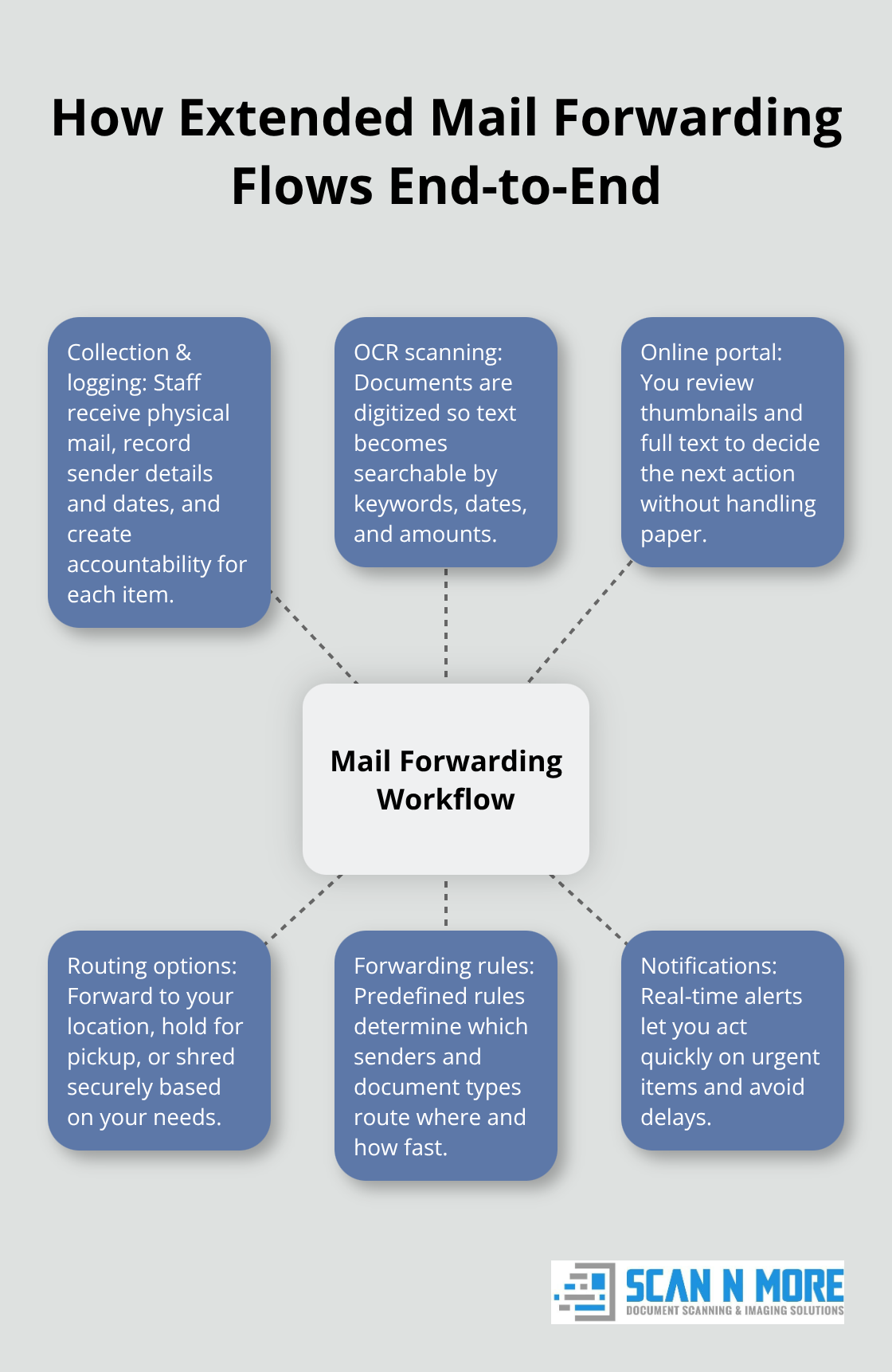
When mail arrives at your forwarding address, it enters a three-stage process that determines its fate. Staff physically collect and log each piece, recording sender information and arrival date. This initial step matters because it creates accountability and prevents mail from disappearing into a black hole. Next, items move into a digital system where OCR technology converts paper into searchable text. Most professional services complete this within 2–5 business days, though premium tiers promise same-day scanning for urgent documents. You then access an online portal showing thumbnail images, sender details, and full document text, allowing you to decide what happens next: forward it to your location, shred it securely, or hold it for later retrieval. The entire workflow depends on clear forwarding rules you set upfront, which specify which senders go where and how fast.
What Happens During the Scanning Phase
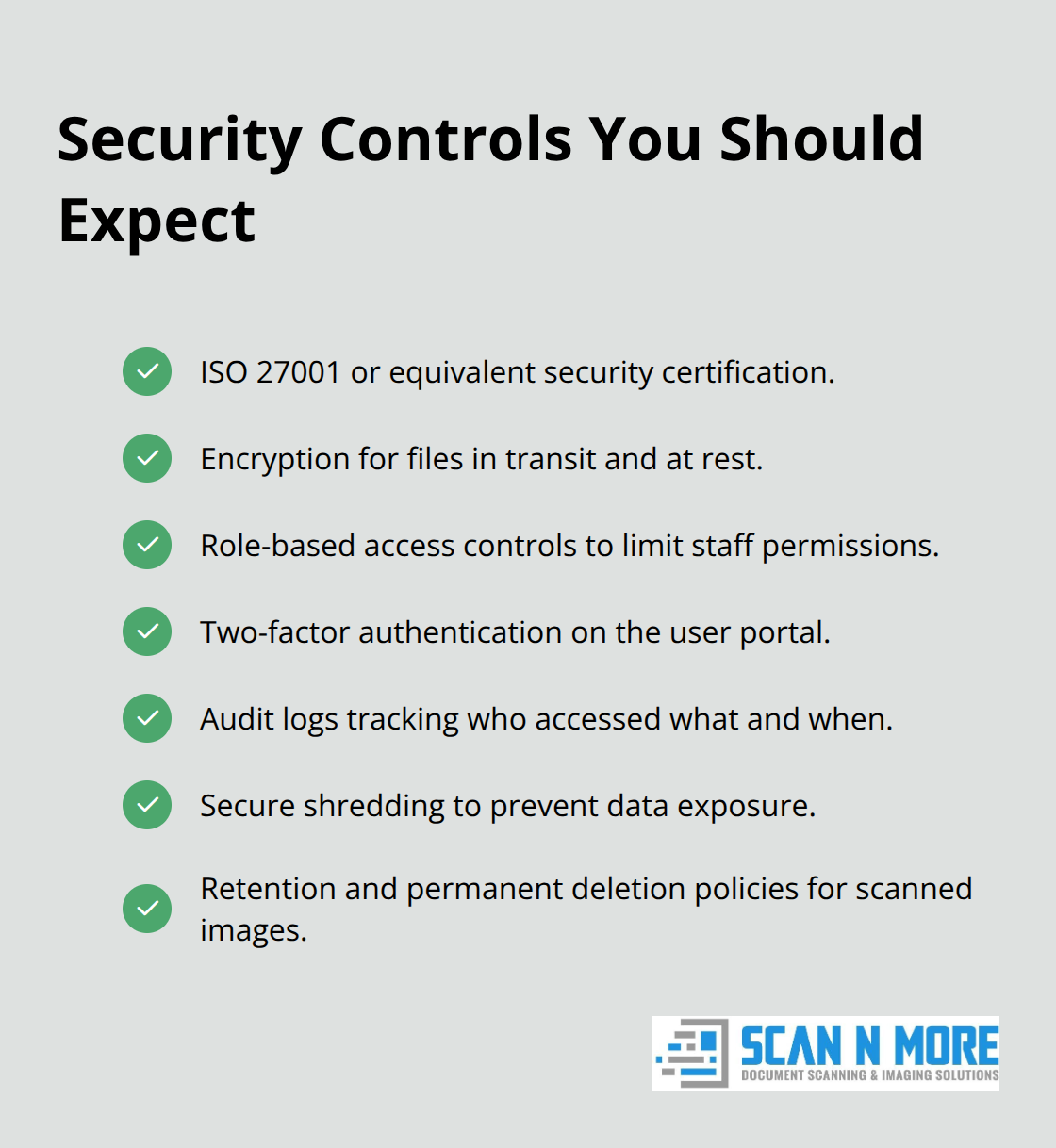
Digital conversion transforms extended mail forwarding from a simple mail drop into a genuinely useful business tool. When documents enter the scanner, OCR software extracts text, making invoices, contracts, and statements searchable by date, amount, or sender name. You can find a specific vendor invoice from three months ago in seconds rather than requesting a rescan. Data security during this phase matters enormously because your mail contains banking details, tax documents, and client information. Reputable providers maintain ISO 27001 certification or equivalent security standards, encrypt files both in transit and at rest, and restrict staff access through role-based permissions. Two-factor authentication on your portal prevents unauthorized access, and secure deletion policies ensure scanned images don’t linger indefinitely in databases. Staff also flag damaged or partially illegible mail for manual review before items reach your inbox.
Routing and Delivery to Your Location
After scanning completes, your mail takes the path you’ve configured. Some documents ship to your primary address via standard mail within 7–10 business days, while others consolidate into weekly batches to reduce shipping costs. International forwarding introduces 14–21 day windows depending on customs processing and carrier schedules, so timing matters if you expect time-sensitive documents. You can set rules like forward all invoices over $500 immediately but hold everything else for monthly consolidation, which cuts shipping expenses significantly. Real-time notifications via email or mobile app alert you when critical items arrive, so you’re never surprised by unexpected bills or deadlines. The security of this final leg depends on the carrier and your address location, which is why some businesses use signature-required delivery for sensitive documents or request hold-for-pickup options at local post offices.
Why Forwarding Rules Shape Your Workflow
The rules you establish at setup determine how efficiently mail moves through your operation. Rather than manually reviewing every piece, you automate decisions upfront: tax documents forward immediately, marketing materials go to shredding, and vendor statements consolidate monthly. This approach (combined with real-time alerts for high-priority senders) keeps your team focused on work that matters instead of mail logistics. Different business types benefit from different rule structures-e-commerce retailers prioritize fast forwarding of customer complaints and payment notifications, while consulting firms may hold non-urgent mail to batch shipments and save on postage. The flexibility to adjust rules as your business evolves means your mail system grows with you rather than constraining your operations.
Security and Compliance Throughout the Process
Each stage of mail forwarding introduces security touchpoints that protect your sensitive information. Physical collection happens in secure facilities with background-checked staff and confidentiality agreements. Scanning occurs on encrypted systems, and access controls limit which team members can view which documents. Your portal itself requires strong authentication, and audit logs track who accessed what and when. Providers that handle regulated documents (medical records, financial statements, legal contracts) must comply with GDPR, CCPA, and industry-specific standards. Secure shredding of unwanted mail prevents identity theft and data breaches, and retention policies specify how long digital images remain in the system before permanent deletion.
This layered approach means your mail stays protected from collection through final delivery.
The combination of physical security, digital encryption, and clear access controls creates a foundation that allows your business to operate confidently across multiple locations. With these systems in place, your next step involves understanding which specific benefits matter most to your operation and how to select a provider that aligns with your priorities.
Why Extended Mail Forwarding Cuts Your Real Operating Costs
The Hidden Expenses of Traditional Mail Handling
Extended mail forwarding eliminates expenses most businesses overlook until they switch systems. Physical office space dedicated to mail handling, filing cabinets, and document storage represents dead capital that generates zero revenue. A dedicated mailroom in a mid-size city office costs $400–$800 monthly just for square footage, plus staff time spent sorting, scanning, and organizing incoming documents. When you shift to extended forwarding, that space converts to productive use or disappears entirely from your lease. Companies with distributed teams see the biggest savings because mail no longer needs to reach a central location before reaching the right person.
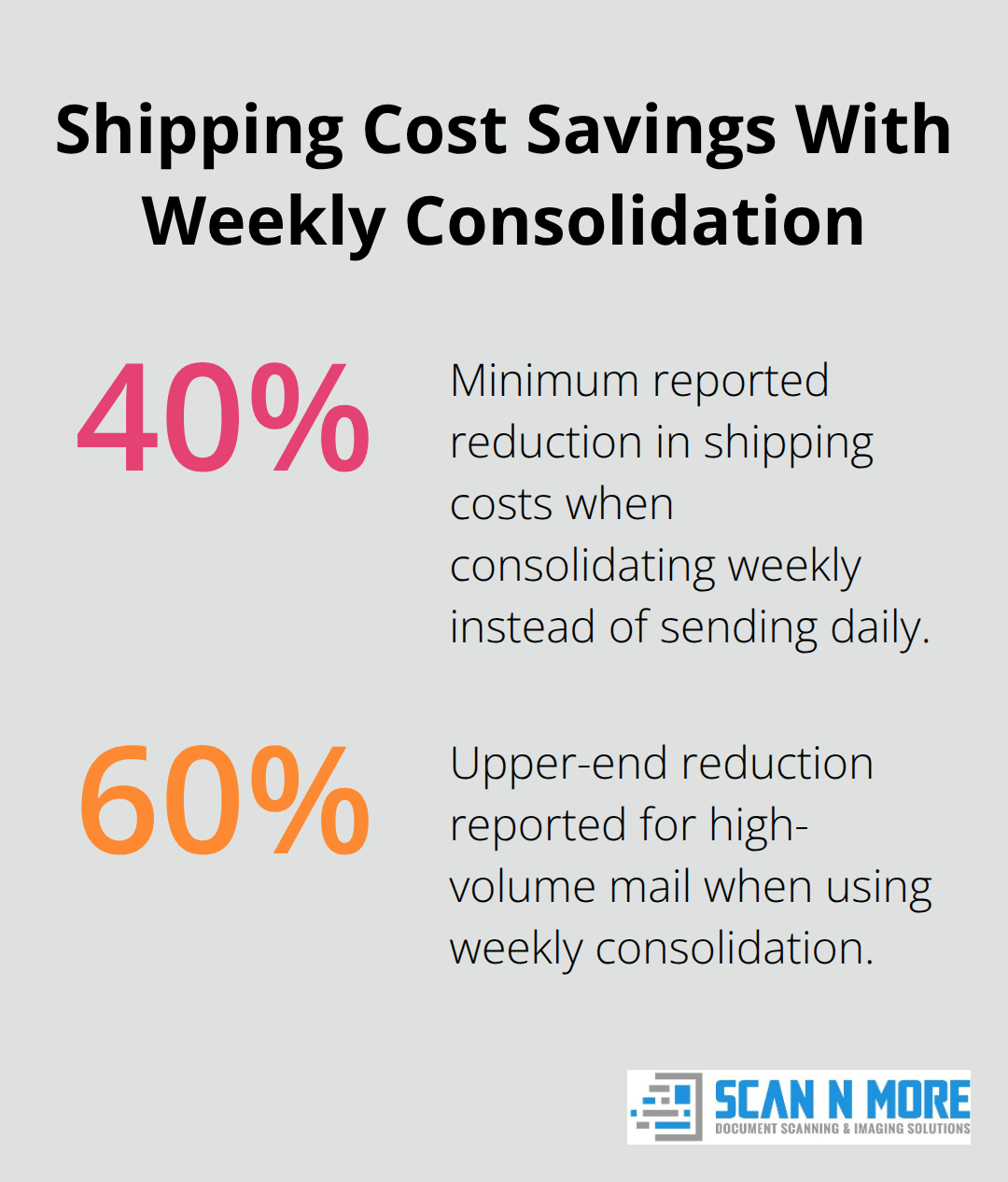
A consulting firm with remote staff across three states eliminated their satellite office mailroom entirely after implementing extended forwarding, recovering $1,200 monthly in rent alone. Shipping costs also drop significantly when you batch forwarding instead of processing mail daily. Rather than paying per-package rates for individual documents, consolidating weekly shipments to your location costs 40–60% less than traditional daily mail delivery. International forwarding introduces longer timelines (14–21 days), but batching creates even steeper discounts for companies with high mail volume, making the math work for businesses willing to adjust their document workflows.
Professional Presence Without Physical Overhead
Your business address carries weight in client perception and regulatory compliance, yet most companies overpay for physical presence. A professional business address signals stability and legitimacy without requiring you to maintain a full office or retail storefront. E-commerce retailers use forwarding addresses to establish local presence in multiple markets, satisfying sales tax registration requirements and customer trust expectations without opening actual locations. Financial services firms and consulting practices maintain professional addresses in key cities while operating entirely remotely-a combination that would cost $2,000–$5,000 monthly per location if done traditionally.
Access Documents From Anywhere, Instantly
The flexibility to access your mail and documents from anywhere transforms how distributed teams operate. A team member traveling for client work, working from home, or based internationally can retrieve critical documents within hours instead of waiting for physical mail to arrive at their location. Real-time notifications mean you never miss time-sensitive invoices, contract deadlines, or regulatory filings regardless of where you sit. This accessibility matters most during business transitions, relocation planning, or temporary work arrangements where your team’s physical location shifts frequently.
The operational advantages stack quickly once you eliminate mail logistics from your overhead structure. Understanding how to select the right provider and configure your forwarding rules determines whether you capture these savings or leave money on the table.
Who Needs Extended Mail Forwarding Most
Remote and Distributed Teams Eliminate Mail Logistics Costs
Remote and distributed teams face a fundamental problem that traditional mail systems cannot solve: mail arrives at a physical address while your people work everywhere else. When your software development team spans five states or your marketing department operates across three countries, forwarding mail to each individual location costs a fortune and creates chaos. Extended mail forwarding consolidates incoming documents at a central hub, digitizes them within 2–5 business days, and delivers them to whoever needs them regardless of location.
A distributed accounting firm reduced their monthly shipping costs after switching to extended forwarding with weekly consolidation. The real win comes from instant digital access-a team member in Denver retrieves a client contract from their inbox within hours instead of waiting five business days for physical delivery, which means faster approvals and fewer missed deadlines.
E-Commerce Retailers Build Compliance Without Physical Offices
E-commerce and online retailers operate under completely different constraints than traditional businesses. You need a professional address in multiple states to satisfy sales tax nexus requirements and customer trust expectations, yet opening physical offices destroys your margin structure. Extended forwarding lets you maintain legitimate business addresses in California, Texas, and New York without paying rent or staffing costs in those locations.
When customer complaints, refund requests, or regulatory notices arrive at these addresses, they scan immediately and route to your support team’s dashboard, cutting response time from days to hours. State tax boards increasingly scrutinize address authenticity, and a forwarding service with proper documentation beats a virtual mailbox for regulatory credibility. International retailers shipping to US customers benefit even more because they establish domestic presence without physical infrastructure, which regulators view as genuine compliance rather than tax avoidance.
Professional Services Firms Protect Client Confidentiality
Professional services firms-law practices, accounting offices, consulting groups-operate on client trust and regulatory compliance, both of which depend on maintaining a professional address. Many consultants and solo practitioners work remotely or travel between client sites, yet they need a stable business address for their website, contracts, and regulatory filings. Extended forwarding solves this without requiring a lease or office staff.
Tax documents, client contracts, and regulatory notices flow directly to your digital inbox, and you set rules to flag high-priority items from specific senders immediately while batching routine mail monthly. A consultant handling multiple clients across different jurisdictions caught deadline-critical documents within hours instead of discovering them after missing submission windows through real-time notifications for regulatory filings. The security layer matters enormously in this industry because your mail contains client confidential information, tax returns, and legal documents that demand encryption, access controls, and secure shredding of unwanted materials.
Final Thoughts
Extended mail forwarding transforms how modern businesses handle documents, shifting from reactive mail management to strategic operational efficiency. The systems we’ve covered-physical collection, digital scanning, secure routing, and real-time access-work together to eliminate friction that slows distributed teams, e-commerce operations, and professional services firms. Rather than treating mail as an afterthought, forward-thinking companies now recognize it as a lever for cost reduction and competitive advantage.
Getting started requires three practical steps: assess your current mail volume and identify which documents matter most to your workflow, configure forwarding rules that automate your mail decisions upfront, and test your setup with a representative sample of incoming mail before fully committing. Companies that implement extended mail forwarding report 40–60% reductions in shipping costs through weekly consolidation, elimination of dedicated mailroom space worth $400–$800 monthly, and faster document access that accelerates approvals and decision-making. Remote teams no longer lose productivity waiting for physical mail, and distributed operations maintain professional addresses across multiple markets without expensive leases.
At Scan N More, we help businesses transition from paper-based processes to digital solutions through our mail scanning service. Our on-site and off-site scanning ensures data security and compliance while transforming your mail into searchable digital assets that support your business strategy rather than constraining it.