
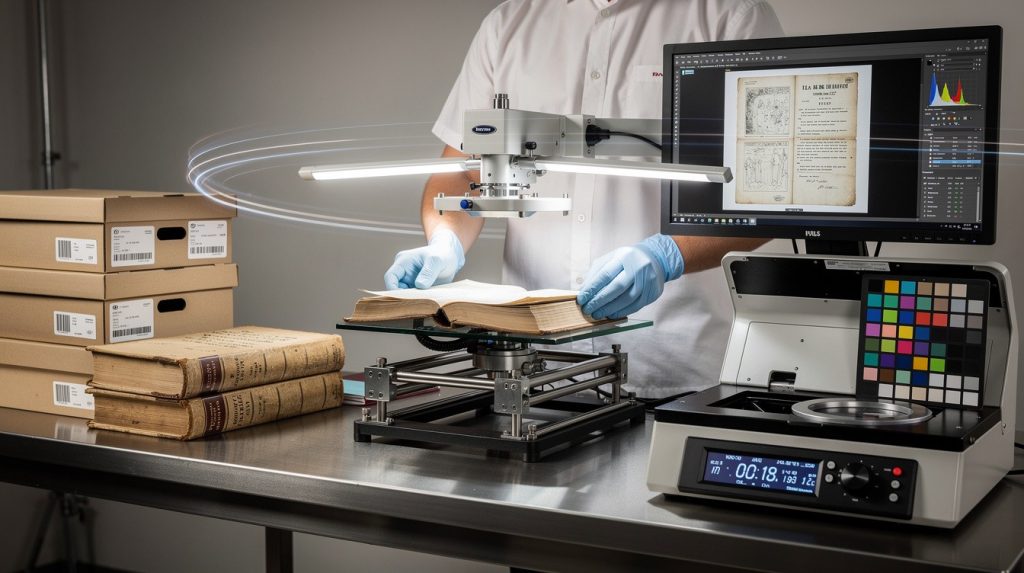
Stacks of paper consume valuable office space and slow down your team’s ability to find information fast. At Scan N More, we work with records imaging specialists who transform paper-based workflows into streamlined digital systems.
The right digitization partner handles your sensitive documents with security protocols while delivering results on schedule. This guide shows you what separates trusted professionals from the rest.
Why Digitization Cuts Real Costs and Boosts Efficiency
Storage Costs Add Up Faster Than You Think
Physical storage drains money faster than most business leaders realize. Companies pay between $3 to $5 per box annually just to store inactive records in off-site facilities, and that’s before accounting for the real estate costs of on-site filing rooms. Storage costs per box and filing cabinet square footage vary by location and facility type. When you multiply that across dozens of cabinets, the math becomes painful. Digitization eliminates this expense entirely within months.
Speed Up Information Retrieval and Reclaim Productivity
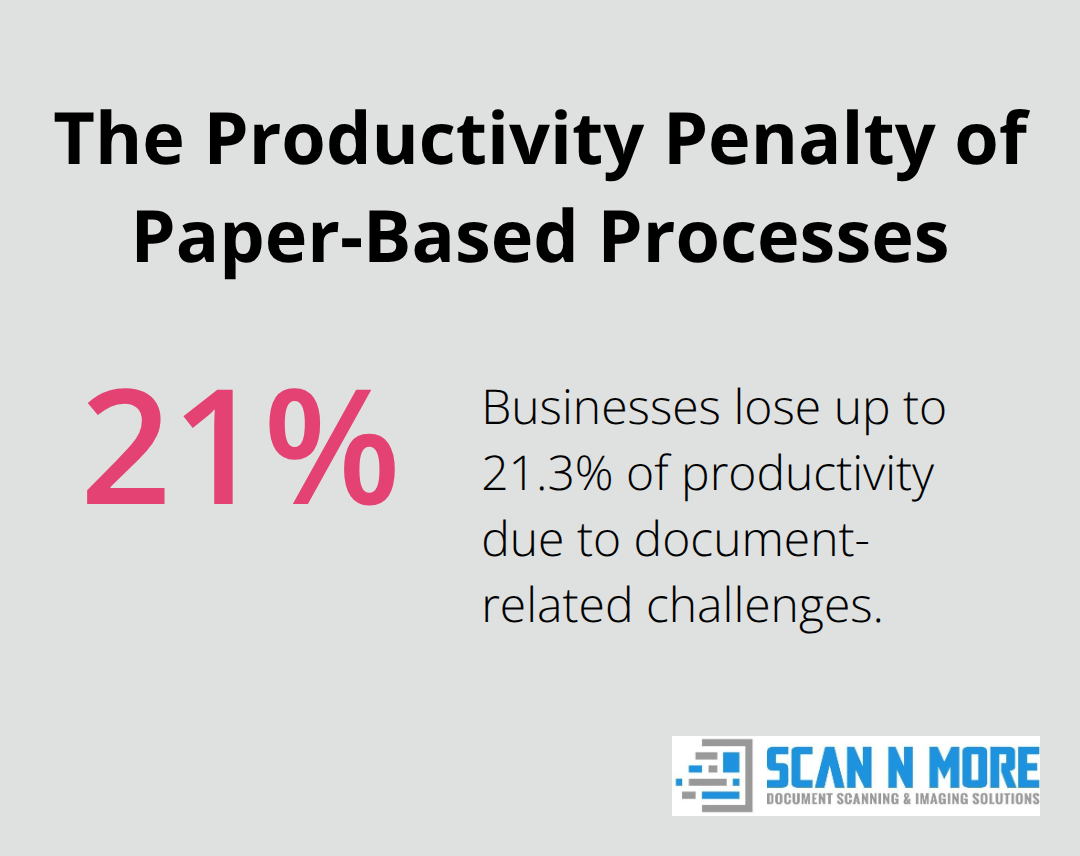
Retrieving documents from physical archives wastes employee time at scale. Businesses lose up to 21.3% of productivity due to document-related challenges.
When a document lives in a digital system with proper indexing and OCR technology, retrieval time drops from hours to seconds. Your team regains productivity immediately and redirects that effort toward higher-value work.
Meet Compliance Requirements Without the Headaches
Security and compliance represent the other major benefit. Physical documents sitting in cabinets create liability-they can be lost, damaged, or accessed by unauthorized staff. HIPAA regulations for healthcare and NARA guidelines for government records demand specific handling, storage, and retention protocols that paper systems struggle to maintain. Digitized records with encrypted storage, access controls, and audit trails meet these standards automatically.
Calculate Your Return on Investment
The financial return appears quickly. Organizations that move to digital workflows typically see ROI within 12 to 18 months through a combination of eliminated storage costs, reduced labor time, and fewer lost or misfiled documents. Disaster recovery improves dramatically too-digital files backed up securely survive fires, floods, or theft that would destroy paper archives permanently. These benefits compound over time as your team operates more efficiently.
What Separates Professional Specialists from DIY Approaches
Moving forward with digitization requires the right partner. Professional imaging specialists bring equipment, security protocols, and expertise that internal teams cannot replicate. They handle sensitive documents with the care and compliance standards your business demands, transforming your paper burden into a competitive advantage. The next section reveals what makes these professionals different from standard service providers.
Why Professional Equipment and Security Matter More Than You’d Expect
Industrial-Grade Scanning Delivers Accuracy at Scale
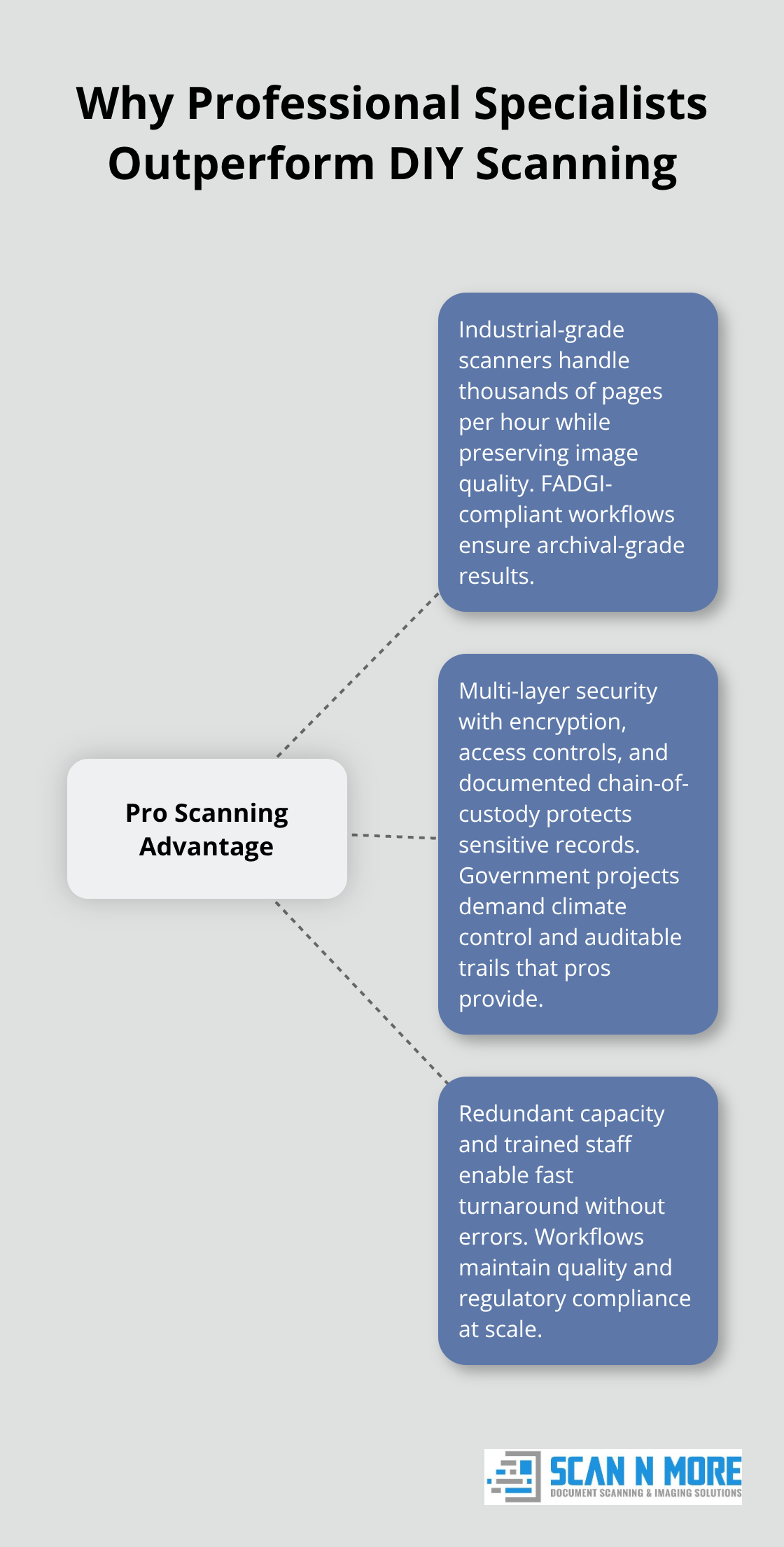
Professional imaging specialists operate with industrial-grade scanning equipment that processes thousands of pages per hour while maintaining image quality standards. The ibml Fusion scanner, used by leading digitization providers, achieves FADGI compliance-a rigorous standard that ensures digitized images meet federal government archival requirements. This matters because scanning at high speed without proper equipment introduces errors: skipped pages, image distortion, or missed text that OCR technology cannot recover.
Your internal team likely owns basic office scanners designed for occasional use, not continuous document processing. Professional specialists maintain equipment specifically calibrated for high-volume work, replace worn components regularly, and train staff on handling different document types-from fragile microfilm to oversized blueprints. They understand that a crumpled 1970s contract or water-damaged medical file requires different scanning techniques than standard letterhead.
Security Protocols Protect Your Most Sensitive Data
Security protocols separate trustworthy specialists from budget providers. HIPAA-compliant medical records digitization demands multi-layer encryption, secure access controls, and documented chain-of-custody procedures that most vendors cannot implement without significant investment. Government agencies require secure transportation, climate-controlled facilities, and audit trails proving no documents were lost or accessed improperly. Professional specialists deliver these safeguards as standard practice because their reputation depends on zero security breaches. They handle sensitive documents with the same rigor that financial institutions use for cash.
Speed Without Sacrificing Quality or Compliance
Fast turnaround becomes possible only when specialists have redundant scanning capacity, experienced staff who work efficiently, and established workflows-not rushed processes that sacrifice accuracy. When you handle medical records, legal documents, or government files, scanning errors create compliance violations and liability exposure that far exceed the cost of professional services. Specialists combine high-capacity scanning equipment with security certifications and proven track records across healthcare, legal, and government sectors. This combination ensures your documents move from paper to digital without risk, delay, or quality loss.
The choice between handling digitization internally and partnering with professionals directly impacts your timeline, security posture, and long-term compliance. Selecting the right partner requires understanding what credentials and capabilities matter most for your specific document types and regulatory environment.
Selecting a Partner With Proven Credentials and Real Experience
Verify Security Certifications and Compliance Standards
Security certifications separate specialists who can handle sensitive data from those who cannot. Ask potential partners for documentation of HIPAA compliance if you manage medical records, NARA certification for government documents, or SOC 2 Type II attestation for general data security. These certifications require independent audits and ongoing compliance verification, not just self-declaration. A provider claiming HIPAA compliance without third-party validation cannot be trusted with healthcare data. Similarly, verify that their encryption protocols meet current standards-AES-256 encryption for data at rest and TLS 1.2 or higher for data in transit. Request their security documentation before signing any contract.
Assess Experience With Your Specific Document Types
Experience with your specific document types matters more than general scanning capacity. A provider skilled at digitizing high-volume financial records may lack expertise handling fragile microfilm or oversized blueprints. Ask how many projects they have completed in your industry and request references from businesses similar to yours. Healthcare providers should confirm they have processed HIPAA-compliant medical records directly into EMR systems, not just scanned paper into generic PDFs. Legal firms need specialists experienced with case file organization, metadata taxonomy, and secure archiving protocols that support litigation hold requirements. Government agencies require vendors with demonstrated experience handling classified or sensitive public records with documented chain-of-custody procedures.
Compare Pricing and Service Flexibility
Pricing transparency reveals whether a partner operates with integrity. Request itemized quotes that separate scanning costs, indexing fees, storage charges, and any rush fees rather than flat-rate proposals that hide actual service components. Compare pricing per page scanned, per box processed, and per month for storage to benchmark against industry rates. The ibml technology ecosystem, used by leading scanning providers nationwide, processes documents at high volume with consistent quality, which should reflect in competitive pricing.
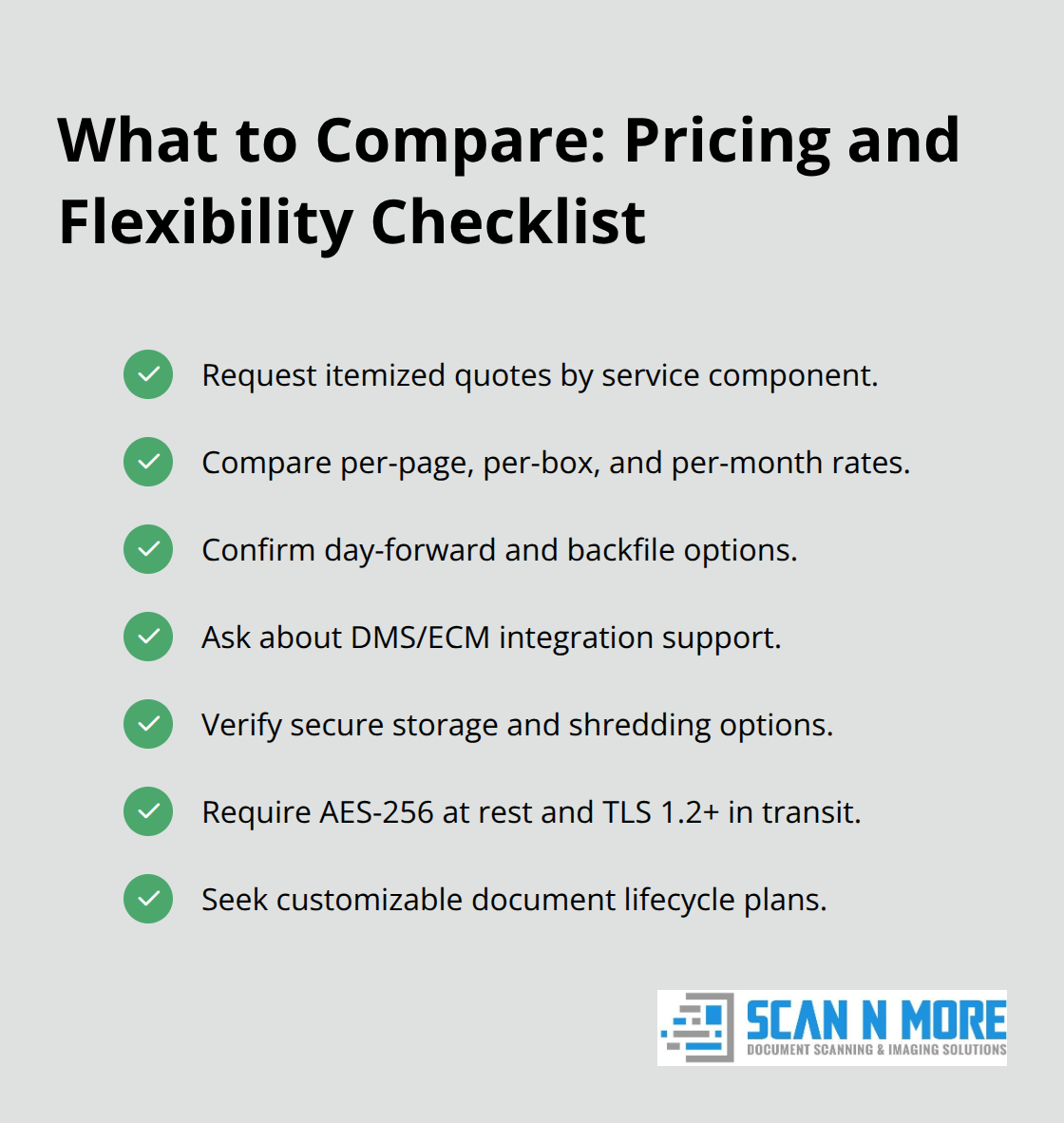
Flexible service options matter because your digitization needs evolve. Day-forward scanning routes new incoming documents directly to the digital center, preventing backlog accumulation, while backfile imaging converts your existing paper archives efficiently. Verify that a provider offers both without forcing you into an all-or-nothing commitment. Ask about integration capabilities with your existing document management system or ECM platform-migration support and data mapping reduce transition friction. Storage flexibility also matters: some businesses need secure off-site storage with climate-controlled facilities and optional shredding, while others prefer cloud-based repositories with encryption and access controls. A partner offering customizable document lifecycle plans tailored to retention schedules and compliance requirements outperforms those with rigid, one-size-fits-all approaches.
Final Thoughts
Digitization transforms how your business operates, and records imaging specialists bring the equipment, security protocols, and industry expertise required to move your documents from filing cabinets to secure digital repositories without errors or delays. Your choice of partner directly determines whether digitization succeeds or becomes another failed initiative. A provider with proper certifications, proven experience in your industry, and transparent pricing delivers results on schedule while protecting your sensitive data.
We at Scan N More work with records imaging specialists who handle this transformation end-to-end. Our professional document scanning services cover on-site and off-site high-quality scanning for all document formats, including legal and medical records, and we guarantee data security and compliance throughout the process. Whether you need mail scanning services, hard drive destruction, or complete backfile conversion, we ensure your transition to digital operations runs smoothly.
Contact Scan N More today to discuss your digitization needs and discover how professional scanning transforms your paper burden into operational efficiency.