
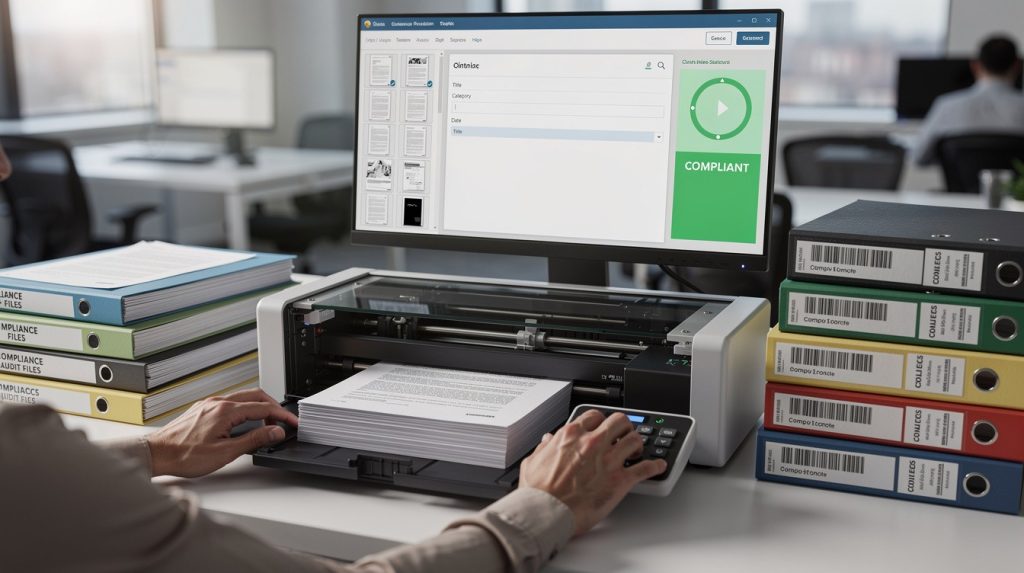
Compliance document scanning isn’t optional anymore. Regulations like HIPAA, SOX, and GDPR demand that organizations handle scanned documents with precision and accountability.
At Scan N More, we’ve helped hundreds of companies navigate these requirements without slowing down their operations. This guide walks you through the standards you need to meet, how professional scanning services handle compliance, and the practices that keep your digitized documents audit-ready.
What Compliance Standards Actually Apply to Your Scanned Documents
HIPAA, SOX, and GDPR: The Big Three
HIPAA applies to healthcare organizations and their business associates, requiring that patient records maintain strict confidentiality and integrity throughout scanning and storage. The Health Insurance Portability and Accountability Act imposes fines up to 1.5 million dollars annually per violation category, according to the U.S. Department of Health and Human Services. SOX, the Sarbanes-Oxley Act, mandates that publicly traded companies maintain auditable financial records for seven years, meaning scanned financial documents must include immutable audit trails showing who accessed them and when. GDPR in Europe goes further, requiring organizations to document consent for processing personal data and prove they can delete information within 30 days of request.

Sector-Specific Rules That Affect Your Scanning
Organizations in finance face SEC requirements to preserve emails and trading records with timestamps that survive legal discovery. Financial institutions must comply with the Gramm-Leach-Bliley Act, which requires encryption of customer financial information both in transit and at rest. Manufacturing companies handling export-controlled materials must follow International Traffic in Arms Regulations, meaning scanned technical documents require access logs. The pharmaceutical industry faces FDA 21 CFR Part 11 requirements for electronic records, demanding that scanned documents maintain their original formatting and metadata without alteration.
Real Penalties for Getting It Wrong
The financial consequences of non-compliance are severe and documented. Target’s 2013 data breach resulted in an 18.5 million dollar settlement, but the actual compliance failures were simpler than the hack itself. Wells Fargo paid 3 billion dollars in 2020 largely because they couldn’t produce auditable records of customer interactions. The FTC fined Equifax 700 million dollars in 2019, with compliance documentation failures accounting for a significant portion. The UK Information Commissioner’s Office fined British Airways 22.6 million pounds in 2020 under GDPR for inadequate security measures in their document systems.
Your organization faces operational shutdowns if regulators find your scanned documents lack proper access controls or retention documentation. Healthcare providers have been forced to halt operations pending document audits. Legal firms have lost their licenses when they couldn’t produce compliant records during litigation discovery. The cost of remediation after non-compliance detection averages 4.45 million dollars per incident according to IBM’s 2023 data breach report (and that’s before regulatory fines begin).
These penalties reveal why your scanning process matters. The standards exist because organizations that cut corners on compliance end up paying far more than they save. What separates compliant organizations from those facing fines is how they handle the actual scanning and storage process itself.
How Professional Scanning Protects Your Compliance Obligations
Why In-House Scanning Creates Compliance Risk
Professional document scanning services handle compliance in ways that in-house scanning simply cannot match. We at Scan N More understand that compliance isn’t just about following rules-it’s about building systems that prove you followed them. When you scan documents internally, you create liability. Your staff lacks the specialized training, your equipment wasn’t built for audit trails, and your storage infrastructure wasn’t designed to meet regulatory standards. Professional scanning services operate under compliance-specific protocols from the moment a document arrives at the facility.
Metadata Capture and Audit Trail Creation
The scanning equipment used in professional services includes metadata capture that records the exact date, time, and operator for every page processed. This isn’t optional-it’s built into the workflow. Your scanned documents automatically include this information without additional effort, which means you create the audit trail regulators demand without slowing down your operations. The documents move from paper to secure digital format with minimal handling, and your staff never touches the originals after handoff. This eliminates the opportunity for accidental exposure or unauthorized access.
Security Protocols That Exceed Regulatory Minimums
Security protocols in professional scanning go far beyond basic encryption. Professional services maintain chain-of-custody documentation that satisfies HIPAA, SOX, and GDPR requirements simultaneously. When financial institutions work with professional scanners, those services typically use air-gapped networks-systems physically disconnected from the internet-to process sensitive documents before secure transfer to your compliant storage system. A 2022 Verizon data breach investigation report found that 82 percent of breaches involved a human element, yet professional scanning services eliminate most human contact with sensitive data through automation.

Access Controls and Separation of Duties
Storage systems provided by professional services include role-based access controls that comply with regulatory requirements. A healthcare administrator cannot access financial records, and a junior accountant cannot delete audit logs. This separation of duties is nearly impossible to maintain with internal scanning. These controls prevent unauthorized access and create the accountability structure that regulators examine during audits.
Quality Assurance and Format Compliance
Quality assurance in professional scanning includes optical character recognition verification and format validation that catches errors before documents enter your system. When the FDA or SEC audits your records, they examine not just what you stored but how you stored it. Professional services maintain documentation that proves every page was scanned at the correct resolution, that metadata remained unaltered, and that file formats comply with your industry standards. This documentation becomes your defense during regulatory review and demonstrates that your organization took compliance seriously from the first scan forward.
How to Lock Down Document Retention Without Slowing Operations
Classify Documents to Match Retention Requirements
Your retention policy forms the foundation of compliance, and most organizations fail by applying blanket timelines to all documents. Start with a document inventory that maps each document type to its specific retention requirement. Healthcare records under HIPAA typically require six years, but individual consent forms may require only three. Financial documents under SOX demand seven years, yet draft emails might have a one-year hold. The key is writing retention rules specific to document classification, not treating everything the same. Once you classify your documents, automate the deletion process through your storage system rather than relying on manual review. Automated deletion reduces human error and proves to regulators that your organization didn’t arbitrarily destroy records.
Automate Deletion to Prove Compliance
When the SEC audits your retention practices, they want to see that your system enforces the policy automatically, not that someone remembered to delete files quarterly. Your storage system should restrict who can view, download, and delete documents based on job function, not general access levels.
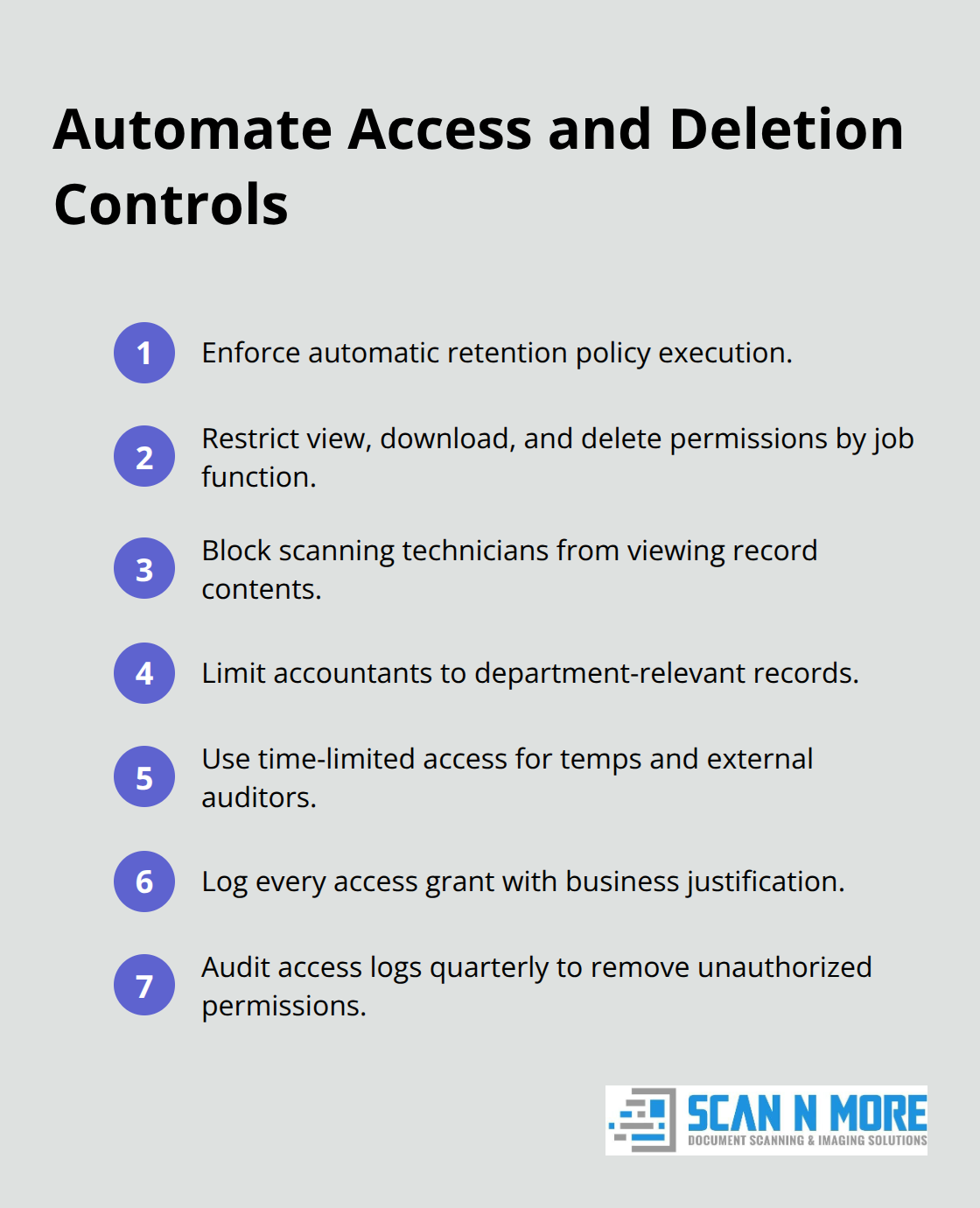
A scanning technician should never have permission to view the contents of financial records, only to confirm successful processing. An accountant preparing for audit should access records relevant to their department, not the entire database. Implement time-limited access for temporary workers or external auditors rather than permanent permissions. Document every access grant with business justification, then audit these logs quarterly to catch unauthorized permissions that accumulated over months.
Conduct Quarterly Compliance Audits
Quarterly compliance audits review both your retention policy execution and your access control logs simultaneously. These audits should compare what your system deleted against your retention schedule, verify that access logs match your approved user list, and test whether users can actually access only what their role permits. Schedule audits on a fixed calendar rather than as-needed, which forces consistency and creates the documentation regulators expect when they arrive with questions. This regular review cycle (conducted every 90 days) catches drift before it becomes a compliance violation. Organizations that audit quarterly report significantly fewer findings during regulatory inspections than those that audit annually or sporadically.
Final Thoughts
Compliance document scanning works only when your organization treats it as a system, not a one-time project. The standards exist because regulators have seen what happens when companies cut corners: data breaches, operational shutdowns, and settlements that dwarf the cost of doing things right from the start. Professional services eliminate the human error that causes most compliance failures, and your team avoids the need for specialized training in HIPAA metadata requirements or SOX audit trail standards.
The financial case is straightforward: non-compliance costs millions in fines and remediation, while compliance costs thousands in professional services. Organizations that faced regulatory penalties consistently report that professional document scanning would have prevented their violations entirely. When you scan documents professionally, you generate audit trails, maintain access controls, and preserve metadata without adding steps to your workflow-your staff processes documents faster because the system handles compliance in the background.
We at Scan N More help organizations transition to compliant digital processes through professional document scanning services that handle HIPAA, SOX, GDPR, and industry-specific requirements simultaneously. Contact us to discuss how your organization can digitize documents while meeting every standard that applies to your business.