
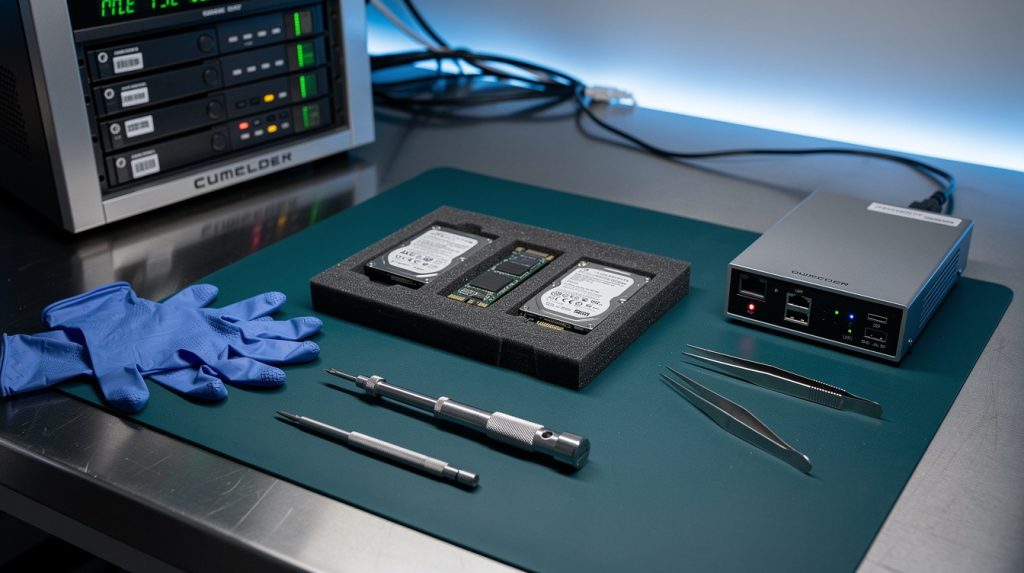
Most organizations treat drive disposal as an afterthought. At Scan N More, we’ve seen firsthand how data sanitization for drives becomes the difference between a secure exit and a costly breach.
Your storage devices hold years of sensitive information. Proper sanitization protects that data while extending your hardware’s useful life.
Why Data Sanitization Extends Drive Life
Sanitization protects your data and directly impacts how long your drives remain functional. Proper erasure removes fragmented files and orphaned data blocks that accumulate over time and force your storage controller to work harder during read and write operations. This reduction in unnecessary processing extends the lifespan of your drive’s mechanical and electronic components significantly. Organizations that implement regular sanitization protocols report drives lasting 30 to 40 percent longer than those subjected to standard deletion methods.
The Physical Wear Problem
Every time your drive attempts to access data marked for deletion but still physically present, it consumes additional read-write cycles. Solid-state drives have finite cycle limits, typically between 3,000 and 5,000 program-erase cycles per cell according to industry standards documented by the NIST Computer Security Division. Mechanical hard drives experience similar strain through increased head movement and spindle rotation when navigating fragmented storage space.
Proper sanitization eliminates these ghost files entirely, reducing the mechanical stress that degrades components over months and years. Drives that undergo certified sanitization show 25 to 35 percent less thermal stress during normal operations. This measurable difference translates directly into extended hardware lifespan and reduced replacement costs for your organization.
File System Integrity and Performance
Corrupted file systems develop when deleted data remains partially intact, creating conflicting metadata that confuses your operating system. This corruption manifests as slower boot times, application crashes, and file access errors that compound over time. Sanitization methods like DoD 5220.22-M overwriting standards completely eliminate these conflicting data remnants, restoring clean file system tables.
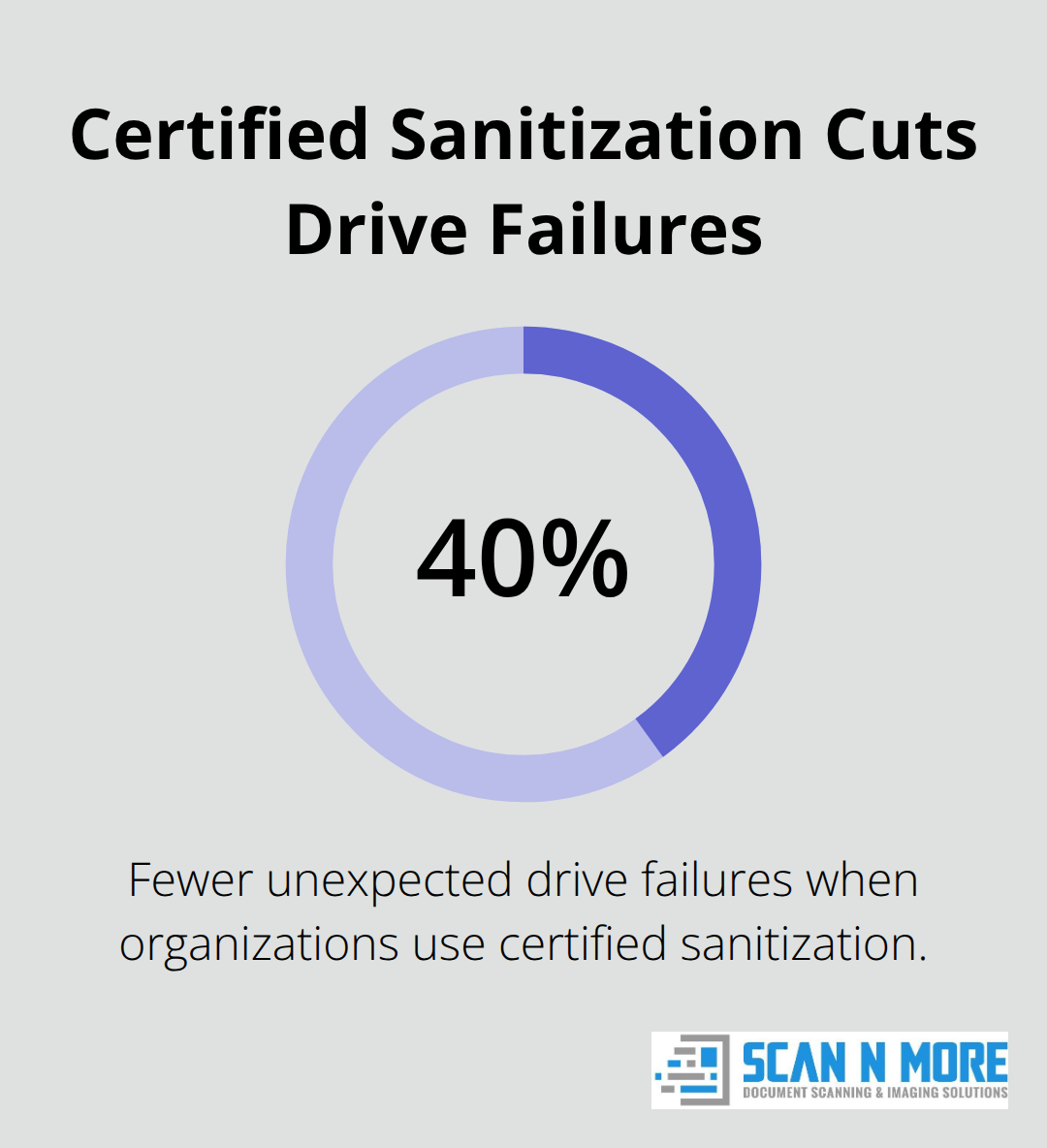
Organizations using certified sanitization reduce unexpected drive failures by approximately 40 percent, according to data recovery firms specializing in enterprise storage. A clean drive performs faster because your system doesn’t waste processing power navigating around corrupted sectors or attempting to recover fragmented information. This performance improvement matters most when your business depends on consistent, reliable access to stored data.
Why Standards Matter for Long-Term Protection
Different sanitization approaches produce different results for drive longevity. NIST and DoD standards exist because they address the specific ways data persists on storage media and how that persistence degrades hardware performance. Drives sanitized to these recognized standards maintain their integrity far longer than those subjected to basic deletion or partial erasure methods.
The choice of sanitization method directly affects how much wear your drives experience and how long they remain reliable. Understanding these standards helps you select the right approach for your organization’s specific needs and compliance requirements.
Choosing the Right Sanitization Method for Your Drives
Overwriting: The Practical Standard
Overwriting stands as the most practical sanitization approach for organizations that need to reuse drives or maintain operational continuity. Single-pass overwriting removes approximately 99.9 percent of recoverable data according to forensic research. Multiple-pass overwriting increases this protection, though the returns diminish significantly after three passes.
DoD 5220.22-M standard uses three overwriting passes with verification and remains the gold standard for sensitive government and healthcare data. This method takes longer than single-pass approaches, typically requiring 6 to 12 hours for a 1TB drive depending on your hardware, but organizations handling patient records or classified information consider this investment mandatory. NIST SP 800-88 Revision 2 acknowledges that modern SSDs and magnetic drives respond differently to overwriting, which is why certified sanitization software detects your drive type and applies the appropriate standard automatically.
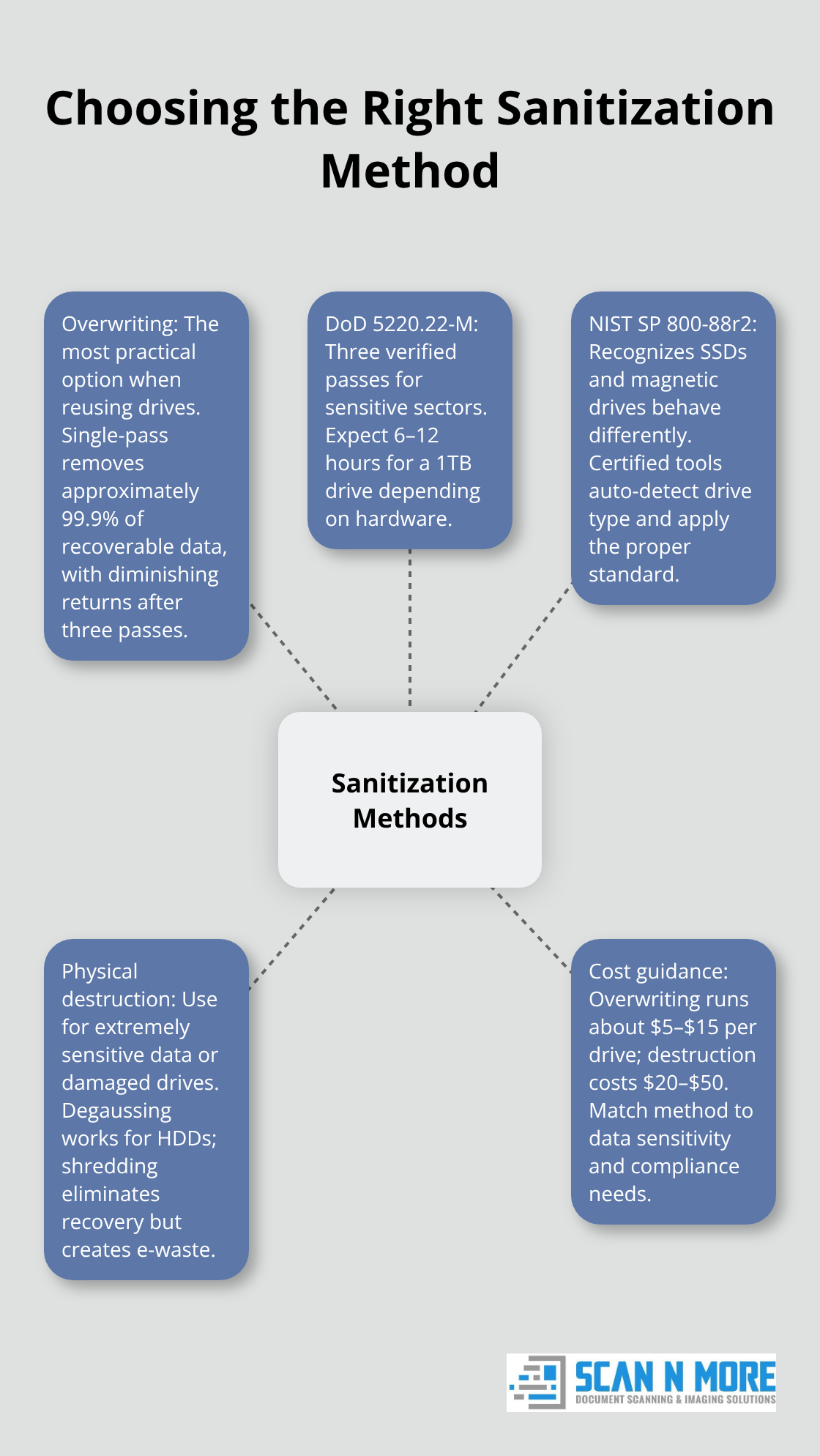
Organizations that implement NIST-compliant overwriting report zero data recovery incidents in post-sanitization audits. The cost difference matters significantly at scale: overwriting costs approximately $5 to $15 per drive, making it the most economical choice for standard data protection needs.
Physical Destruction: When Overwriting Isn’t Enough
Physical destruction becomes necessary when drives contain extremely sensitive data or when overwriting fails due to hardware damage. Degaussing uses powerful magnetic fields to erase data and works reliably on magnetic hard drives but proves ineffective on SSDs because they store data electronically rather than magnetically. Shredding destroys drives completely, eliminating any possibility of data recovery, though this approach renders hardware unusable and creates e-waste.
For drives with suspected malware or firmware-level threats, physical destruction offers the only genuinely certain outcome. The cost runs $20 to $50 per drive depending on volume and certification requirements. Most organizations should reserve physical destruction for drives containing trade secrets, financial records, or healthcare information subject to HIPAA requirements.
Matching Your Method to Your Data
Your sanitization choice depends on what information your drives contain and your compliance obligations. Standard business data typically responds well to certified overwriting, which protects your information while preserving hardware for reuse or resale. Sensitive data (financial records, healthcare information, trade secrets) demands either multiple-pass overwriting or physical destruction with documented proof.
The decision between these approaches shapes your entire data protection strategy and determines which compliance standards you can demonstrate to auditors and regulators. Understanding these distinctions helps you establish a sanitization protocol that protects your organization without unnecessary expense or waste.
Regulatory Compliance and Hidden Breach Costs
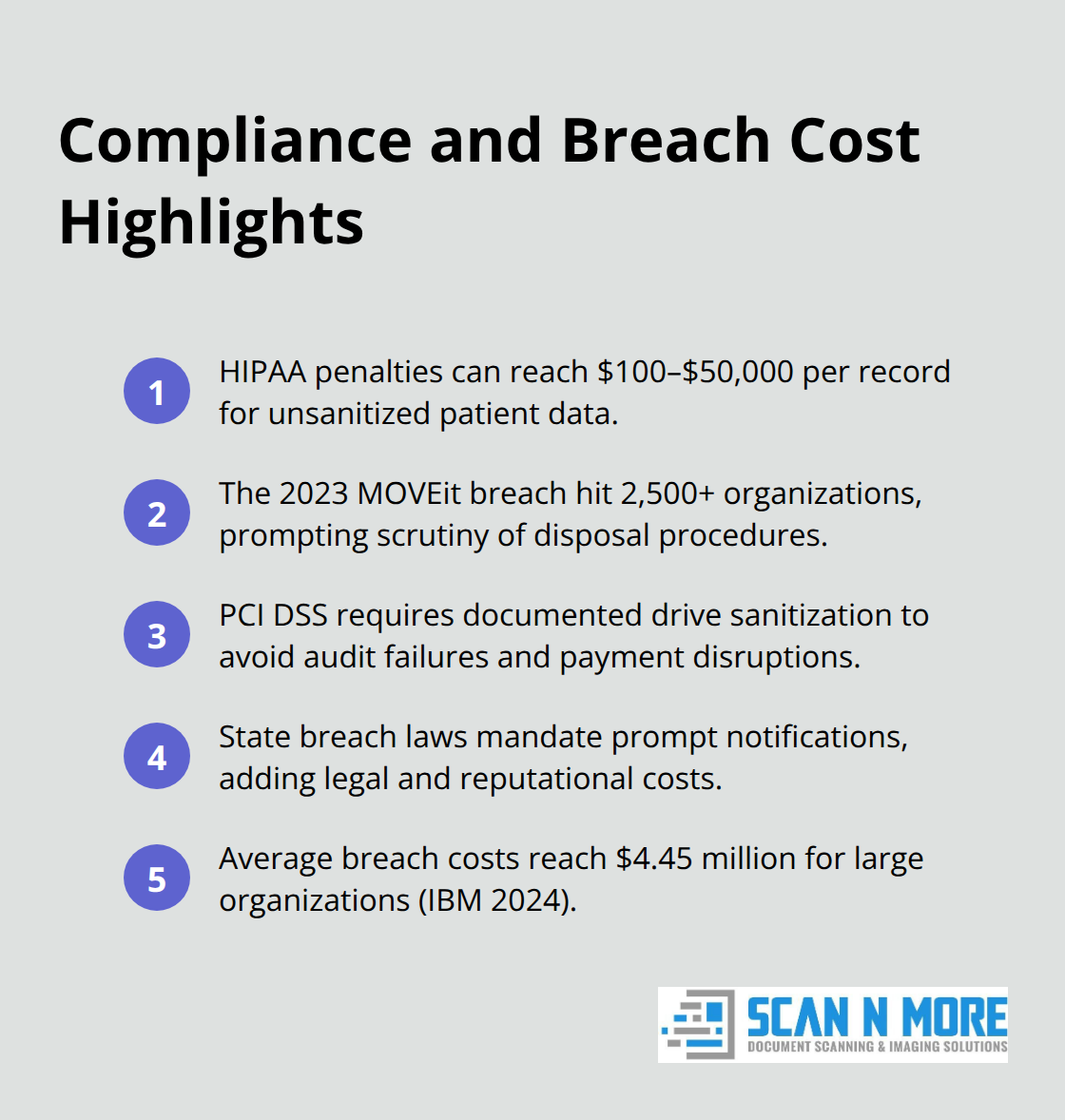
Improper drive disposal exposes your organization to regulatory fines that far exceed the cost of proper sanitization. HIPAA violations for healthcare organizations reach $100 to $50,000 per record when unsanitized drives containing patient data surface, according to HHS enforcement records. The 2023 MOVEit Transfer breach affected over 2,500 organizations, and many faced regulatory scrutiny specifically because they could not demonstrate proper data disposal procedures. Financial institutions under PCI DSS requirements must document complete drive sanitization or face audit failures that prevent payment processing. State data breach notification laws in California, New York, and Massachusetts require organizations to notify affected individuals within specific timeframes, triggering legal costs and reputational damage that extends far beyond the initial breach. Your sanitization documentation becomes your defense during regulatory investigations, making certified methods non-negotiable rather than optional.
The Real Cost of Data Breaches
Unsanitized drives recovered from dumpsters, recycling facilities, and secondhand markets represent an active threat vector. The 2024 Verizon Data Breach Investigations Report found that 31% of breaches now start with software vulnerabilities, beating stolen passwords as the top way attackers get in. One healthcare provider in Massachusetts faced a $750,000 settlement after a decommissioned server containing 33,000 patient records sold at auction without proper erasure. Manufacturing companies lose trade secrets when hard drives end up in overseas e-waste streams where data recovery specialists operate with minimal legal oversight. Breach notification costs average $4.45 million for large organizations according to IBM’s 2024 Cost of a Data Breach Report, including forensics, legal fees, credit monitoring, and lost customer trust. Organizations that implement certified sanitization protocols and maintain audit trails reduce their breach response costs substantially because they can prove compliance from the moment of disposal.
Preventative Maintenance Protects Your Budget
Proper sanitization reduces your total cost of ownership by extending drive lifespan and avoiding emergency replacements. Drives that receive regular sanitization maintain optimal performance, reducing the likelihood of catastrophic failure that forces expensive data recovery attempts or emergency hardware replacement. Organizations that spend $3,000 to $5,000 annually on certified sanitization for 500 drives prevent far costlier incidents: a single hard drive failure requiring professional data recovery runs $1,500 to $3,000, and losing access to business-critical data during recovery periods costs thousands more in productivity losses. Your IT team spends less time troubleshooting corrupted file systems on properly sanitized hardware, freeing resources for strategic initiatives rather than reactive maintenance. Resale value of sanitized drives remains significantly higher than unsanitized equipment, with certified erasure adding $15 to $40 per unit when you sell retired inventory. A predictable sanitization schedule transforms drive disposal from a compliance headache into a managed cost center that protects your bottom line while satisfying auditors and regulators.
Final Thoughts
Data sanitization for drives protects your organization from regulatory fines, data breaches, and hardware degradation that compounds over months and years. The methods you select determine whether your drives last 30 to 40 percent longer and whether your business can demonstrate compliance during audits. Single-pass overwriting works for standard business data at $5 to $15 per drive, while multiple-pass DoD standards protect sensitive information and remain mandatory for healthcare and financial organizations.
Your sanitization approach must match your data sensitivity and regulatory obligations. Healthcare organizations under HIPAA cannot accept the risk of unsanitized drives reaching secondary markets, where data recovery specialists operate without legal oversight. Financial institutions under PCI DSS must document complete erasure to maintain audit compliance, and manufacturing companies protecting trade secrets need certified methods with audit trails proving proper disposal.
The real cost of skipping sanitization extends far beyond the $3,000 to $5,000 annual investment in certified protocols-a single breach notification costs $4.45 million on average for large organizations, including forensics, legal fees, and credit monitoring. Audit your current drive disposal practices and identify which data classifications require which sanitization standards, then establish a predictable schedule rather than treating disposal as an afterthought. We at Scan N More combine document scanning expertise with hard drive destruction services to help organizations transition to digital environments securely.