

Data breaches cost companies an average of $4.45 million per incident, according to IBM’s 2024 report. Yet many organizations still operate without proper data encryption services in place.
At Scan N More, we’ve seen firsthand how encryption transforms security from an afterthought into a competitive advantage. This guide covers what you need to know about protecting your data, whether it’s sitting in storage or moving across networks.
What Encryption Actually Does to Your Data
Encryption converts readable information into unreadable ciphertext using mathematical algorithms and cryptographic keys. Without the correct key, attackers cannot access the original data even if they steal it. AES-256, the gold standard for data protection, encrypts data in 128-bit blocks with 256-bit keys, making brute-force attacks virtually impossible with current technology. When you encrypt data before storage or transmission, you shift the security burden away from preventing access and toward protecting the encryption keys themselves. This fundamental change in approach means your organization stops betting on perimeter defenses alone and instead makes data worthless to anyone who intercepts or steals it.
The 2024 average data breach cost of $4.88 million according to IBM underscores why this matters. Organizations that implement encryption across their infrastructure reduce breach impact dramatically because stolen data becomes useless without decryption keys.
Data at Rest Requires Physical and Digital Protection
Data at rest sits on servers, laptops, databases, and backup drives where it accumulates value over time. Attackers target stored data because it remains stationary and vulnerable to physical theft, unauthorized access, or compromised employee credentials. Full-disk encryption on laptops and file-level encryption for sensitive databases prevent unauthorized access even when devices are stolen or hard drives are removed.
Organizations handling sensitive documents-such as legal records, medical files, or financial statements-face particular risk. Proper encryption of stored data ensures that even if someone physically removes a hard drive or gains unauthorized system access, the information remains protected and unreadable without the decryption key.
Data in Transit Faces Constant Interception Risk
Data in transit moves across networks between your office and cloud applications, between remote workers and company servers, or between cloud services. This state is fundamentally riskier because data travels beyond your direct control through multiple network segments where interception is possible. TLS encryption, HTTPS for web traffic, and VPNs protect data in motion by establishing encrypted channels that prevent man-in-the-middle attacks.
SSL certificates protect data in transit by establishing encrypted channels, yet many organizations still transmit sensitive internal data without equivalent protection. This gap represents a critical vulnerability that attackers actively exploit.
Encryption Standards Determine Your Real Security Level
AES remains the only encryption algorithm approved by the U.S. National Institute of Standards and Technology for protecting classified information. RSA works well for securing smaller data sets and digital signatures but performs poorly for encrypting large files due to computational overhead. TLS 1.3 is the current standard for secure web communications and should be your baseline for any internet-facing application.
Organizations still using DES or 3DES encryption operate with outdated protection that modern computers can crack in hours. When selecting encryption solutions, avoid anything older than AES-128, and demand AES-256 for highly sensitive information like financial records, health data, or customer personally identifiable information.
Key Management Infrastructure Determines Real Protection
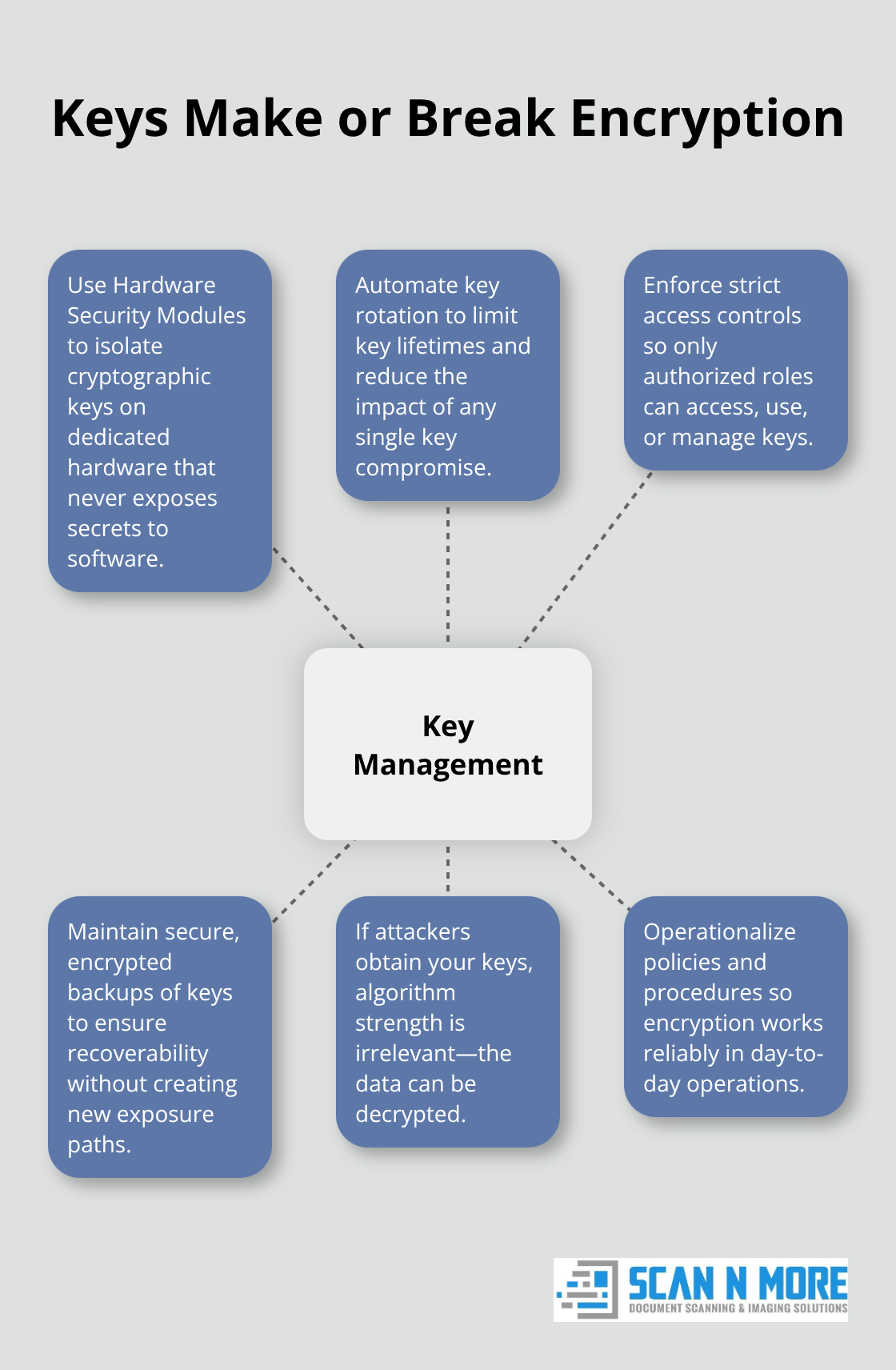
Key management infrastructure matters as much as the encryption algorithm itself. IBM notes that encryption is only as secure as its cryptographic keys, meaning poor key storage or rotation practices can undermine even the strongest algorithms. Hardware Security Modules provide the most robust key protection by storing encryption keys on dedicated hardware devices that never expose keys to software systems where they could be compromised.
Your encryption strategy fails if attackers obtain your keys, regardless of algorithm strength. Organizations that implement strong key management practices-including automated rotation, access controls, and secure backup procedures-transform encryption from a theoretical safeguard into an operational reality. The next section examines how to select and implement the right encryption methods for your specific business requirements.
Why Breaches Cost More Than You Think
The 2024 average data breach cost reached $4.88 million according to IBM, but this figure masks the real damage. Organizations without encryption face exponentially higher costs because attackers gain access to usable data. When encryption protects your information, stolen data becomes worthless, dramatically reducing breach impact and the financial fallout that follows.
Insider Threats Inflict the Highest Costs
Mimecast’s State of Human Risk 2026 Report reveals that insider-driven data exposures cost approximately 13.1 million per incident. This means your biggest threats come from within your organization, where employees have legitimate access to systems but may expose sensitive information through negligence or malice. Encryption stops insiders from weaponizing stolen data because the information remains unreadable without proper decryption keys.
Regulatory Fines Escalate Without Encryption
GDPR violations carry fines up to 20 million euros or four percent of annual revenue, whichever is higher. HIPAA breaches involving electronic protected health information trigger penalties starting at $100 per record with annual maximums exceeding $1.5 million. PCI DSS non-compliance results in fines between $5,000 and $100,000 per month until your organization achieves compliance. These regulatory frameworks explicitly require encryption as a core control, meaning your organization cannot claim compliance without demonstrating strong encryption practices across data at rest and in transit.
Attackers Extract Data Faster Than You Detect Breaches
The Verizon 2024 Data Breach Investigations Report shows that 73 percent of breaches involve external actors, but 27 percent involve insiders. What matters most is time: organizations typically take weeks to discover breaches, and attackers extract data within hours. Unencrypted data means immediate exposure becomes operational damage.
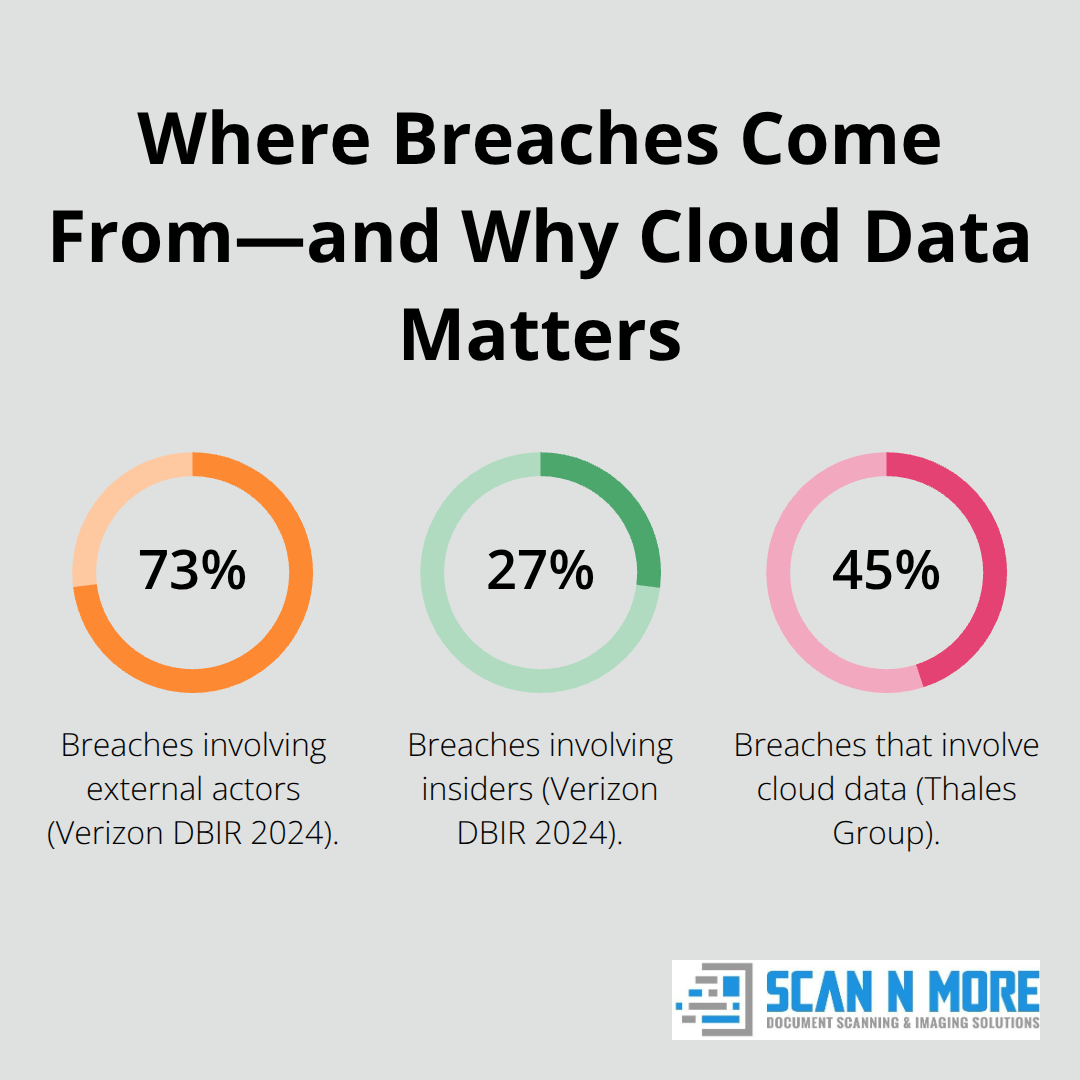
Thales Group reports that 21 to 60 percent of organizations store sensitive data in the cloud, yet approximately 45 percent of breaches involve cloud data. This gap between cloud adoption and encryption deployment represents a critical vulnerability that organizations ignore at their peril.
Customer Data Breaches Multiply Your Liability
Companies handling customer personally identifiable information face particularly severe consequences because breaches expose sensitive data at scale. When attackers steal unencrypted customer data, your organization faces notification costs, legal liability, and reputational damage that can exceed the initial breach cost by multiples. Organizations that implement encryption across email, collaboration tools, and cloud storage reduce breach impact substantially because even if attackers penetrate your systems, the stolen data remains protected.
Compliance Frameworks Mandate Encryption as a Legal Requirement
GDPR requires organizations to implement encryption as a technical measure for protecting personal data of EU citizens, making encryption mandatory rather than optional. The Article 29 Data Protection Working Party explicitly states that encryption is absolutely necessary for maintaining confidentiality and integrity of personal information. HIPAA mandates encryption for electronic protected health information both in transit and at rest, with specific requirements for healthcare organizations to implement cryptographic protections. PCI DSS requires encryption of cardholder data during transmission across public networks and mandates strong key management practices for organizations processing payment cards. These frameworks do not suggest encryption as a best practice; they require it as a legal obligation. Organizations operating without adequate encryption cannot pass compliance audits and face audit failures, remediation costs, and potential license revocation. Startups should align their encryption strategies with these frameworks from day one rather than retrofitting security after growth, because achieving SOC 2 and ISO 27001 certifications requires demonstrating encryption controls that signal trustworthiness to enterprise customers and business partners. The next section examines how to select and implement the right encryption methods for your specific business requirements.
How to Deploy Encryption Without Disrupting Your Operations
Selecting the right encryption method requires understanding what data you handle and where it travels. AES-256 for sensitive information should be your default for sensitive information like financial records, health data, and customer databases, but AES-128 suffices for lower-sensitivity operational data. The critical mistake organizations make is treating encryption as a one-size-fits-all decision rather than matching encryption strength to data classification. Start by auditing your current data landscape to identify what information exists, where it lives, and who accesses it. This data classification process determines whether you need full-disk encryption on employee laptops, database-level encryption for stored records, or TLS encryption for data moving between systems. Organizations that skip this step waste resources encrypting low-value data while leaving sensitive information unprotected.
Match Encryption Strength to Your Data Classification
Hardware Security Modules provide the strongest key protection but cost significantly more than software-based key management systems, so reserve HSMs for your most critical encryption keys and use automated Key Management Systems for routine operations. Self-Encrypting Drives encrypt data at the hardware level and deliver strong protection with minimal performance impact compared to software encryption, making them the practical choice for widespread device deployment across your organization. The integration challenge most organizations face involves legacy systems that predate encryption as a standard practice. Your existing databases, file servers, and backup systems may require substantial modification to support encryption without performance degradation.
Plan Your Encryption Rollout in Phases
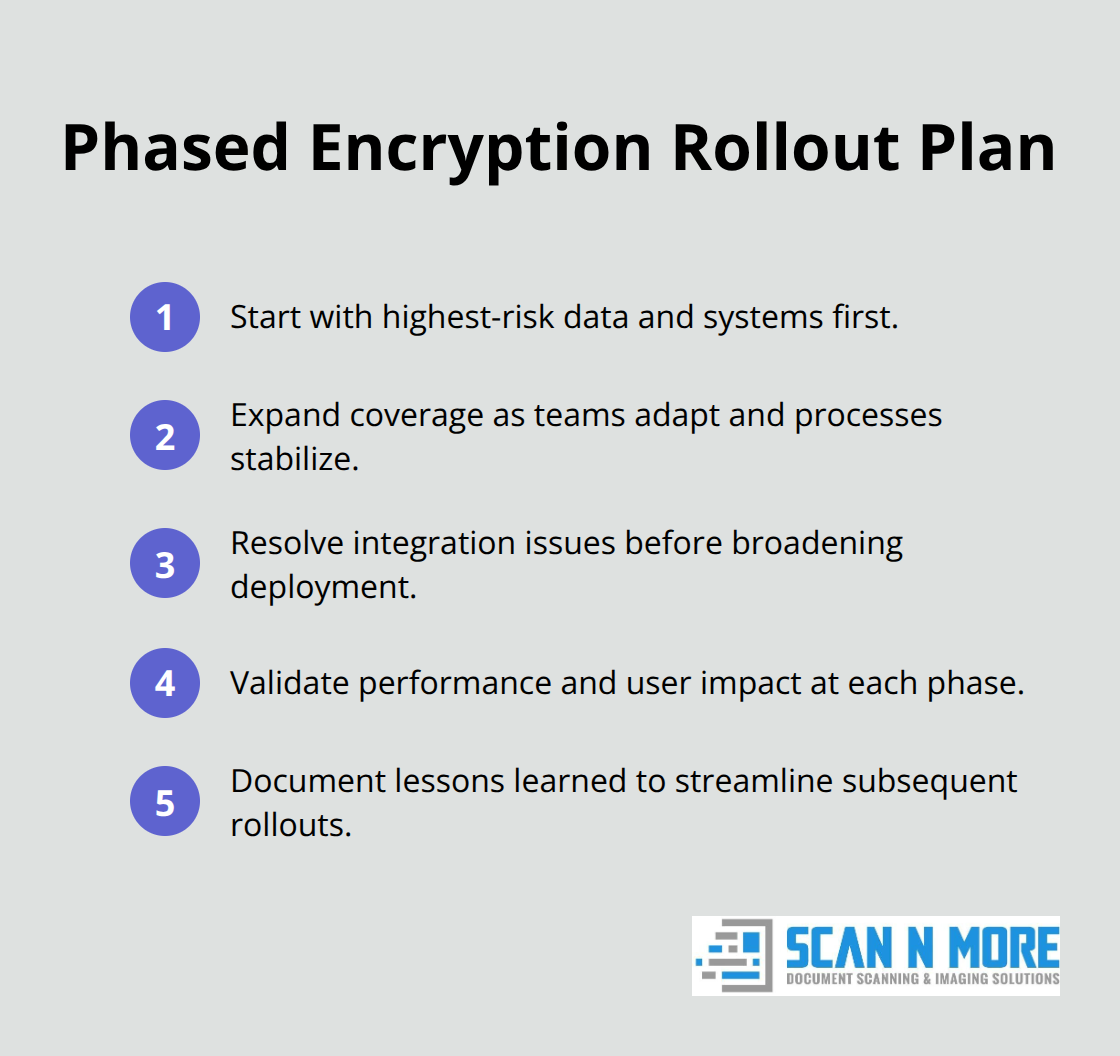
Plan your encryption rollout in phases rather than attempting organization-wide deployment simultaneously, because large-scale encryption implementation creates operational friction that disrupts workflows and generates resistance from employees who experience system slowdowns. Start with your highest-risk data and systems, then expand encryption coverage systematically as teams adapt to new processes. This phased approach allows your IT team to identify integration problems early and resolve them before rolling out encryption to additional systems.
Monitor Encryption Effectiveness Continuously
Encryption provides excellent data protection but creates a false sense of security if you cannot verify that encryption actually operates across your entire infrastructure. Implement automated monitoring to track encryption and alert your team when unencrypted data appears where encryption should exist. Mimecast’s State of Human Risk 2026 Report found that 42 percent of organizations saw a rise in malicious insider incidents, which means your monitoring must include controls that prevent insiders from bypassing encryption or extracting unencrypted copies of protected data.
Enforce Encryption Policies Automatically
Data Loss Prevention tools scan email attachments, cloud transfers, and removable drives to enforce encryption policies automatically, blocking transmission of unencrypted sensitive data before it leaves your organization. Audit logs documenting who accessed encrypted data, when they accessed it, and what they did with it provide essential evidence for compliance audits and security investigations. Organizations handling customer data under GDPR, HIPAA, or PCI DSS requirements must maintain detailed audit trails proving encryption controls operated continuously and that no unencrypted sensitive data exposed during the audit period.
Schedule Regular Encryption Reviews
Schedule quarterly reviews of your encryption configuration to verify that new systems deployed by your IT team include encryption from day one rather than getting added months later as an afterthought. The organizations that maintain strong encryption postures combine technical controls with documented processes that require encryption for all new systems and regular testing that confirms encryption functions correctly across the entire infrastructure. This systematic approach transforms encryption from a one-time project into an operational standard that protects data throughout its lifecycle.
Final Thoughts
Encryption transforms data protection from a theoretical concept into operational reality. Organizations implementing AES-256 encryption across data at rest and in transit reduce breach impact dramatically compared to those relying on perimeter defenses alone. The $4.88 million average breach cost becomes substantially higher when attackers access unencrypted customer data, regulatory fines accumulate without encryption controls, and insider threats multiply your liability across GDPR, HIPAA, and PCI DSS frameworks that mandate encryption as a legal requirement.
Your next step requires auditing your current data landscape to identify what information you handle, where it lives, and whether encryption protects it. Match encryption strength to data classification rather than applying uniform protection across all systems, then deploy encryption in phases starting with your highest-risk data. Implement automated monitoring to verify encryption operates continuously, and schedule quarterly reviews to confirm new systems include encryption from day one.
The complexity of encryption implementation across legacy systems, cloud services, and remote work environments means most organizations benefit from expert guidance. We at Scan N More understand that data security extends beyond encryption alone, and our data encryption services help organizations transition from paper-based processes to secure digital environments while maintaining compliance with regulatory requirements. Start your encryption journey today by assessing your current protection gaps and committing to the systematic implementation that transforms encryption from a compliance checkbox into a competitive advantage.