
Every year, organizations lose millions to data breaches during document digitization. The risks are real, and the stakes are high when confidential files move from paper to digital systems.
At Scan N More, we’ve seen firsthand how secure document scanning protects what matters most. This guide walks you through the security measures, compliance standards, and industry practices that keep your sensitive information safe.
Why Your Documents Are at Risk During Digitization
Scanning documents without proper security measures opens multiple vulnerability points that most organizations underestimate. When files move from locked cabinets to digital systems, they pass through several stages where unauthorized access becomes possible. Handlers access physical documents, equipment operators process sensitive data, files transfer between systems, and storage locations hold everything. A single weak link in this chain exposes confidential information.
The Financial Penalties Regulators Impose
Healthcare providers face HIPAA penalties up to $25,000 per violation category per calendar year. Legal firms handling client documents risk malpractice claims and professional license suspension. Financial institutions face regulatory fines and customer lawsuits if account information leaks during digitization. These consequences exist because inadequate scanning processes create real exposure windows.
Improper document preparation leaves papers unprotected before scanning begins. Unencrypted file transfers send data across networks in readable format. Weak access controls allow multiple staff members to view documents they shouldn’t access. Missing audit trails make it impossible to identify who accessed what information and when. Organizations that skip security measures during digitization often discover breaches months or years later, long after damage spreads across customer databases.
Regulatory Requirements Demand Specific Security Practices
GDPR violations in the European Union result in fines up to 20 million euros or 4 percent of annual revenue, whichever is higher. HIPAA violations in healthcare average 100 to 50,000 dollars per record exposed, with total breaches regularly exceeding millions in penalties and settlements. PIPEDA violations in Canada reach up to 10 million dollars per violation. Regulators actively enforce these standards across all industries.
Your industry determines which regulations apply, but all require documented security measures, access controls, retention schedules, and secure destruction protocols. Organizations cannot claim compliance without proving they implemented these controls during digitization. Auditors examine your scanning partner’s credentials, facility security, personnel background checks, encryption standards, and destruction certificates. Professional scanning services maintain ISO 27001 certification, which demonstrates they meet international information security standards. This certification requires annual independent audits, documented security procedures, and continuous improvement processes.
The True Cost of Data Breaches Extends Far Beyond Fines
IBM’s 2024 Cost of a Data Breach Report found that the average organizational cost of a data breach reached 4.45 million dollars, with healthcare breaches averaging 10.93 million dollars. These costs include notification expenses, credit monitoring services, legal fees, investigation costs, and revenue losses. Customer attrition following data breaches averages 4.7 percent of affected customers, according to Ponemon Institute research.
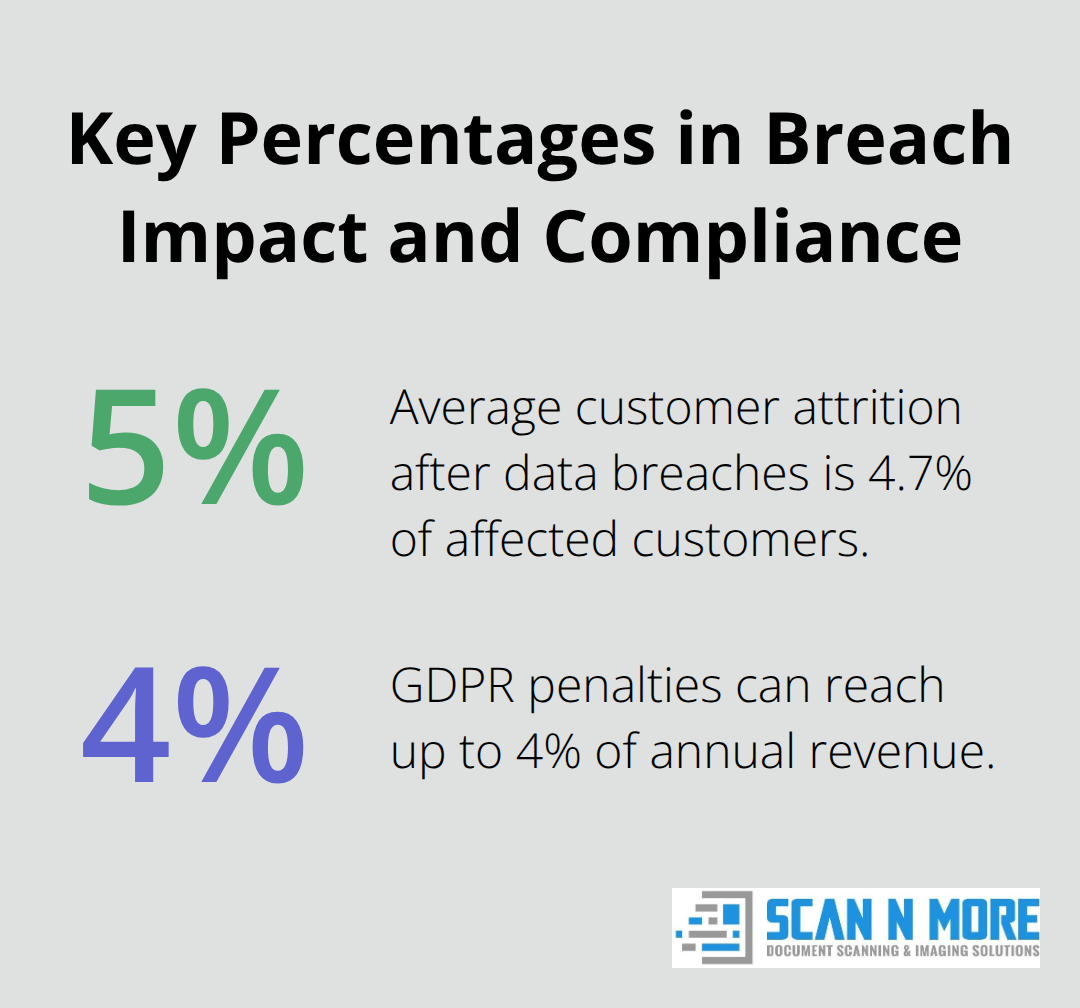
A mid-sized financial institution with 50,000 customers loses 2,350 customer relationships if 4.7 percent depart. At average account values, this represents millions in lost revenue. Operational disruption costs money too. Organizations must halt normal scanning operations during breach investigations, delaying document processing for weeks or months. Employees spend time responding to breach notifications instead of productive work. IT teams rebuild systems and implement emergency security measures.
Your reputation suffers damage that takes years to repair. Prospects hesitate to work with organizations known for security failures. Partners question your ability to protect their information. Secure scanning prevents these cascading costs entirely. Professional services handle digitization with proven security measures, trained personnel, controlled environments, and documented chain of custody. This approach costs significantly less than recovering from a breach-which brings us to how secure document scanning actually protects your files at every stage.
How Secure Document Scanning Protects Your Files
Secure document scanning works through a series of interconnected security measures that operate before, during, and after digitization. The process starts with controlled pickup where trained personnel collect documents in sealed containers with documented chain of custody. Transport uses GPS-tracked vehicles with 24/7 surveillance to prevent interception. Upon arrival at the scanning facility, staff log every box and document batch into a tracking system that records who handled materials and when. Auditors require this level of documentation to verify compliance with HIPAA, GDPR, and other regulations. The scanning environment itself remains restricted, with only background-checked employees accessing sensitive documents.
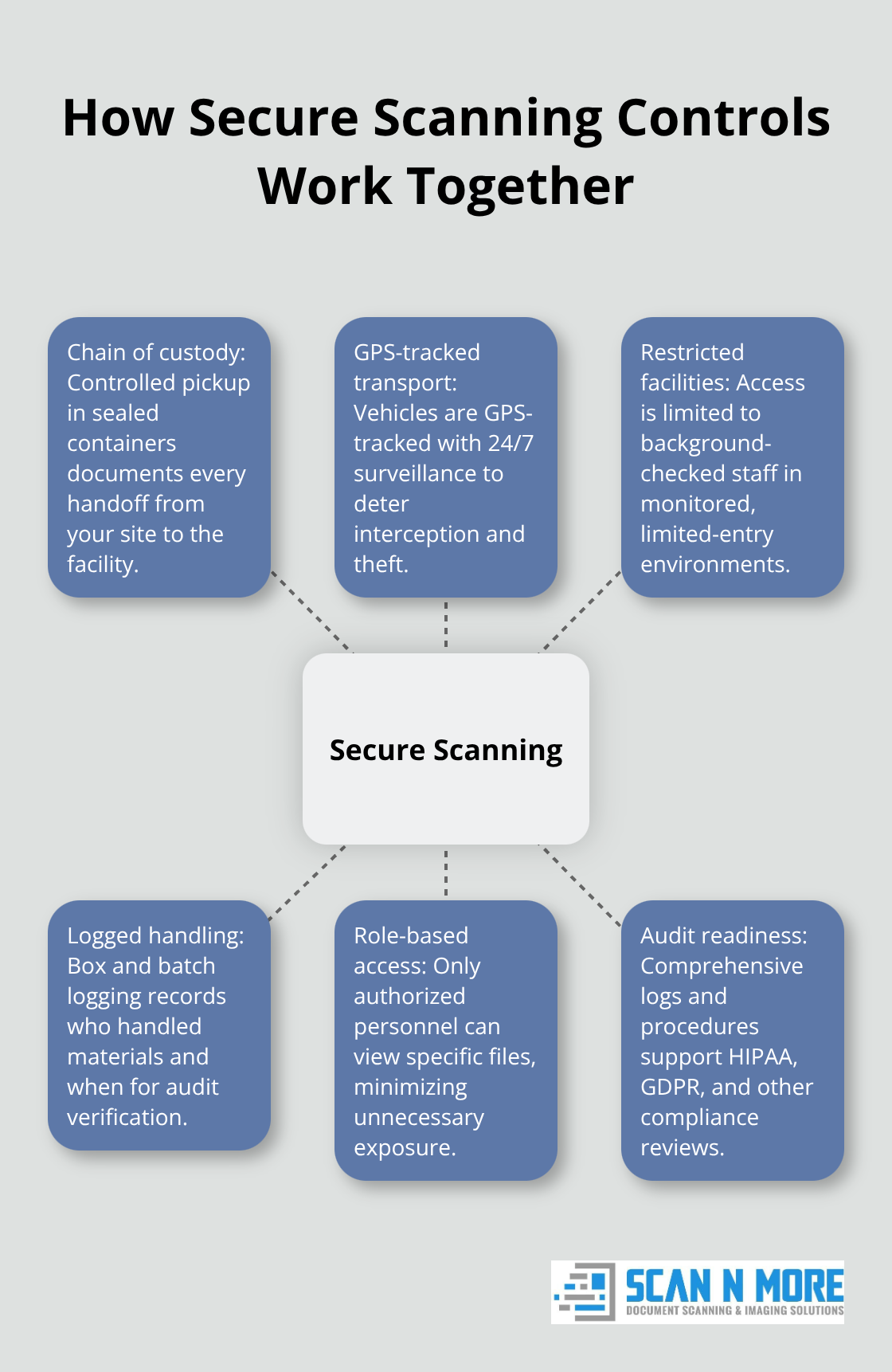
Facilities maintain 24/7 surveillance and limited entry points to prevent unauthorized access. Before documents reach scanning equipment, staff removes staples, paper clips, and fasteners to prevent jams and misalignment that require re-scanning and extended handling time. Staff straightens pages to avoid skewed images that reduce OCR accuracy and create indexing problems later.
Encryption Renders Intercepted Data Unreadable
During the actual scanning process, files become encrypted immediately after capture before transfer to any system. This encryption renders data unreadable if someone intercepts it during transit between the scanning facility and your internal systems or cloud storage. Professional scanning services use AES-256 encryption, which the NSA approves to protect classified government information. After indexing and OCR processing, files remain encrypted at rest in secure storage environments with role-based access controls that restrict visibility to only necessary personnel. A staff member in accounting cannot access medical records, and a junior employee cannot view executive financial documents. Access logs track every file opened, who accessed it, and when, creating an audit trail that regulators examine during compliance reviews.
Destruction Eliminates Physical and Digital Traces
Destruction represents the final security step in the document lifecycle. When retention periods expire, professional services use cross-cut shredding that reduces physical documents to particles with a maximum edge size of 1 millimeter by 5 millimeters, making reconstruction impossible. Digital files are permanently deleted using methods that overwrite data multiple times, preventing recovery even with specialized forensic tools. This two-pronged approach (physical and digital destruction) satisfies regulatory requirements across all industries and eliminates liability from retained documents.
Quality Control Catches Vulnerabilities Hidden in Degraded Scans
Quality control processes catch problems that create security vulnerabilities before files enter your systems. Post-scan verification checks for image clarity, legibility, and completeness, and staff re-scans skewed pages, cut-off content, or illegible text rather than accepting degraded images that might be misindexed or misfiled. Automated redaction tools remove sensitive information like social security numbers or account details before documents are shared internally or retained long-term, eliminating reliance on manual review that introduces human error. Consistent naming conventions and logical folder structures speed retrieval and reduce the time documents remain exposed during search operations.
Multiple Security Layers Protect Against Single Points of Failure
Iron Mountain scanned over 3 billion documents in 2025 across 141 imaging centers, demonstrating the scale at which professional services execute these controls consistently. The combination of controlled environments, trained personnel, encryption at every stage, documented chain of custody, and rigorous quality control creates multiple barriers against unauthorized access. A single control failure does not compromise your data because other layers remain intact. This redundancy separates professional scanning from internal digitization attempts where a single mistake often exposes everything. Understanding how these security measures work together prepares you to evaluate which industries face the greatest risks during document digitization and why they demand professional-grade protection.
Industries That Rely on Secure Document Scanning
Legal Firms Face Confidentiality Obligations That Demand Protection
Legal firms operate under strict confidentiality obligations that make document security non-negotiable. Client communications, case files, and settlement agreements contain information that competitors would pay substantial sums to access. A single breach exposes attorney-client privilege, triggering malpractice liability that exceeds most firms’ insurance coverage. Law practices handle documents with 7-year retention requirements minimum, sometimes extending decades, meaning security failures compound over time as more sensitive material accumulates.
The American Bar Association requires lawyers to implement reasonable safeguards for client information, but many firms still manage documents in filing cabinets with minimal access controls. When these firms transition to digital systems, professional scanning becomes essential because internal digitization attempts often skip encryption during file transfer or fail to implement role-based access controls that prevent paralegals from viewing executive communications or partner financial arrangements.
Healthcare Providers Cannot Afford Scanning Vulnerabilities
Medical offices face HIPAA’s most stringent penalties because patient privacy violations directly impact vulnerable individuals. Scanning patient records requires controlled environments where staff cannot photograph documents with personal devices or email files to external email accounts. A single employee mistake exposes hundreds of patient records instantly.
Healthcare providers report that improper indexing during scanning causes the most frequent compliance violations because misfiled records get accessed by unauthorized staff searching for different patients. Professional scanning services reduce this risk through automated classification that flags potential mislabeling before files enter your system. Medical practices also struggle with retention compliance because HIPAA requires keeping records for minimum periods that vary by record type, yet many practices lack systematic destruction schedules.
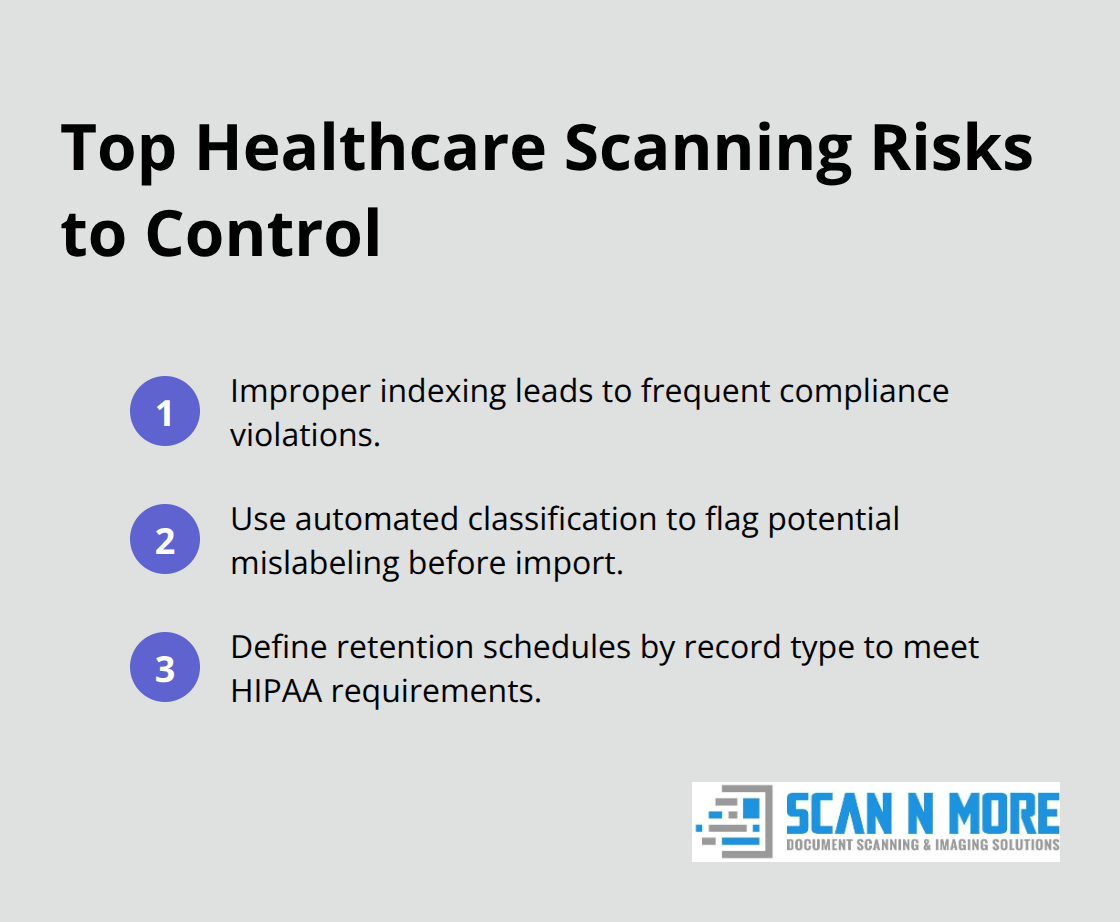
Secure scanning partners establish these schedules upfront and execute them automatically when retention periods expire, eliminating the liability of retained records sitting in digital storage indefinitely.
Financial Institutions Cannot Tolerate Data Exposure
Banks and financial services firms handle the most attractive targets for cybercriminals because stolen account information has immediate monetary value. Regulatory agencies examine financial institutions’ scanning practices during compliance audits with particular scrutiny because customer account data cannot be recovered once compromised.
A financial institution digitizing legacy account records from the 1990s must implement the same encryption and access controls as current systems, even though older documents may contain weaker identifying information. This creates practical challenges because staff must treat decades-old records with identical security measures as current data, increasing operational complexity. Financial institutions also face unique destruction challenges because regulatory requirements mandate keeping certain records for seven years while immediately destroying others, requiring precise retention scheduling during the scanning process. When indexing fails and documents are misfiled, retrieval becomes difficult during regulatory examinations, creating compliance violations even when the underlying data remains secure.
Final Thoughts
Secure document scanning eliminates the vulnerability windows that plague internal digitization attempts. Organizations across legal, healthcare, and financial sectors have learned that cutting corners on security during scanning creates exponential costs through breaches, regulatory penalties, and reputation damage. The protection you gain from professional scanning far outweighs the investment required.
Encryption at every stage-during capture, transfer, and storage-makes intercepted data unreadable and removes the primary attack vector cybercriminals exploit. Documented chain of custody with GPS tracking, surveillance, and access logs creates the audit trail regulators demand during compliance reviews. Controlled environments with background-checked personnel and restricted access prevent the human errors that cause most breaches, and these measures work together to eliminate single points of failure that could expose your confidential files.
Transitioning your documents safely requires planning before scanning begins. Establish retention schedules that specify how long each document category must remain accessible and when destruction occurs, audit your current storage to identify what actually needs digitization versus what can be destroyed immediately, and select a scanning partner with ISO 27001 certification and verifiable client references. Contact us today to discuss how we transform your paper-based processes into secure digital solutions without the risk.