
Every year, companies face hefty fines for improper data disposal. Regulations like HIPAA, GDPR, and SOX demand proof that sensitive information is permanently destroyed.
We at Scan N More help organizations outsource drive destruction to eliminate compliance risk. When you partner with a certified provider, you get documented proof of erasure and protection against data breaches that could cost millions.
Compliance Violations Cost Companies Millions Every Year
Non-compliance with data destruction regulations carries steep penalties across every industry. HIPAA violations in healthcare average $100 to $50,000 per record exposed, according to the U.S. Department of Health and Human Services. GDPR fines reach up to 20 million euros or 4% of global annual revenue, whichever is higher. SOX violations in financial services trigger criminal charges alongside civil penalties. The SEC has imposed fines exceeding $1 billion on financial institutions for inadequate data controls. These aren’t theoretical risks-they’re documented enforcement actions that happen regularly. A 2023 IBM study found that data breaches cost organizations an average of $4.45 million globally, with breach discovery and response consuming months of resources.
What Regulators Actually Require
Different industries face distinct destruction mandates. Healthcare organizations must comply with HIPAA’s Security Rule, which requires that all electronic protected health information become unreadable and indecipherable. Financial institutions follow the Gramm-Leach-Bliley Act, demanding secure disposal of customer information within specific timeframes. State attorneys general enforce data breach notification laws that require proof of destruction. The FTC enforces the Safeguards Rule, holding companies accountable for written policies on data disposal. These regulations demand documentation-not just destroying drives, but proving they were destroyed properly. The NIST Special Publication 800-88 outlines specific guidelines for media sanitization that regulators reference during audits. Companies that cannot produce destruction certificates face immediate enforcement action.
Stock Prices Fall When Breaches Hit the News
A single data breach announcement triggers stock price declines averaging 2-5% within days, according to research from the Ponemon Institute. Customer trust erodes faster than recovery takes.

When Target suffered a breach in 2013, they lost 40 million customer records, faced $18.5 million in settlements, and saw customer traffic drop 5% year-over-year. Equifax’s 2017 breach exposed 147 million people’s personal information and destroyed executive credibility despite $700 million in settlements. The reputational cost extended years beyond legal resolution. Companies lose contracts when prospects discover inadequate data handling practices during due diligence. A single compliance failure can disqualify organizations from bidding on government contracts worth millions annually.
How Destruction Standards Protect Your Organization
Proper drive destruction follows established standards that regulators recognize and accept. NIST guidelines and DoD certification standards provide the framework that auditors expect to see in your documentation. Organizations that implement certified destruction methods avoid the costly back-and-forth with compliance teams during audits. The difference between proper and improper destruction often determines whether regulators view your company as negligent or responsible. This distinction matters when fines are calculated and when your organization applies for contracts or partnerships. Certified providers maintain the documentation trail that transforms destruction from a liability into proof of compliance. The next section examines how outsourcing this function eliminates the operational burden while strengthening your compliance posture.
Hard Drive Destruction Methods and Standards
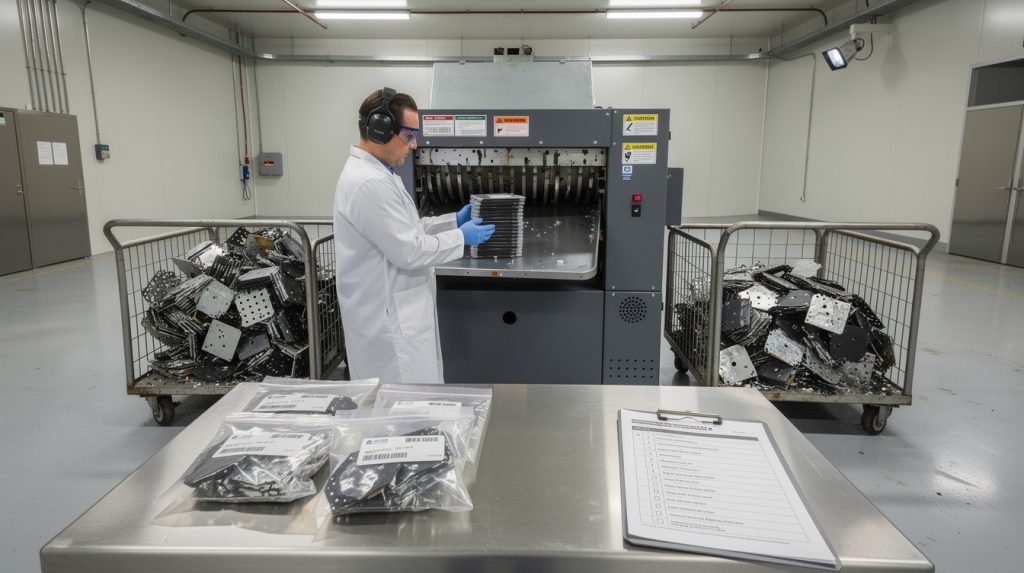
Physical destruction and data wiping serve fundamentally different purposes, and your choice between them determines whether your organization meets regulatory requirements or falls short. Physical destruction mechanically shreds, degaussing, or incinerates hard drives until they become unrecoverable metal fragments. Data wiping overwrites existing data with random characters multiple times, rendering information inaccessible without removing the physical device. NIST Special Publication 800-88 recognizes both approaches as valid, but regulators increasingly favor physical destruction because it eliminates any theoretical recovery risk.

When Physical Destruction Becomes Mandatory
The National Security Agency and Department of Defense mandate physical destruction for classified information, which means any organization handling government contracts must follow DoD 5220.22-M standards or newer certification levels. Wiping works for non-sensitive data or devices you plan to repurpose, but healthcare providers under HIPAA, financial institutions under GLBA, and companies handling credit card data under PCI-DSS face auditor skepticism toward wiping alone. Insurance companies now offer better coverage rates for organizations using certified physical destruction, recognizing the liability reduction it provides.
The cost difference matters less than you think. Professional destruction runs $15 to $50 per drive depending on volume and certification level, while failed compliance costs millions. Your industry’s actual enforcement pattern should guide your method selection, not theoretical requirements.
What Certification Standards Auditors Verify
NIST guidelines provide the baseline, but DoD certification carries the weight that matters during audits. DoD 5220.22-M standards are considered obsolete, with what matters being that the overwrite covers the whole drive and the result is verified and recorded. The newer NIST 800-88 acknowledges this limitation and recommends physical destruction as the stronger standard.
Military and intelligence agencies follow NSA/CSS 02-105-02, which mandates physical destruction for any device containing classified data. State attorneys general reference these standards during breach investigations, meaning your destruction documentation must explicitly cite which standard was followed. Auditors expect to see serial numbers, destruction dates, and certification signatures on every device destroyed. Generic destruction certificates without specific standard references raise red flags during compliance reviews.
Your documentation must survive regulatory scrutiny, which means selecting a destruction partner who understands these certification requirements becomes your next critical decision.
Benefits of Outsourcing Drive Destruction
Handling drive destruction internally creates operational headaches that most organizations underestimate. Your IT team gets pulled away from core responsibilities to manage logistics, coordinate pickups, document destruction events, and maintain certification records. Companies that attempt in-house destruction programs spend an average of 40 to 60 hours monthly on administrative overhead alone, according to data from destruction service providers who track client transitions. That translates to roughly $8,000 to $15,000 annually in labor costs for a mid-sized organization, before factoring in equipment purchases, facility requirements, and staff training on evolving standards. A certified destruction partner eliminates this burden entirely and handles the compliance documentation that regulators actually scrutinize during audits.
Certified Providers Generate Auditor-Ready Documentation
Regulators do not accept generic destruction certificates. They want specific serial numbers, destruction dates, certification standards applied, and signatures from authorized personnel. Auditors cross-reference destruction records against your asset inventory to verify nothing slipped through unwiped or undestroyed.
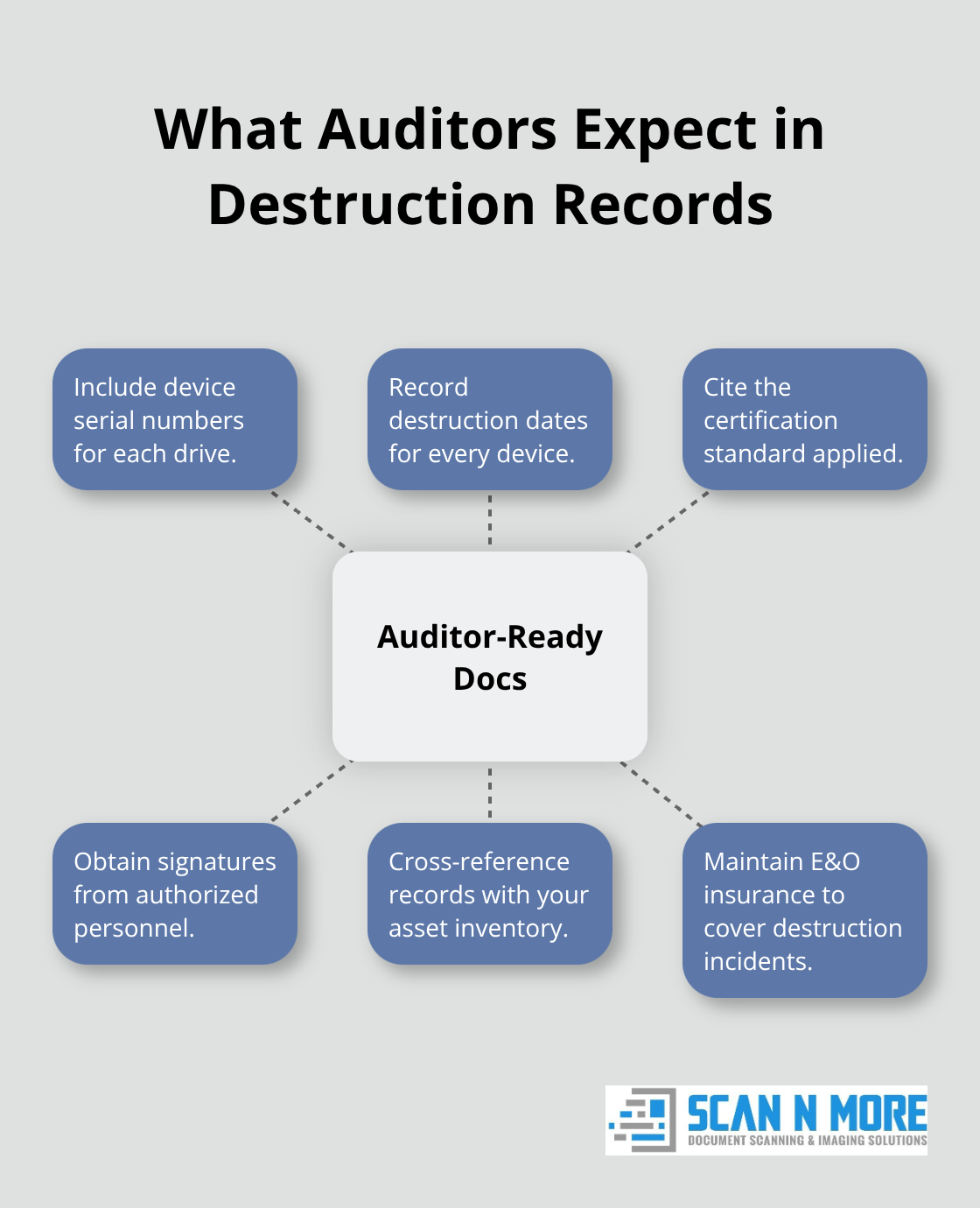
When you outsource to a certified partner, they maintain the documentation chain that transforms a potential liability into concrete proof of compliance. Third-party providers also carry E&O insurance that covers destruction-related incidents, shifting liability away from your organization. If a destroyed drive somehow resurfaces with recoverable data, their insurance covers the breach notification costs and regulatory fines. Your in-house program carries no such protection. Auditors also trust external certification more readily than internal records because the provider has financial incentive to maintain standards and faces regulatory penalties for falsified documentation.
The Real Cost Comparison Favors Outsourcing
External destruction costs between $15 and $50 per drive depending on volume and certification level, with bulk pricing dropping toward the lower end for organizations destroying 500 or more drives annually. Compare this against in-house expenses including equipment depreciation on industrial shredders or degaussing machines that cost $50,000 to $150,000 upfront, facility space dedicated to destruction, ongoing maintenance, staff training, and liability insurance. Organizations destroying fewer than 2,000 drives yearly break even financially within the first year of outsourcing. Larger organizations see savings expand because certified providers achieve economies of scale that individual companies cannot replicate. You also avoid the risk of equipment failure mid-destruction, which creates compliance gaps and scrambled recovery efforts. A partner handles peak volume spikes without straining your resources, meaning you do not need to purchase equipment sized for your busiest month only to run it half-empty most of the time.
Compliance Standards Update Automatically With External Partners
When standards change, your outsourced provider updates their processes automatically. NIST guidelines and DoD certification requirements evolve, and staying current requires continuous monitoring and staff retraining. A certified destruction partner maintains compliance updates as part of their service model because regulatory violations directly threaten their business license. This accountability structure ensures your organization never falls behind on standard requirements. Auditors also view external destruction as a control that operates independently from your organization’s internal processes, strengthening your overall compliance posture in their assessment. Your team avoids the constant pressure to track regulatory shifts and retrain staff on new certification protocols.
Final Thoughts
Compliance failures in data destruction cost organizations millions in fines, settlements, and lost contracts. HIPAA, GDPR, SOX, and industry-specific standards demand documented proof that sensitive data becomes permanently destroyed, and auditors scrutinize serial numbers, destruction dates, certification standards, and authorized signatures on every device. Your choice between physical destruction and certified wiping depends on what regulators in your industry actually enforce during audits, but the documentation trail matters more than the method itself.
Outsourcing drive destruction eliminates the operational burden that pulls your IT team away from core work. In-house programs consume 40 to 60 hours monthly on administrative overhead, costing $8,000 to $15,000 annually before equipment and training expenses, while a certified partner handles logistics, maintains auditor-ready documentation, and carries liability insurance that protects your organization if something goes wrong. External destruction also costs less than in-house programs for most organizations, especially those destroying fewer than 2,000 drives yearly, and when standards change, your provider updates automatically without requiring staff retraining.
We at Scan N More provide hard drive destruction services that guarantee compliance and documentation. Contact Scan N More to discuss how outsourcing your drive destruction strengthens your compliance posture and eliminates the operational headaches of managing destruction internally.