

Your team spends hours hunting through filing cabinets and email chains for a single document. Meanwhile, decisions wait, deadlines slip, and frustration builds.
Electronic document access changes this. At Scan N More, we’ve seen firsthand how businesses that digitize their files operate faster, cut costs, and eliminate the chaos of paper-based workflows. This post shows you exactly how.
Why Your Business Loses Money Every Day Without Digital Documents
Employees at most companies waste 30 percent of their workday searching for information, according to research from McKinsey. That means a team of ten people loses three full-time workers worth of productivity just hunting through filing cabinets, email folders, and desk drawers. When a client calls with an urgent request or a manager needs a contract signed within the hour, paper-based systems fail.

Someone must physically locate the file, scan it if needed, email it around, and hope nobody loses it in transit.
Remote Workers Face Impossible Barriers
Remote workers cannot access physical files at all unless someone mails them or photographs documents with a phone camera, introducing quality issues and security risks. This limitation cripples teams that operate across multiple locations and time zones. The bottleneck destroys productivity every single day. The real cost is not just wasted time but missed opportunities. A sales team waiting for contract approval loses deals. A compliance officer scrambling to find records during an audit risks penalties. A customer service representative unable to access account history provides poor service. Electronic document access eliminates these failures entirely.
Compliance Stops Being a Nightmare
Regulatory bodies demand audit trails showing who accessed what and when. Paper systems cannot provide this. Digital systems create automatic logs that show every interaction with every document, satisfying requirements from HIPAA, SOX, and industry-specific regulations without additional effort. You stop relying on manual record-keeping and guesswork. When an auditor arrives, your data is already organized and traceable.
Storage Costs Disappear Fast
Physical filing takes up expensive real estate. A four-drawer filing cabinet occupies roughly 10 square feet and costs between 1,500 and 3,000 dollars per year in office space depending on your location. Large organizations maintain entire rooms of filing cabinets. Digital storage costs a fraction of that amount and scales infinitely without requiring more office space (no expansion budgets, no lease negotiations, no wasted square footage).
Information Moves at Business Speed
When documents live in a secure digital system, anyone with proper access retrieves them in seconds instead of minutes or hours. Decision-makers get the information they need instantly. Projects move forward without waiting. Teams collaborate without passing physical copies around. This speed advantage compounds over time, creating measurable improvements in how fast your organization responds to market changes and customer needs. The question is not whether you can afford to digitize, but whether you can afford to stay paper-based.
How Digital Document Systems Transform Your Workflow
Transforming paper into digital documents requires more than just running files through a scanner. The scanning process converts physical pages into high-quality digital images, but the real value emerges afterward. Each scanned document needs metadata attached-file names, dates, document types-so your team can find specific files later. Without proper organization during this stage, you end up with thousands of image files that are just as difficult to locate as physical papers. This is why the scanning process matters far less than what happens next.
Cloud Storage Gives You Access Without Geographic Limits
Once documents are digitized, they live in secure cloud storage accessible from any device with internet connection and proper login credentials. This removes the geographic limitations that plague paper-based systems. Your remote employees in different time zones access the same files simultaneously without waiting for someone to email attachments or mail physical copies. Cloud storage scales instantly as your document volume grows, eliminating the need to purchase additional filing cabinets or rent larger office space. Access controls determine who views what, so sensitive HR files stay away from general staff while customer contracts reach the sales team instantly. The system logs every access attempt, creating the audit trail that auditors require without anyone lifting a finger.
Search Speed Transforms Daily Operations
A paper filing system requires someone to physically navigate to the correct cabinet, open drawers, and flip through folders. Digital systems let employees search by keyword, date range, document type, or customer name in seconds.

Search speed transforms daily operations by eliminating time wasted hunting through disconnected systems. Moving to a unified digital platform cuts this time dramatically. Your finance team finds invoices by vendor name instead of hunting through years of filing cabinets. Your legal department locates contracts by client or date range without manual review. Customer service representatives pull account history while the customer waits on the phone, transforming the quality of support you provide.
Access Controls Protect Sensitive Information
Permission settings determine exactly who retrieves what documents and when. A marketing coordinator cannot access payroll records. A junior accountant cannot modify completed tax filings. Access controls protect sensitive information by setting permissions at the document, folder, or workspace level to control who can view, edit, or share content. These restrictions happen automatically without requiring IT staff to manually grant or revoke access each time someone changes roles. The system tracks who viewed confidential files, creating accountability that paper systems cannot match. This combination of restriction and transparency satisfies compliance requirements while protecting your organization from internal threats and accidental data exposure.
Your organization now has the infrastructure to move information at business speed. The next step involves understanding the real financial and operational impact that this transformation creates across your entire company.
How Digital Documents Cut Real Costs
Eliminating physical storage eliminates one of your largest hidden expenses. A single four-drawer filing cabinet occupies 10 square feet and costs 1,500 to 3,000 dollars annually in office space. Most organizations maintain dozens of these cabinets scattered across multiple locations.
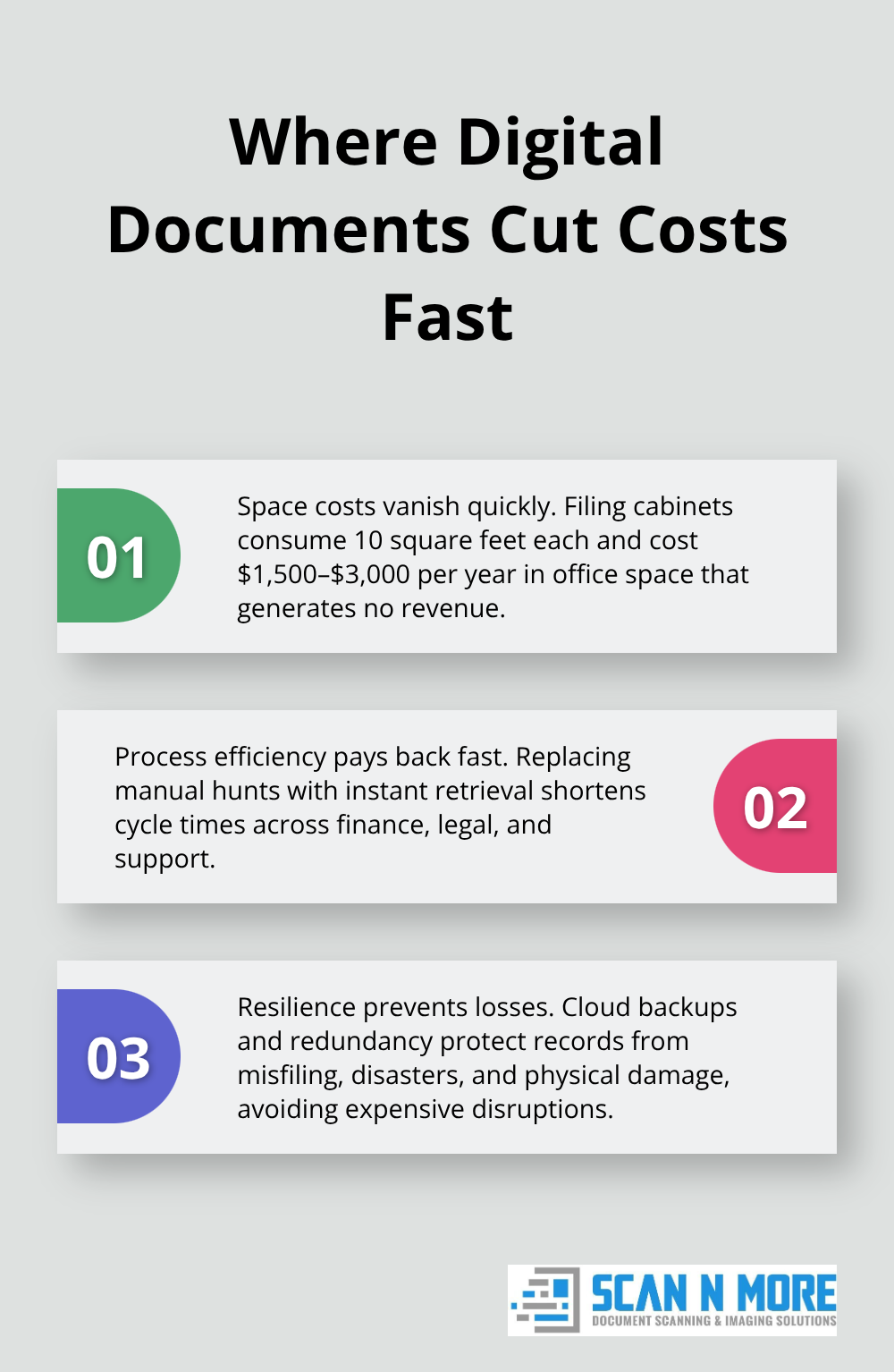
A company with 100 filing cabinets wastes between 150,000 and 300,000 dollars every year on space that produces zero revenue. Digital storage costs a fraction of this amount and scales infinitely without requiring additional square footage or lease renegotiations. Beyond space costs, physical documents require climate control, fire suppression systems, and regular maintenance. These operational expenses vanish when your files live in the cloud.
Speed of Access Directly Impacts Revenue
When your finance team spends 45 minutes hunting for an invoice instead of 30 seconds retrieving it from a digital system, you lose money on every single transaction. A company processing 500 invoices monthly loses roughly 375 hours annually just searching for documents. At an average employee cost of 35 dollars per hour, that equals 13,125 dollars per year wasted on a single workflow. Digital systems eliminate this drag entirely. Sales teams close deals faster when they access contracts instantly instead of waiting for someone to locate physical files. Customer service representatives resolve issues on first contact when they pull account history while customers wait on the phone. That speed advantage compounds across hundreds of daily decisions, creating measurable revenue impact that justifies the entire digitization investment within months.
Document Loss and Damage Stop Costing You Money
Physical documents get misfiled, damaged by water or fire, lost during office moves, or accidentally thrown away. A single misplaced contract can cost your company thousands in legal disputes or lost business. Digital files stored in secure cloud systems with automatic backups never disappear. Multiple redundant copies exist across geographically separated data centers, meaning no single disaster eliminates your critical documents. Your organization regains peace of mind knowing that customer records, financial documents, and compliance files remain protected and accessible regardless of what happens to your physical office space. This security alone justifies the transition to digital systems.
Final Thoughts
Electronic document access transforms how your organization operates by eliminating wasted hours and enabling decisions at business speed. Teams stop hunting through filing cabinets while remote employees gain instant access to critical information. Your compliance team stops scrambling during audits because audit trails already exist, and your finance department processes invoices in seconds instead of minutes.
Security and accessibility work together in digital systems rather than against each other. Proper access controls protect sensitive documents while authorized employees retrieve what they need instantly. Cloud storage with automatic backups safeguards your critical files from loss or damage, giving your organization peace of mind that customer records, contracts, and compliance documents remain secure and recoverable regardless of physical disasters.
We at Scan N More handle the heavy lifting through professional document scanning services that transform your existing paper files into organized digital assets. Contact Scan N More to discuss how our scanning solutions can accelerate your transition to digital operations and start saving your company money today.