
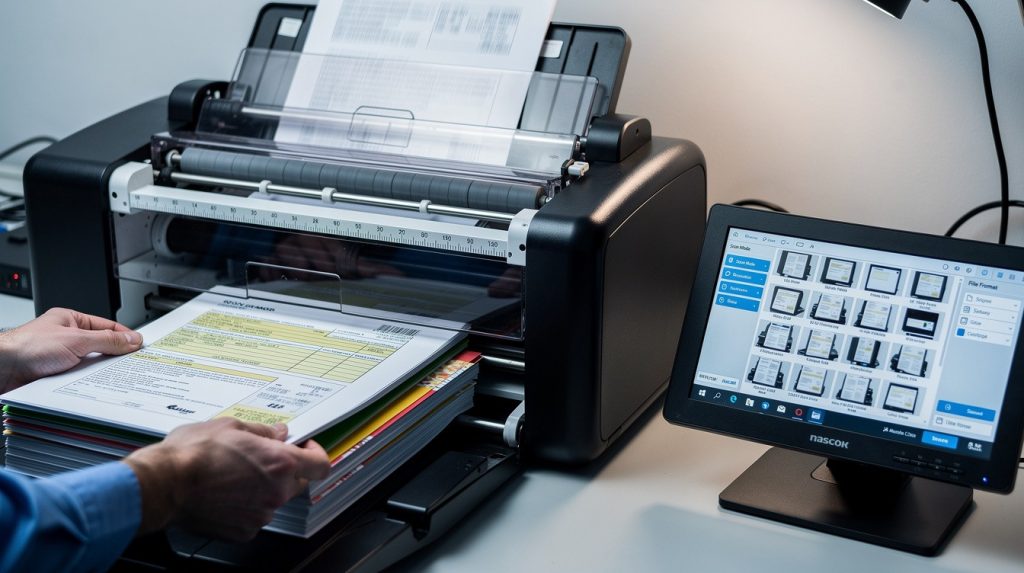
Most businesses still scan documents at a crawl. Stacks pile up, deadlines slip, and your team wastes hours on manual processing.
At Scan N More, we’ve seen firsthand how high speed document scanning changes everything. You get faster digitization without sacrificing the quality your business depends on.
Why Speed Actually Matters
Document Backlogs Drain Your Bottom Line
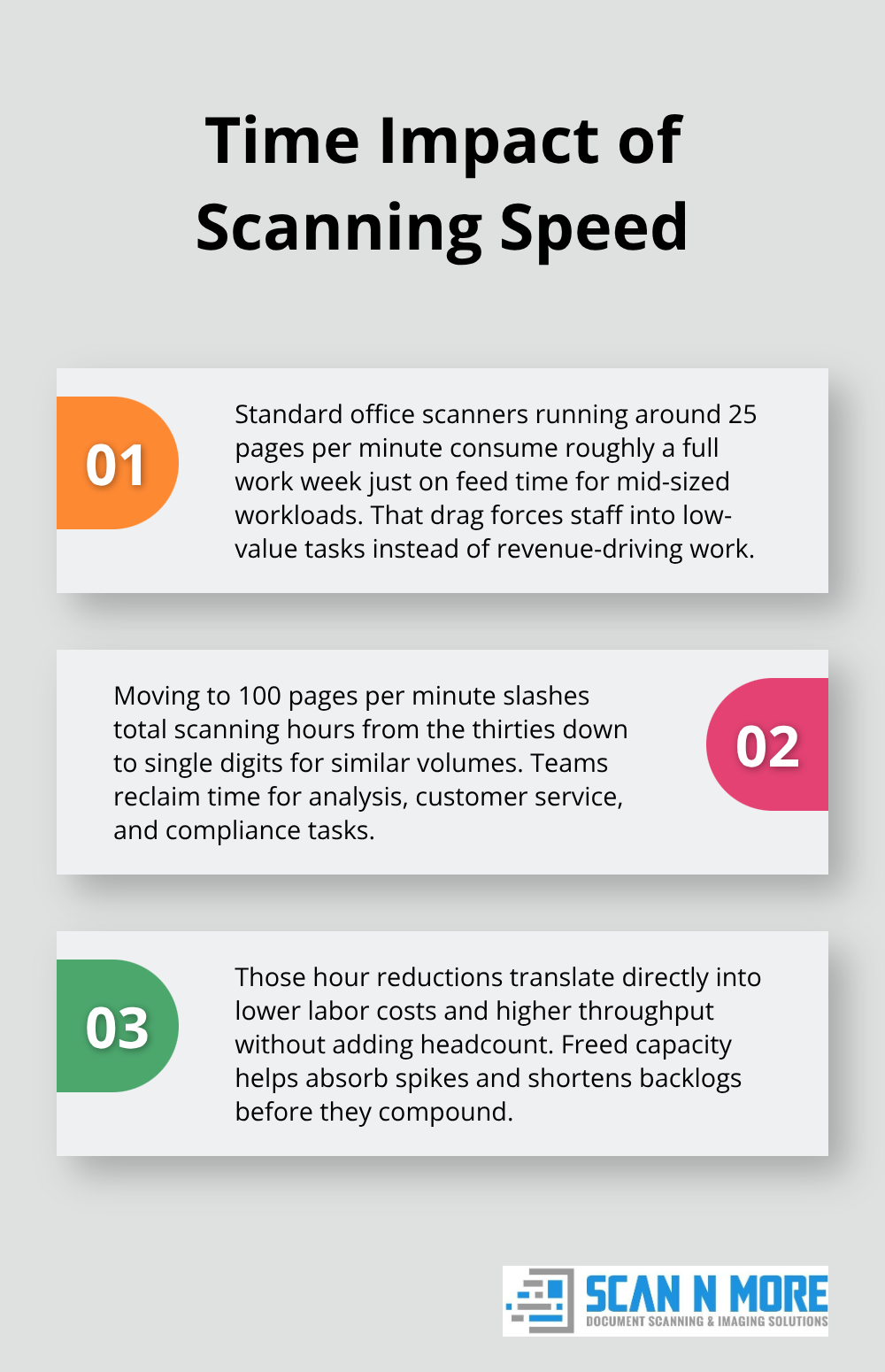
Document backlogs cost money in ways most businesses underestimate. When invoices sit unprocessed, you delay cash flow. When patient records pile up, healthcare providers miss reimbursement windows. When contracts languish in filing cabinets, legal teams can’t meet compliance deadlines. A typical mid-sized business processing 50,000 pages monthly with standard office scanners at 25 pages per minute requires roughly 33 hours of scanning time alone. That’s nearly a full work week spent just feeding documents. High-speed scanners operating at 100 pages per minute cut that to 8 hours. The difference translates directly to labor costs and freed-up staff capacity for higher-value work.
Speed Accelerates Cash Flow and Compliance
Financial services companies report that faster invoice digitization reduces payment cycles by 3 to 5 days, which compounds significantly across thousands of monthly transactions. In healthcare, accelerated claims scanning directly impacts reimbursement speed and cash position. These aren’t minor improvements-they affect your organization’s financial health month after month.
Volume Spikes Demand Production-Grade Capacity
Backlogs don’t stay static. They compound. One delayed batch becomes two, then three, and suddenly you’re months behind on digitization. Government agencies and large enterprises often face quarterly spikes in document volume during audits or fiscal closes. Standard scanning simply can’t handle these peaks without massive temporary staffing. High-speed production scanners handle 100+ pages per minute, letting organizations absorb volume surges without hiring temporary workers or delaying operations. The RICOH fi-7700, for instance, processes roughly 100 pages per minute with integrated flatbed capability for exception documents, making it suitable for mixed-document environments without workflow bottlenecks.
Real-World Impact Across Industries
Manufacturing and construction sectors digitize blueprints, schematics, and project documentation under similar constraints. Faster capture means project teams access digital assets sooner, enabling faster decision-making and reducing project delays. The speed advantage isn’t theoretical. It’s the difference between accessing a customer contract in minutes versus days, between filing insurance claims within processing windows versus missing deadlines, between maintaining regulatory compliance and facing penalties. These operational realities set the stage for understanding what actually drives high-speed scanning performance-and how modern technology achieves both velocity and reliability without compromise.
What Makes High-Speed Scanners Actually Fast
Engineering Precision Over Raw Power
Modern production scanners achieve their speed through engineered precision rather than brute force. The RICOH fi-7700 processes 100 pages per minute, which translates to roughly 40,000 to 44,000 pages per day under continuous operation. Fusion HD reaches 730 pages per minute, positioning it among the world’s fastest production units. This performance gap matters because it determines whether your organization clears backlogs in weeks or months.
Three Integrated Systems Drive Performance
The speed comes from three integrated systems working in parallel. First, advanced imaging sensors capture documents at high resolution while maintaining throughput, using dynamic thresholding to preserve small print and subtle marks across mixed document types in a single batch. Second, independent roller control prevents cascading feed errors by delaying the next document when the previous one skews, eliminating the jam-and-restart cycles that destroy productivity on slower machines. Third, ultrasonic multi-feed detection prevents overlapping pages from being scanned as one image, protecting data integrity without slowing the feed rate.
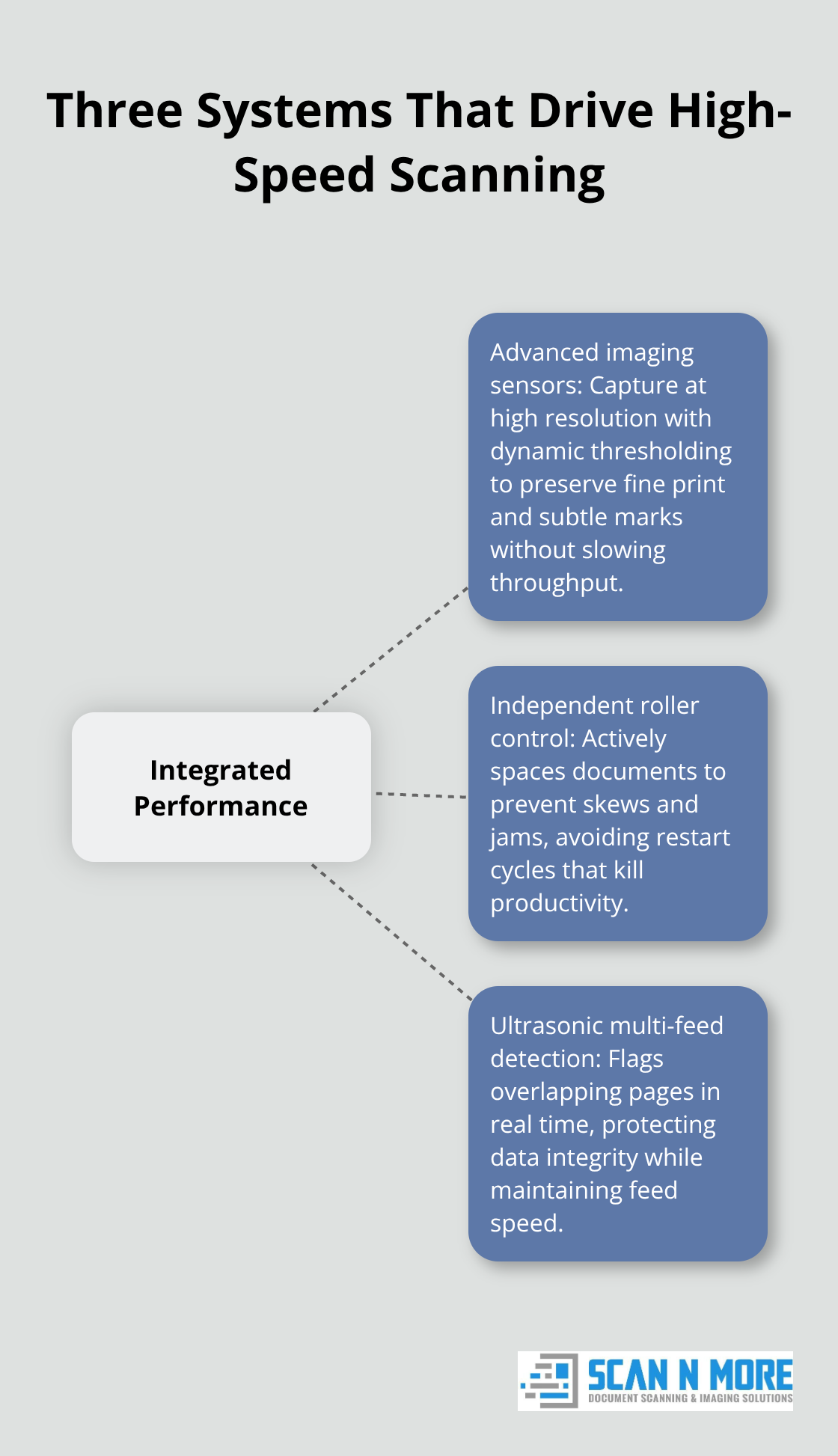
These aren’t optional features-they’re foundational to production-grade performance. Standard office scanners lack this precision, which is why they stall under volume.
Quality Assurance Integrated Into Capture
Quality assurance happens during scanning, not after. High-speed systems integrate automated image enhancement, OCR confidence scoring, and real-time validation to flag errors before documents leave the scanner. This approach differs fundamentally from batch-processing quality checks that discover problems hours later when rework becomes expensive. The RICOH fi-7700 includes an integrated flatbed for exception documents that can’t feed through the automatic document feeder, maintaining speed without workflow bottlenecks when handling bound materials or irregular shapes.
Reducing Manual Intervention and Rework
Large automatic document feeders supporting 200 to 500 pages per batch reduce loading frequency and human intervention. Seamless integration with capture software and business systems translates scanned images directly into actionable data, enabling downstream automation for invoice processing, claims handling, and records management. Organizations using production scanners report measurable improvements in OCR accuracy because clearer, higher-resolution scans require less post-processing correction.
Total Cost of Ownership Improves Across Multiple Dimensions
The total cost of ownership improves not just from labor savings but from reduced rework, faster data availability, and fewer compliance risks. Speed and quality aren’t competing priorities in modern high-speed scanning-they’re engineered as a single outcome. This integration of velocity and reliability sets the foundation for understanding how organizations actually maintain accuracy when processing thousands of pages daily, a challenge that requires more than hardware alone.
Speed and Accuracy Work Together, Not Against Each Other
The False Choice Between Velocity and Quality
The fundamental tension in high-speed scanning doesn’t exist. Organizations that treat speed and accuracy as competing priorities end up with neither. The data from production environments shows a clear pattern: faster scanning actually improves accuracy when the system is engineered correctly. The real problem most businesses face isn’t that speed destroys quality-it’s that they use equipment designed for office environments, not production workloads. A standard office scanner at 25 pages per minute forces operators to rush, creating fatigue-induced errors and manual mistakes that no amount of post-processing fixes. Production-grade scanners like the RICOH fi-7700 operating at 100 pages per minute eliminate operator fatigue because the machine handles the work, not the person.
How Production Scanners Catch Errors During Capture
The scanner’s independent roller control and ultrasonic multi-feed detection catch errors during capture, not hours later when corrections become expensive. This means OCR accuracy actually improves because clearer, higher-quality scans require less post-processing correction. Financial services companies processing invoices see measurable improvements in field extraction accuracy when they move from standard scanners to production units-fewer manual corrections, faster downstream automation, fewer payment errors. Healthcare providers scanning patient records and claims experience the same pattern: faster digitization with fewer data-entry mistakes because the imaging quality supports reliable automated data extraction.
Speed Strengthens Security and Compliance
The speed advantage compounds across compliance and security dimensions. When documents sit in physical form waiting for slow scanning, they occupy filing space, require climate control, and create longer periods where sensitive information exists in uncontrolled environments. Faster digitization moves documents to secure digital systems sooner, reducing exposure windows for HIPAA-regulated medical records or financial documents subject to regulatory retention requirements. The speed of capture directly supports security objectives because documents transition from vulnerable physical storage to encrypted digital systems faster.
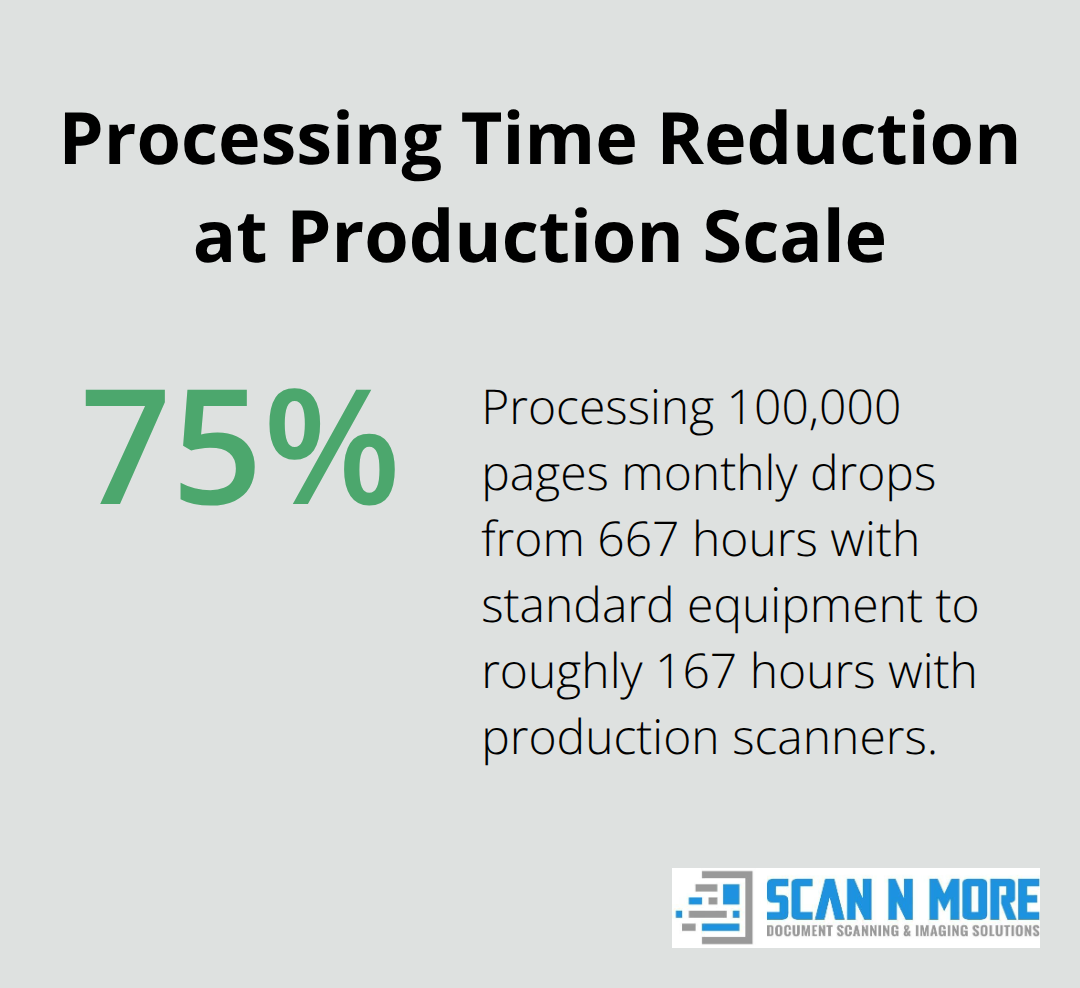
Real-world benchmarks show that organizations processing 100,000 pages monthly with production scanners complete digitization in roughly 167 hours versus 667 hours with standard equipment-a 75 percent reduction in processing time. That time savings translates to lower labor costs, but the accuracy gains matter more: fewer rescans, fewer manual corrections, fewer compliance risks. The throughput capacity also absorbs seasonal spikes without temporary staffing, which eliminates training overhead and reduces error rates that spike when organizations bring in unfamiliar workers for peak periods.
Integrated Quality Assurance Built Into Capture
Production scanners achieve the speed-accuracy balance through integrated quality assurance built into the capture process. Automated image enhancement using dynamic thresholding preserves small print and subtle marks across mixed document types in a single batch, eliminating the need to separate documents by size or type before scanning-a practice that slows standard workflows and introduces human error. OCR confidence scoring flags uncertain extractions in real time, allowing operators to rescan problematic documents immediately rather than discovering extraction failures during batch processing. Seamless integration with capture software and business systems means scanned images flow directly into downstream workflows with metadata, classification, and indexing already applied, reducing manual touchpoints where errors compound.
Organizations implementing this approach report measurable improvements in first-pass accuracy because the system architecture prevents errors from accumulating across multiple processing stages. The RICOH fi-7700’s integrated flatbed handles exception documents like bound materials without workflow bottlenecks, maintaining speed while accommodating the document types that often cause quality failures on standard equipment. This design eliminates the false choice between speed and completeness-you process mixed-format batches quickly without sacrificing accuracy on difficult documents.
Compliance Requirements Demand Automated Precision
Compliance requirements reinforce this integrated approach. FADGI-compliant scanning solutions for government archives and accessibility requirements demand consistent image quality across thousands of pages, which production scanners deliver through automated quality checks and standardized processing parameters. The alternative-manual quality verification of every page-makes high-volume digitization economically impossible and introduces human inconsistency. Production systems achieve compliance through automation and precision, not manual oversight.
Final Thoughts
High-speed document scanning transforms how organizations handle digitization, delivering measurable results that extend far beyond labor savings. Processing 100,000 pages monthly takes 167 hours instead of 667 hours, which frees your staff for work that actually drives revenue. The accuracy improvements compound across every downstream process because clearer scans require fewer corrections, faster data extraction reduces payment cycles by 3 to 5 days in financial services, and compliance risks drop when documents transition to secure digital systems sooner.
The real transformation happens when speed and quality work as integrated outcomes rather than competing priorities. Production-grade systems catch errors during capture through ultrasonic multi-feed detection and independent roller control, meaning problems surface immediately when they cost the least to fix. OCR confidence scoring flags uncertain extractions in real time, and automated image enhancement preserves detail across mixed document types in a single batch. This architecture prevents errors from accumulating across multiple processing stages, which is how standard office equipment fails under volume.
If your organization still processes documents at standard speeds, the gap between your current state and production-grade performance represents significant untapped efficiency. We at Scan N More help organizations transform paper-based processes into digital solutions with professional document scanning services for all formats, including legal and medical documents. Contact us today to discuss how high-speed document scanning can accelerate your specific workflows and eliminate the backlogs holding your team back.