

Legal firms face a constant tension: clients demand quick turnarounds, yet regulations demand airtight security. Fast legal document scanning doesn’t have to mean cutting corners on protection.
At Scan N More, we’ve built our service around a simple principle: speed and security aren’t opposing forces. They work together when you have the right infrastructure and expertise backing your digitization process.
Why Speed Matters in Legal Document Scanning
Time pressure costs law firms real money
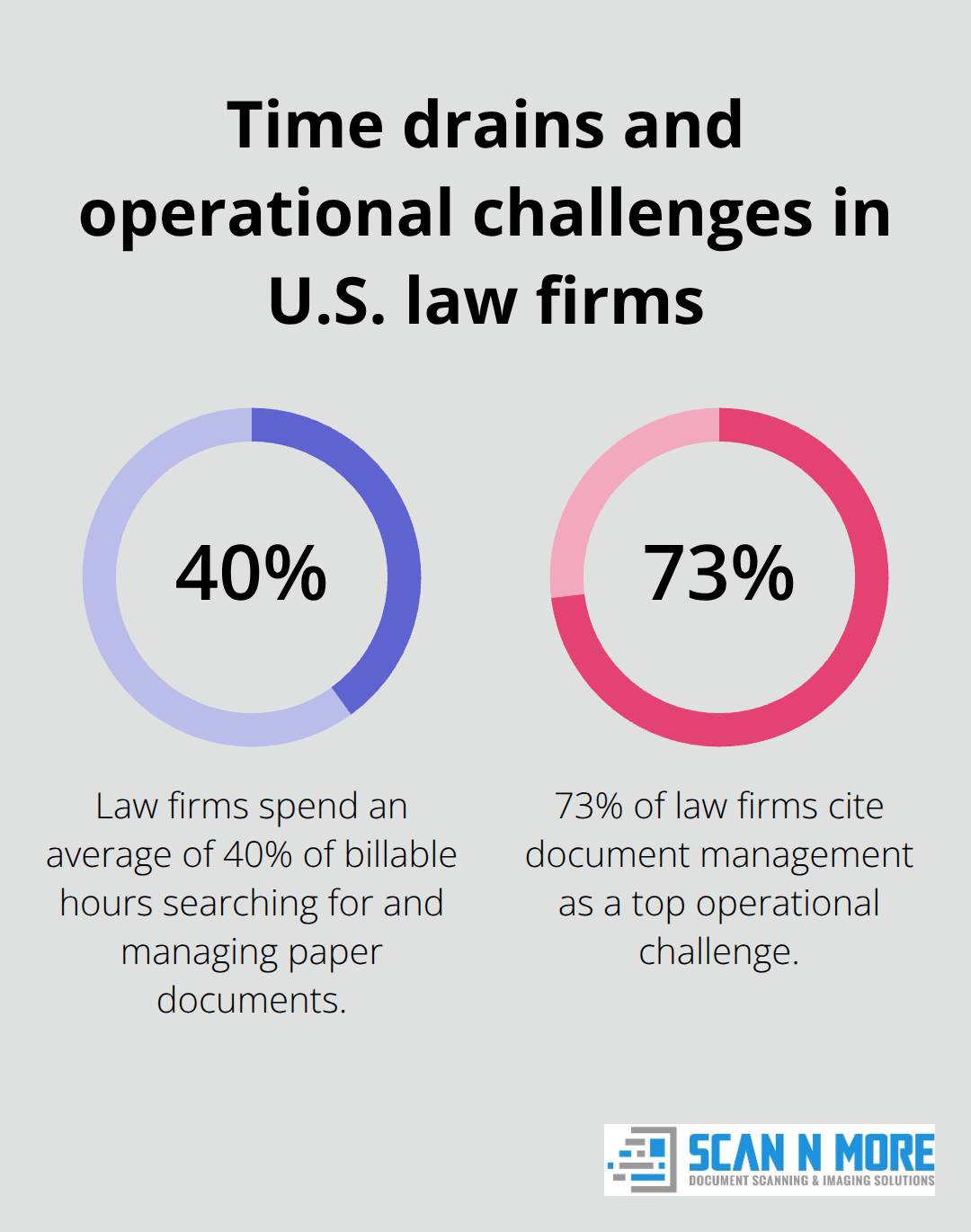
Legal firms lose money every day documents sit in filing cabinets. A 2023 Thomson Reuters survey found that law firms spend an average of 40% of billable hours searching for and managing paper documents instead of serving clients. That’s not just inefficient-it’s money left on the table. When a client needs contract review within 48 hours and your team spends two days locating physical files, you’ve already failed the deadline.
Slow digitization processes don’t just frustrate clients; they directly reduce your firm’s profitability. Every hour spent on manual document handling represents an hour your attorneys can’t bill for strategic work.
Regulatory deadlines demand immediate action
Litigation holds, regulatory investigations, and discovery requests operate on fixed timelines. The Federal Rules of Civil Procedure require parties to produce documents within 30 days after being served, and missing these deadlines can result in sanctions or default judgments. A law firm handling a major litigation case with 50,000 documents needs to digitize, index, and produce those files in weeks, not months. Manual scanning or slow batch processing simply won’t work. According to the American Bar Association, 73% of law firms cite document management as a top operational challenge, largely because they lack the speed to meet regulatory requirements. Fast scanning isn’t a luxury-it’s a baseline requirement for legal practice.
Clients now evaluate firms on operational speed
Clients expect rapid document access and quick case updates. When a general counsel asks your firm for a status report and needs supporting documentation attached within 24 hours, you can’t deliver if your scanning process takes weeks. Corporate clients increasingly evaluate law firms partly on operational efficiency, not just legal expertise. A law firm that can turn around document digitization in days rather than weeks gains a competitive advantage in retaining business. The cost of slow processes extends beyond internal inefficiency-it affects your ability to win and keep clients in an increasingly competitive market.
This operational pressure sets the stage for the real challenge: how to achieve this speed without compromising the security and compliance standards that legal documents demand.
Security Standards That Cannot Be Sacrificed
Legal documents aren’t like other files. They carry attorney-client privilege, contain sensitive client information, and serve as evidence in disputes. The stakes for security failures are existential. A data breach doesn’t just expose information-it can result in malpractice claims, regulatory fines, and loss of client trust. The American Bar Association’s Model Rules of Professional Conduct require lawyers to maintain client confidentiality and take reasonable steps to protect client information. This isn’t optional guidance; it’s a binding ethical obligation. Law firms that cut corners on security during digitization expose themselves to disciplinary action, civil liability, and criminal penalties. When you scan documents fast, you cannot compromise on the infrastructure that keeps those documents protected.
Compliance requirements shape every scanning decision
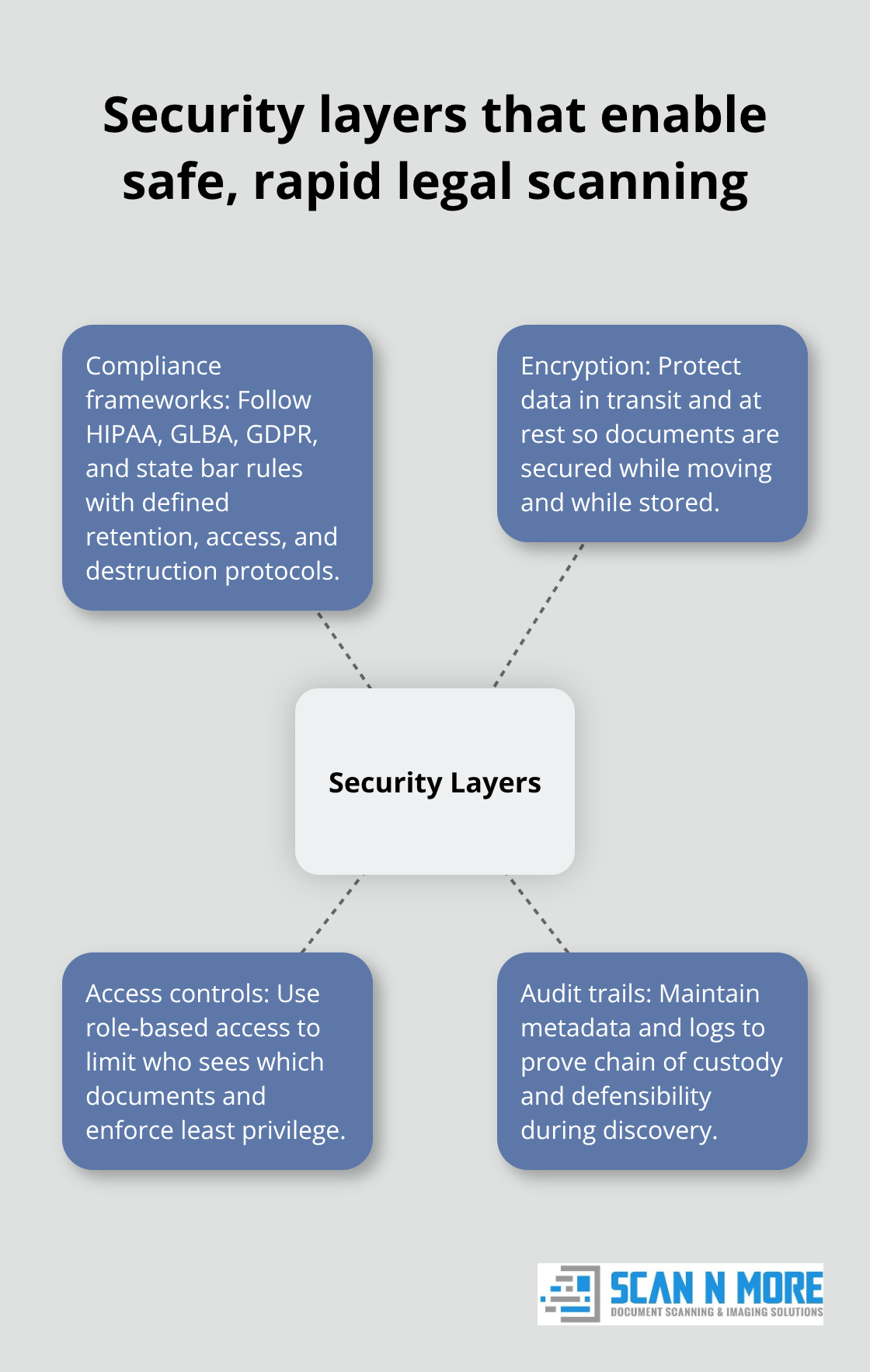
HIPAA applies if your firm handles healthcare-related documents. GLBA governs financial information. State bar associations impose their own data protection standards. The EU’s GDPR affects any firm representing international clients or handling documents with personal data of EU residents. Each regulation mandates specific retention periods, access controls, and destruction protocols. A law firm handling bankruptcy documents must comply with the Bankruptcy Code’s privacy requirements. A firm managing real estate transactions must follow state-specific rules about document retention. The complexity means you cannot use generic document scanning; you need a provider who understands legal-specific compliance requirements and builds those standards into their process from the first scan.
Encryption and access controls must be non-negotiable
Documents in transit and at rest require encryption. This means two separate security layers: data encrypted while moving from your office to storage, and data encrypted while sitting in the system. Access controls determine who can view what documents and when. A junior associate shouldn’t access confidential client strategy files. A client should only access documents relevant to their matter, not your entire client base. Role-based access control systems enforce these restrictions automatically. Audit logs track every access-who opened what file, when they opened it, and what they did with it. If a document is subpoenaed, you need to prove that only authorized people touched that file. Many law firms fail here because they implement encryption but skip the access control layer, leaving documents technically encrypted but accessible to anyone with system login credentials. The two must work together.
Audit trails create accountability and defensibility
When opposing counsel questions whether your firm tampered with documents, audit trail proves you didn’t. Metadata, access logs, and audit trails document how evidence was preserved, handled, accessed, and maintained. This creates an unbreakable chain of custody. Discovery disputes often hinge on whether documents were altered after production. A complete audit trail proves the documents haven’t changed since they were scanned. It also shows which documents were accessed during litigation preparation, which matters for privilege assertions. Some firms avoid audit trails because they worry about visibility into their own workflows. That’s backward thinking. Audit trails protect you by creating evidence of proper handling. They’re your defense against malpractice claims and disciplinary complaints. The firms that resist transparency typically end up in the worst legal trouble because they lack the documentation to prove they did things correctly.
These security layers-compliance frameworks, encryption, access controls, and audit trails-form the foundation that allows law firms to scan documents at speed without exposing themselves to risk. The real question becomes how to implement all of this without slowing down your digitization process.
Professional scanning services solve this problem by building security into their infrastructure from the start, meaning speed and protection operate in parallel rather than in opposition.
How Professional Scanning Services Handle Speed and Scale
Professional scanning services process documents at volumes that would overwhelm internal teams. High-speed scanners can process 200 pages per minute, but that’s only the first step. Documents then move through optical character recognition, quality verification, metadata application, and secure indexing before reaching your system. A professional scanning service has all these systems integrated and running in parallel, not sequentially. This parallel processing creates actual speed. When your firm attempts to digitize documents internally, each stage waits for the previous one to finish.
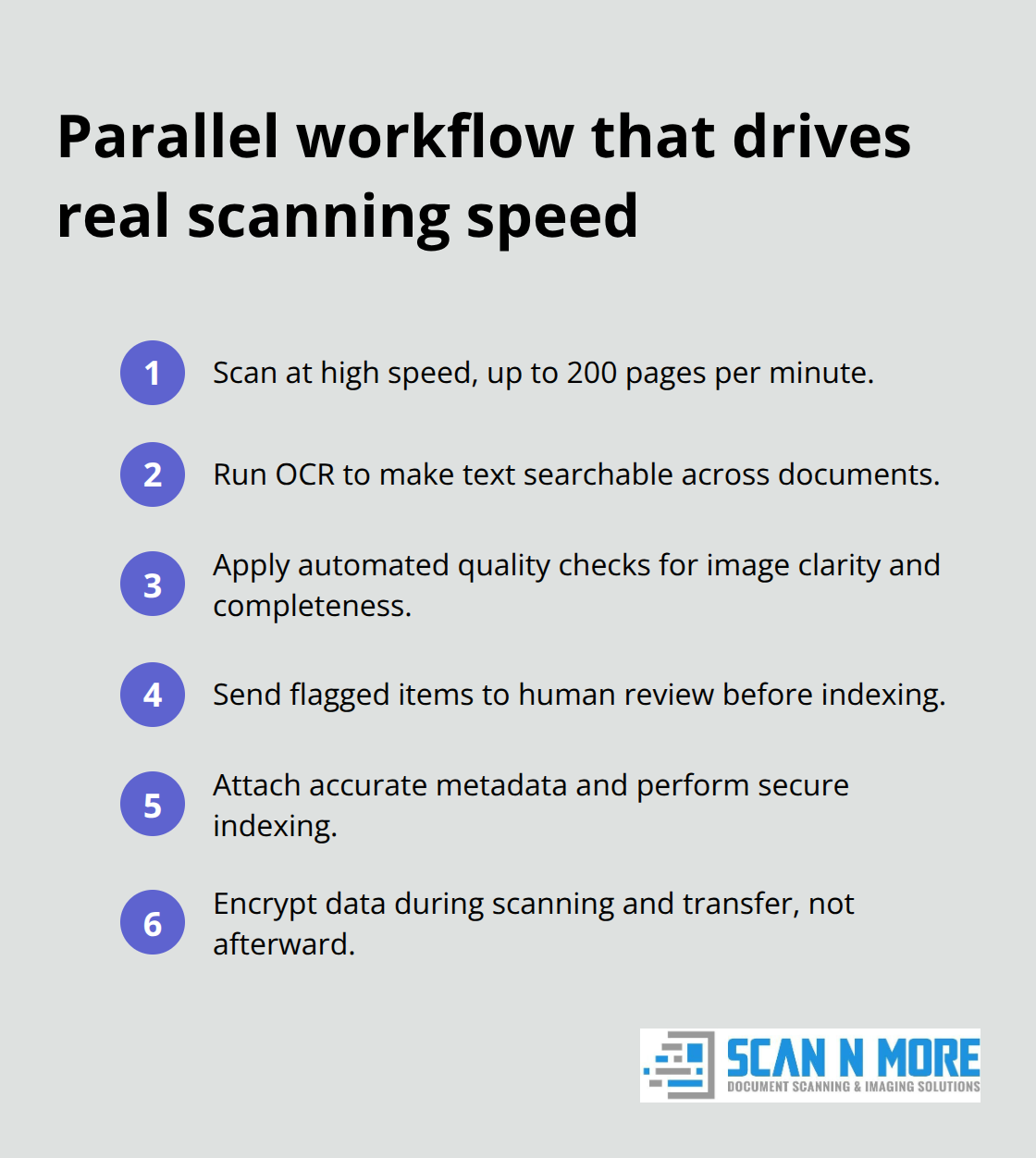
A single quality control issue can halt the entire batch. Professional services have redundancy built in, so one scanner going down doesn’t stop production. Encryption happens during the scanning process, not afterward as an afterthought.
Certifications prove security is engineered into the process
Law firms should demand that their scanning provider holds specific certifications that apply to legal document handling. ISO 27001 certification means the provider has implemented an information security management system and undergoes regular independent audits. SSAE 18 SOC 2 Type II certification verifies that the provider maintains controls over security, availability, and confidentiality over a sustained period, not just at a single point in time. These certifications require documented procedures for everything from how documents are transported to how hard drives are destroyed after scanning. A provider claiming security without these certifications asks you to trust their word instead of third-party verification. Look for providers that publish their audit reports or summaries. The fact that a provider undergoes external audits and passes them repeatedly demonstrates they take security seriously. The provider you select should also maintain compliance with state bar association requirements where you practice, since these vary by jurisdiction.
Quality assurance happens at multiple checkpoints, not at the end
Many scanning operations perform quality checks only after all documents are scanned, which means discovering errors late in the process. Professional services that handle legal documents build quality assurance into the workflow at multiple stages. Documents are scanned, then immediately checked by automated systems for image quality, completeness, and proper orientation. Any documents flagged by automated systems go to human review before they are indexed. This catch-and-correct approach at the front end prevents bad documents from reaching your attorneys. Metadata accuracy matters enormously in legal work. A document misfiled into the wrong matter or missing critical information can cause problems during discovery. Quality assurance verifies that document metadata matches what appears on the page, that page counts are accurate, and that the scanning captured all content clearly. For high-stakes litigation, some firms request spot-checks where random documents are pulled and manually verified against originals. This adds time but provides absolute confidence that nothing was lost or corrupted during digitization. The cost of quality assurance at the scanning stage is far lower than the cost of discovering problems later when documents are already in use.
Infrastructure redundancy keeps production moving
A single point of failure can cripple an internal scanning operation. Professional services maintain multiple scanners, backup systems, and redundant storage to prevent downtime. When one scanner requires maintenance, others continue processing without interruption. This redundancy costs money to build and maintain, which is why most law firms cannot justify it internally. A professional service spreads these infrastructure costs across multiple clients, making redundancy economically feasible. The result is that your documents move through the system continuously, not in fits and starts. Backup power systems, redundant network connections, and failover storage ensure that technical problems don’t delay your digitization timeline. This infrastructure also supports the security architecture-encrypted backups, geographically distributed storage, and automated disaster recovery all require investment that professional services can justify through scale.
Access controls and audit trails operate in real time
Documents require protection not just during scanning but throughout their lifecycle in your system. Role-based access control systems ensure secure and efficient document management by assigning access based on user roles. Audit logs track every access in real time, showing who opened what file, when they opened it, and what they did with it. If a document is subpoenaed, you need to prove that only authorized people touched that file. Many law firms fail here because they implement encryption but skip the access control layer, leaving documents technically encrypted but accessible to anyone with system login credentials. The two must work together. Real-time audit trails also create accountability. When opposing counsel questions whether your firm tampered with documents, audit trails prove you did not. Metadata, access logs, and audit trails document how evidence was preserved, handled, accessed, and maintained. This creates an unbreakable chain of custody that protects your firm during discovery disputes and disciplinary reviews.
Final Thoughts
The tension between speed and security in legal document scanning is false. They’re not competing priorities-they’re interdependent. Fast legal document scanning only works when security is built into the infrastructure from the start, not added afterward. Law firms that try to cut corners on protection to save time end up spending far more on breach remediation, malpractice claims, and regulatory fines.
Choosing the right scanning partner determines whether you get genuine speed with real protection or false economy that creates hidden risks. A professional service provider brings three advantages your internal team cannot replicate: specialized infrastructure designed for legal documents, certifications that prove security standards are met consistently, and the scale to process high volumes without sacrificing quality (they understand compliance requirements across different practice areas and jurisdictions). They maintain redundant systems so technical failures don’t delay your digitization, and they implement access controls and audit trails that protect you during discovery disputes.
We at Scan N More built our service specifically for legal document handling. Our on-site and off-site scanning services process documents at speed while maintaining the security and compliance standards your practice demands. When you’re ready to move from paper-based workflows to digital operations, contact Scan N More to learn how we deliver the speed and security your firm requires.