
Deleting files isn’t enough. Hard drives and storage devices often retain sensitive data even after standard deletion, leaving your business exposed to breaches and compliance violations.
At Scan N More, we know that secure media destruction is the only way to guarantee your data stays protected. This guide covers the methods, mistakes to avoid, and steps to implement proper destruction protocols that actually work.
Why Your Business Can’t Afford to Ignore Data Security
Data breaches cost organizations an average of 4.45 million dollars according to IBM’s 2024 Cost of a Data Breach Report. That figure represents more than just lost money-it includes regulatory fines, notification expenses, and the operational chaos that follows. For most businesses, a single breach exposes customer information, financial records, or proprietary data that should have been destroyed years ago. The problem isn’t that companies lack security awareness; it’s that they fail to treat data destruction with the same urgency they apply to data protection. When devices reach end-of-life, many organizations assume deletion is sufficient. It isn’t. The Federal Trade Commission and industry regulators increasingly penalize companies that cannot prove they’ve permanently destroyed sensitive data, and those penalties have become substantially steeper in recent years.
Regulatory Fines Are Getting Worse
HIPAA violations now carry penalties up to $2,134,831 per violation category as of October 2024. GDPR fines reach 20 million euros or 4 percent of global revenue, whichever is higher. State-level regulations like California’s Consumer Privacy Act add another layer of enforcement. These aren’t theoretical numbers-they’re actual penalties imposed on real companies. A healthcare provider in Massachusetts paid 3 million dollars in 2022 after failing to properly destroy patient records on decommissioned servers. A financial services firm in New York faced 2.5 million dollars in fines when investigators discovered recoverable data on drives supposedly destroyed. Regulators now specifically require certified destruction with documented proof, not just vendor promises. Organizations that cannot produce chain-of-custody documentation for destroyed media face immediate scrutiny during audits.
Reputation Damage Spreads Faster Than You Think
Customers don’t distinguish between data breaches caused by inadequate security and those caused by improper destruction. Both signal the same message: your company doesn’t protect their information seriously. Research from Pew Research Center shows 79 percent of consumers worry about how companies use their data. When a breach occurs, that concern transforms into action-customers switch providers, post negative reviews, and avoid future transactions. A retail company’s 2023 breach involving improperly destroyed customer payment data resulted in a 12 percent customer attrition rate within six months, according to industry reports. The financial impact extended far beyond the immediate incident cost. Employee recruitment and retention also suffer when companies develop reputations for data mishandling. Talented professionals increasingly consider data governance practices before joining organizations.
What Comes Next
The stakes are clear. Regulatory penalties mount, customers abandon companies that fail them, and reputations collapse under the weight of poor data practices. Yet many organizations still treat destruction as an afterthought rather than a core security function. The methods exist to prevent these outcomes-they just require the right approach and the right partner.
How to Actually Destroy Data So It Stays Destroyed
Physical Destruction Methods That Work
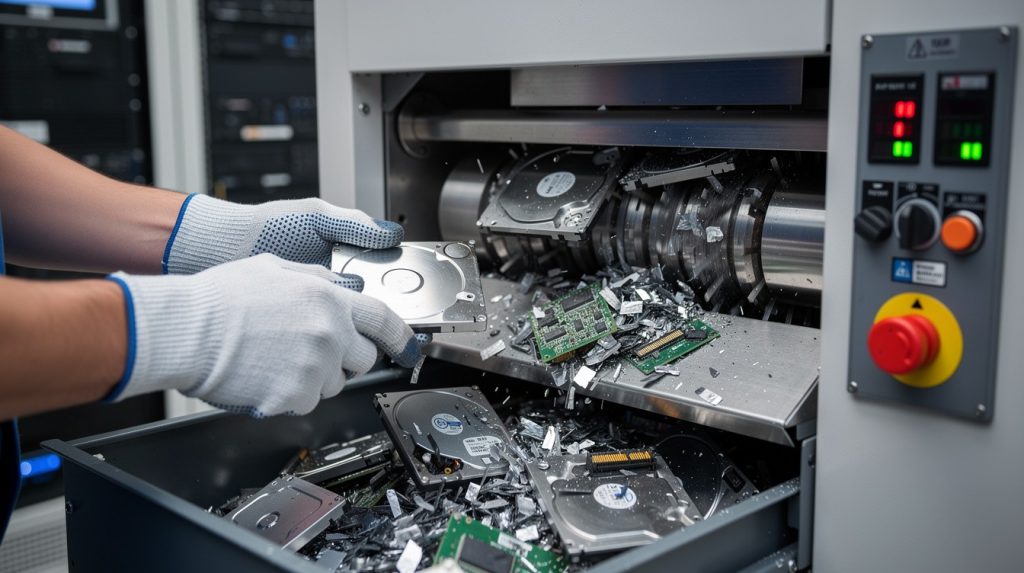
Standard deletion leaves magnetic traces on hard drives that forensic tools can retrieve in seconds. Physical destruction and certified services represent the only methods that guarantee data cannot be recovered. Hard drive destruction requires either degaussing, shredding, or incineration performed by certified providers who document every step.
Degaussing uses powerful magnetic fields to erase data but works only on magnetic media, not solid-state drives. Shredding physically fragments the drive into pieces smaller than 6 millimeters, which is the standard requirement for certified destruction. Incineration reaches temperatures above 1,000 degrees Celsius and leaves no recoverable material whatsoever. The National Institute of Standards and Technology recommends physical destruction as the most reliable method for high-security environments, particularly when handling classified or sensitive personal information.

Why Chain-of-Custody Documentation Matters
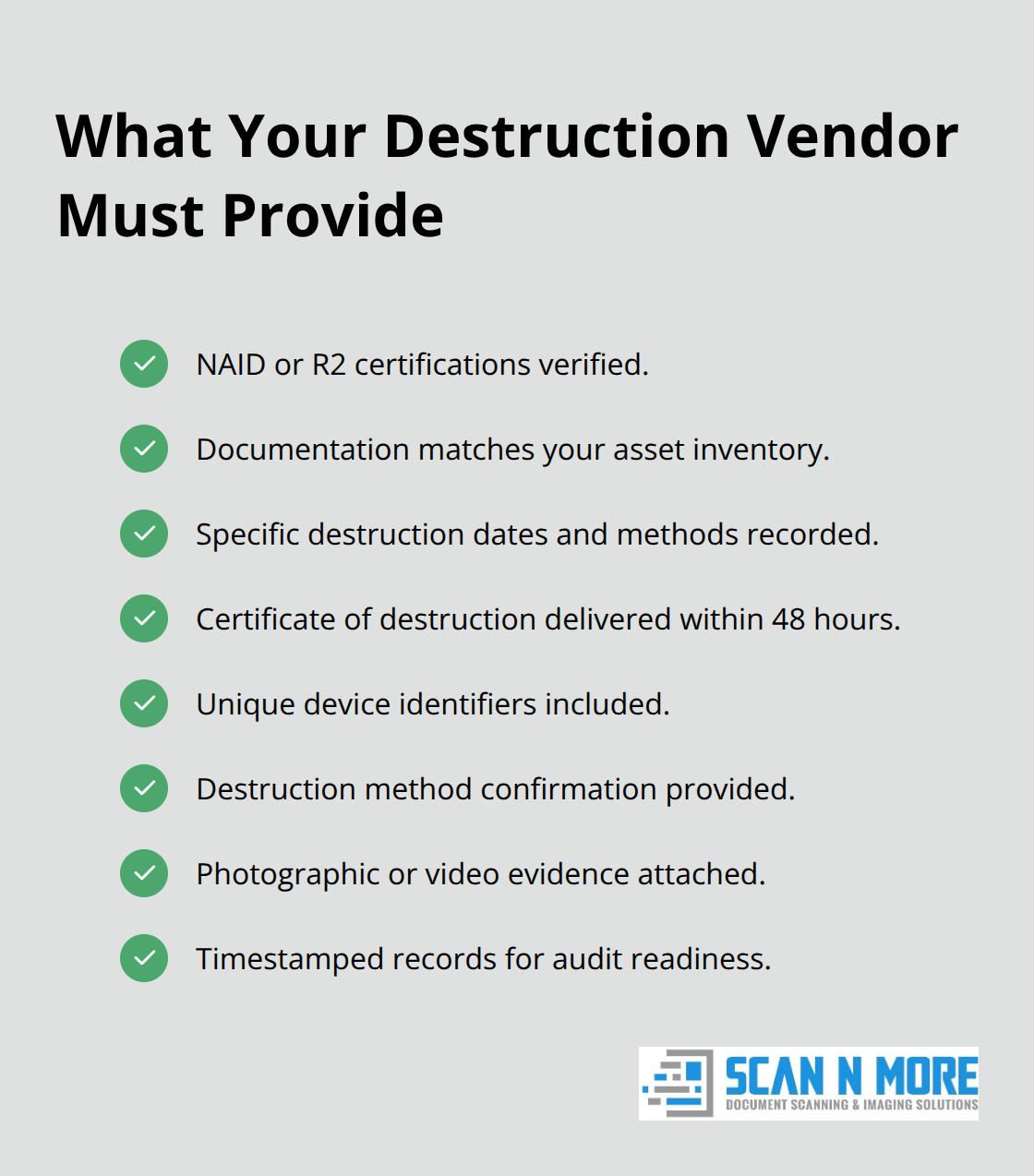
Certified destruction providers must maintain chain-of-custody documentation from pickup through final destruction with photographic or video evidence of the process. This documentation becomes your legal protection during regulatory audits and breach investigations. Regulators immediately flag destruction reports lacking serial numbers or timestamps as insufficient.
When you select a destruction partner, verify they hold certifications from NAID or R2 standards organizations, which require annual third-party audits and strict operational protocols. Demand detailed documentation that matches your asset inventory exactly, with specific destruction dates and methods. A financial services company requires their destruction vendor to provide certificate of destruction within 48 hours of service completion, complete with unique device identifiers and destruction method confirmation. This practice prevents the common mistake of accepting generic certificates that don’t prove your specific devices were actually destroyed.
What Separates Adequate From Inadequate Destruction Services
Many organizations accept destruction reports that lack the specificity regulators demand. Generic certificates without device identifiers create liability rather than protection. Destruction partners who cannot provide timestamped photographic evidence or video documentation of the actual destruction process should raise immediate red flags.
The difference between adequate and inadequate destruction comes down to verification. You need proof that your specific devices underwent destruction on specific dates using documented methods. Secure destruction requires the same rigor you apply to data collection and storage. Organizations that treat destruction as a checkbox exercise rather than a critical security function discover during audits that their supposedly destroyed media still contains recoverable information.
Common Mistakes in Media Destruction
The Documentation Gap That Regulators Exploit
Most companies fail at data destruction not because the technology lacks effectiveness, but because they underestimate what regulators actually demand. The gap between what organizations think constitutes proper destruction and what auditors require has widened considerably. A 2023 survey of IT managers found that 64 percent of companies believed their standard deletion procedures met regulatory requirements, yet when audited, only 18 percent could produce documentation proving devices were actually destroyed. This disconnect creates massive liability.

Organizations often select destruction partners based solely on cost, skipping the verification step that transforms a service into legal protection. When auditors later request proof of destruction, generic certificates without serial numbers, timestamps, or destruction methodology descriptions fail immediately. The company then faces the nightmare scenario of admitting they cannot prove sensitive data was actually destroyed, which regulators treat as evidence the data still exists somewhere. Businesses scramble to locate destruction documentation years after the fact, discovering their vendors never maintained proper records. The real cost emerges during compliance reviews when companies learn their supposedly destroyed drives contained customer payment information, employee records, or proprietary materials that should have vanished permanently.
Selecting Vendors Without Proper Certifications
The second critical mistake involves selecting vendors who lack proper certifications or auditable processes. NAID and R2 certified destruction providers undergo annual third-party audits and maintain chain-of-custody protocols that create an unbreakable audit trail. Uncertified vendors operating from unmarked facilities with no photographic evidence of destruction represent pure risk.
A healthcare organization in Texas selected a local destruction company offering rates 40 percent below certified alternatives, only to discover during a HIPAA audit that the vendor had simply stored drives in a warehouse for months before allegedly destroying them without documentation. The organization faced regulatory penalties. Certified destruction providers photograph or video every device before and after destruction, maintain serial number matching to your asset inventory, and issue timestamped certificates within specified timeframes. These requirements exist because regulators have encountered too many situations where companies claimed destruction without verification.
Understanding the True Cost of Cheap Destruction Services
The cost difference between certified and uncertified services typically ranges from 15 to 30 percent, yet that premium becomes negligible against potential regulatory fines that start at hundreds of thousands of dollars. Organizations that view destruction as a commodity purchase rather than a compliance necessity consistently face the worst outcomes during audits. Certified providers maintain documentation standards that protect your organization during regulatory reviews, while uncertified vendors offer no such protection. The investment in proper destruction services pays for itself many times over when you avoid the penalties, notification costs, and reputational damage that follow inadequate destruction practices.
Final Thoughts
Secure media destruction now forms a non-negotiable part of your data security strategy. Regulatory audits become straightforward when you possess documented proof of destruction, breach response becomes simpler because older data no longer exists, and customer confidence increases when you demonstrate that their information was permanently eliminated. The financial impact extends far beyond avoided penalties into operational efficiency and reduced liability exposure.
Start today by reviewing your current destruction practices and identifying where improvements are needed. Audit your operations against NAID or R2 standards to find gaps in your chain-of-custody documentation, then select a certified destruction partner who provides timestamped photographic or video evidence matched to your asset inventory with specific device serial numbers. We at Scan N More understand that secure media destruction forms part of a comprehensive data security strategy, and our professional document scanning services help you transition from paper-based processes while maintaining strict data security and compliance standards.
The investment in certified destruction services protects your organization far more effectively than cutting corners ever could. Whether you’re destroying old media or digitizing current documents, the principle remains the same: control your data throughout its entire lifecycle.