

Healthcare providers still manage millions of patient files in paper format, despite decades of digital innovation. The transition to medical record imaging has become unavoidable as regulations tighten and security threats grow.
At Scan N More, we’ve helped countless medical practices convert their paper-based systems into secure digital archives. This guide walks you through why the shift matters and how to do it right.
Why Healthcare Still Clings to Paper Records
Paper medical records persist in healthcare facilities across the United States for reasons that go far beyond outdated thinking. According to a 2023 survey by the American Medical Association, approximately 40% of small and mid-sized medical practices still maintain paper-based or hybrid filing systems. The reality is that regulatory frameworks, aging infrastructure, and legitimate security concerns create genuine barriers to full digitization.

Regulatory Confusion Slows the Transition
HIPAA compliance requirements established in 1996, were written with paper records in mind, and many healthcare providers interpret these regulations as requiring physical documentation alongside digital systems. This dual-system approach feels safer to practitioners who’ve worked with paper for decades, even though it actually increases compliance risks. Legacy Electronic Health Record systems at many hospitals cannot easily integrate with modern scanning technology, forcing administrators to choose between expensive system overhauls or continuing paper workflows. The cost of replacing integrated systems can reach millions of dollars, which explains why some facilities maintain parallel paper and digital records indefinitely.
The Compliance Paradox
Healthcare providers often believe that keeping paper records provides additional legal protection under HIPAA, but this assumption is backwards. The regulations require secure storage, controlled access, and audit trails-standards that paper records actually struggle to meet. Physical files stored in filing cabinets offer no automated way to track who accessed patient information, no encryption, and no version control. Yet many healthcare administrators continue paper systems because they fear that moving entirely to digital creates new vulnerabilities.
This hesitation reflects a real problem: data breaches increased 73% between 2020 and 2021 in terms of affected individuals. When a facility experiences a breach, paper records feel tangible and controllable in ways that digital systems do not, even though statistics prove the opposite. The transition requires confidence in specific security protocols, certified partners, and documented compliance measures that many smaller practices lack the expertise to evaluate independently.
Moving Forward with Confidence
Healthcare providers who want to abandon paper systems need more than good intentions. They need partners who understand both the technical requirements and the regulatory landscape that governs medical records. The right scanning solution addresses these concerns head-on, transforming paper files into protected digital archives that actually meet HIPAA standards more effectively than physical storage ever could.
What Changes When You Go Digital
Speed Transforms Patient Care
Digitized patient files reduce retrieval time from hours to seconds, which directly impacts patient care quality and staff productivity. This translates to fewer delays in patient appointments, faster treatment decisions, and staff members spending actual time on clinical work instead of file hunting. When a patient calls with a medication question, your team no longer searches through physical folders. The record appears on screen instantly, allowing providers to answer questions and address concerns in real time rather than scheduling callbacks.
Compliance Becomes Automatic
Document scanning solves the compliance problem that paper records create. Digital files with proper access controls, encryption, and audit trails actually meet HIPAA requirements more effectively than physical storage ever could. Every access to a patient record gets logged automatically with timestamp, user ID, and action taken, creating the accountability framework that HIPAA demands. Paper systems cannot provide this level of documentation without manual effort, which means most paper-based practices operate in a compliance gray zone without realizing it.

Security Protocols Protect Patient Privacy
Version control ensures that no patient information gets accidentally overwritten or lost. Encrypted storage protects data whether it sits on servers or in transit. The cost of implementing these protections through professional scanning is substantially lower than the financial and reputational damage from a data breach or compliance violation. Healthcare providers who digitize their records stop juggling two incompatible systems and start operating under a single, auditable process that satisfies regulatory requirements and actually protects patient privacy more reliably than filing cabinets ever could.
Making the Transition Work
Professional document scanning services handle the technical complexity that many healthcare facilities lack the expertise to manage independently. These partners understand both the technical requirements and the regulatory landscape that governs medical records. They transform paper files into protected digital archives with security protocols built into the workflow from day one. The right scanning solution addresses compliance concerns head-on, giving healthcare administrators the confidence to abandon paper systems completely.
Healthcare providers who want to move forward need to understand not just why digitization matters, but how to select the right partner and implement proper security measures. The next section covers the specific practices that separate successful digital transformations from incomplete ones.
How to Choose a Scanning Partner That Actually Protects Your Records
Selecting a document scanning partner ranks as one of the most consequential decisions a healthcare facility makes during digitization. The wrong choice exposes patient data to unnecessary risk, while the right partner transforms your operation into a compliant, efficient digital system.
Verify Certifications and Security Standards
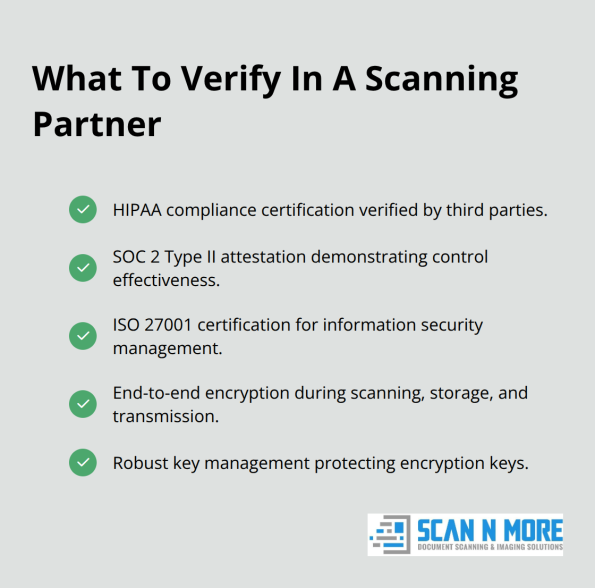
Start by verifying that potential partners hold specific certifications rather than generic quality claims. Look for HIPAA compliance certification, SOC 2 Type II attestation, and ISO 27001 standards, which demonstrate that third-party auditors have verified their security practices. Many scanning companies advertise security without these formal certifications, which means their claims lack independent verification.
Beyond certifications, ask potential partners about their specific protocols for handling sensitive medical documents. Request details on encryption methods they use during scanning, storage, and data transmission. Ask whether they employ end-to-end encryption and what key management systems protect your files. Vague answers about security indicate that the company hasn’t invested in robust protocols.
Confirm Secure Handling Procedures
Healthcare facilities should verify that the scanning partner maintains separate, secure facilities for handling medical records rather than processing all document types in the same environment. Ask about their hard drive destruction procedures and whether they provide certificates of destruction for all devices that touched your patient data. These specifics matter because HIPAA requires documented proof that data has been permanently eliminated when no longer needed.
Demand Proper Access Controls and Audit Trails
Implementation of access controls separates mediocre scanning services from partners who understand healthcare operations. Your digitized records must restrict access to authorized personnel only, with role-based permissions that prevent administrative staff from viewing clinical notes and clinical staff from accessing billing information.
Demand that your scanning partner provides detailed audit trail reports showing exactly who accessed which records and when. These reports should include timestamps, user identities, and specific actions taken, formatted in a way that your compliance officer can review without technical expertise. The scanning partner should also integrate these access controls with your existing Electronic Health Record system rather than creating a separate, disconnected archive that staff must toggle between. Integration reduces errors and ensures that your entire operation functions under a single security framework.
Plan a Phased Implementation Approach
During implementation, insist on a phased approach rather than converting your entire paper archive simultaneously. Start with a pilot program involving one department or a limited patient population, which allows your team to identify workflow problems before they affect your entire operation. This staged rollout also provides time to train staff on the new digital system and adjust access controls based on real-world usage patterns.
Healthcare facilities that rush digitization often discover that their security protocols don’t match actual clinical workflows, forcing expensive modifications after implementation. A phased approach costs more upfront but prevents costly mistakes and ensures that your digitized records work for your staff rather than creating new frustrations.
Establish Clear Contractual Protections
Finally, establish a contract that specifies response times for technical issues and includes penalties if the scanning partner fails to meet agreed-upon security standards. Healthcare operations cannot tolerate extended downtime when patient records become inaccessible, so your agreement should guarantee rapid resolution of access problems.
The contract should also clarify data ownership and specify that your facility retains all rights to digitized records, with clear procedures for retrieving your data if the relationship ends. These contractual details protect your investment and ensure that the scanning partner prioritizes your facility’s needs rather than treating you as interchangeable with other clients.
Final Thoughts
The transition from paper to digital medical records represents a fundamental shift in how healthcare providers protect patient information and operate efficiently. Medical record imaging eliminates the compliance risks that paper systems create while simultaneously improving the speed at which your team accesses critical patient data. Digitized records provide the audit trails, encryption, and access controls that HIPAA actually requires, transforming compliance from a source of anxiety into a documented, automated process.
Healthcare providers ready to move forward should start by assessing their current paper volume and identifying which departments would benefit most from immediate digitization. A pilot program allows your staff to adapt to new workflows while your compliance officer verifies that security protocols match your facility’s specific needs. Document everything during this phase, including staff feedback and any workflow adjustments, so that full implementation proceeds smoothly.
Your scanning partner handles the technical complexity that most healthcare facilities lack the expertise to manage independently, from secure document handling to encrypted storage and proper data destruction. They understand the regulatory landscape and implement security measures that protect your operation from day one. Scan N More transforms paper-based processes into digital solutions with on-site and off-site scanning that maintains the exceptional quality that healthcare records demand.