
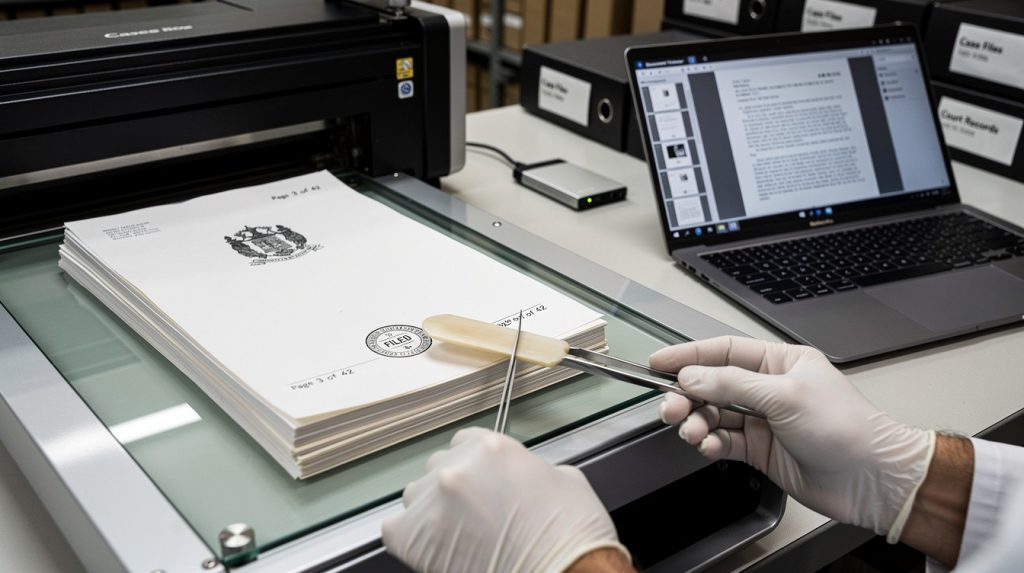
Courts demand digitized records that meet strict filing standards and security requirements. At Scan N More, we’ve helped legal teams transform paper archives into court-ready systems that cut retrieval time and storage costs.
Legal records digitization isn’t optional anymore-it’s how modern practices stay compliant and efficient. This guide covers the scanning standards, security measures, and organizational systems you need to implement.
Why Courts Need Digital Records Now
Courts across the United States face mounting pressure to digitize case files, and compliance isn’t the only driver. The Superior Court of California digitized 22.6 million pages and eliminated 9,600 square feet of storage space, saving $85,500 annually in lease costs alone. That’s the financial reality courts can’t ignore. Federal policy reinforces this urgency. OMB M-19-21 mandates the transition to electronic records across federal agencies, with deadlines extended to June 30, 2024.
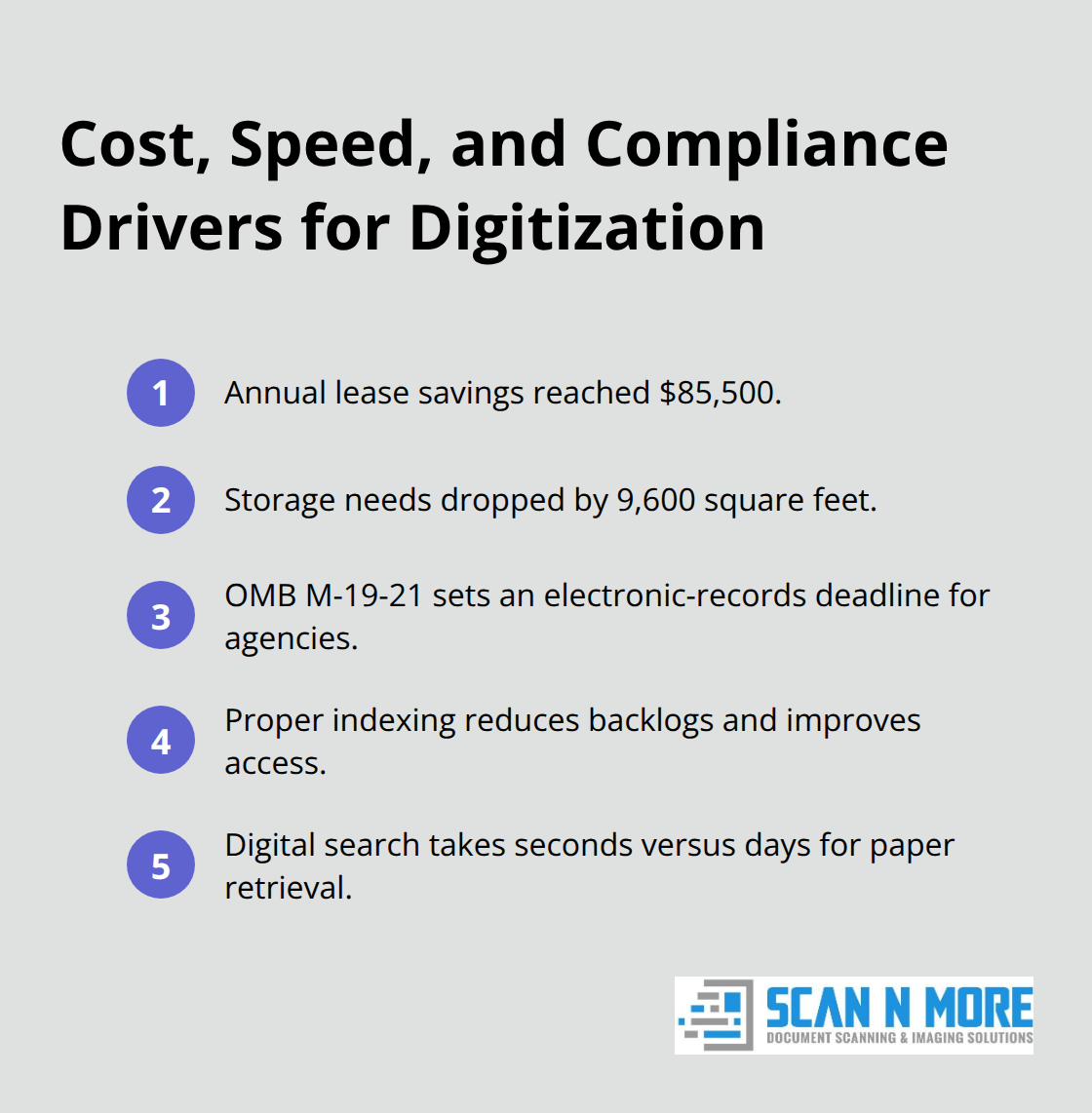
Courts must meet these standards or face penalties and operational gridlock. When records remain paper-based, retrieval times stretch from days to weeks. A digitized system with proper indexing directly reduces case backlogs and improves public access. Courts that implement metadata-enriched digital assets support staffing decisions and resource allocation. This isn’t theoretical-it’s operational necessity.
Storage Costs Drive Immediate Action
Physical storage of legal records consumes real budget dollars. Courts maintaining millions of paper case files rent warehouse space, manage microfilm equipment degradation, and employ staff to locate files manually. Digitization eliminates these expenses. The California example shows courts can recover their investment within months. Once scanned and indexed properly, records occupy cloud storage at a fraction of the cost of physical facilities. Sealed and confidential records remain protected through role-based access controls and secure chain-of-custody protocols in digital systems, eliminating the need for separate physical vaults. Courts that delay digitization continue bleeding money on outdated infrastructure.
Retrieval Speed Transforms Case Management
A court clerk searching a paper archive might spend an hour locating a single file. The same search in a digitized system with full-text OCR takes seconds. This speed advantage compounds across thousands of daily queries. Case backlogs shrink when staff spend less time hunting for documents and more time processing cases. Public inquiries, subpoena requests, and media access all accelerate when records become searchable and accessible from any location. Courts implementing onsite scanning achieve real-time e-file readiness, meaning cases transition to digital workflows immediately after digitization rather than sitting in transition limbo.
Metadata Enrichment Powers Strategic Decisions
Digital records unlock operational insights that paper systems cannot provide. Courts that tag records with metadata (case type, filing date, judge assignment, resolution status) can generate dashboards showing case flow patterns, bottleneck areas, and staffing needs. Administrators can identify which case categories experience the longest delays and allocate resources accordingly. This data-driven approach transforms records from static files into strategic assets that inform budget decisions and policy changes. Courts without this visibility operate reactively, responding to crises rather than preventing them.
The next step involves understanding how to capture and organize records so they meet court standards from day one.
How to Capture Legal Records That Courts Will Accept
Resolution Standards That Courts Demand
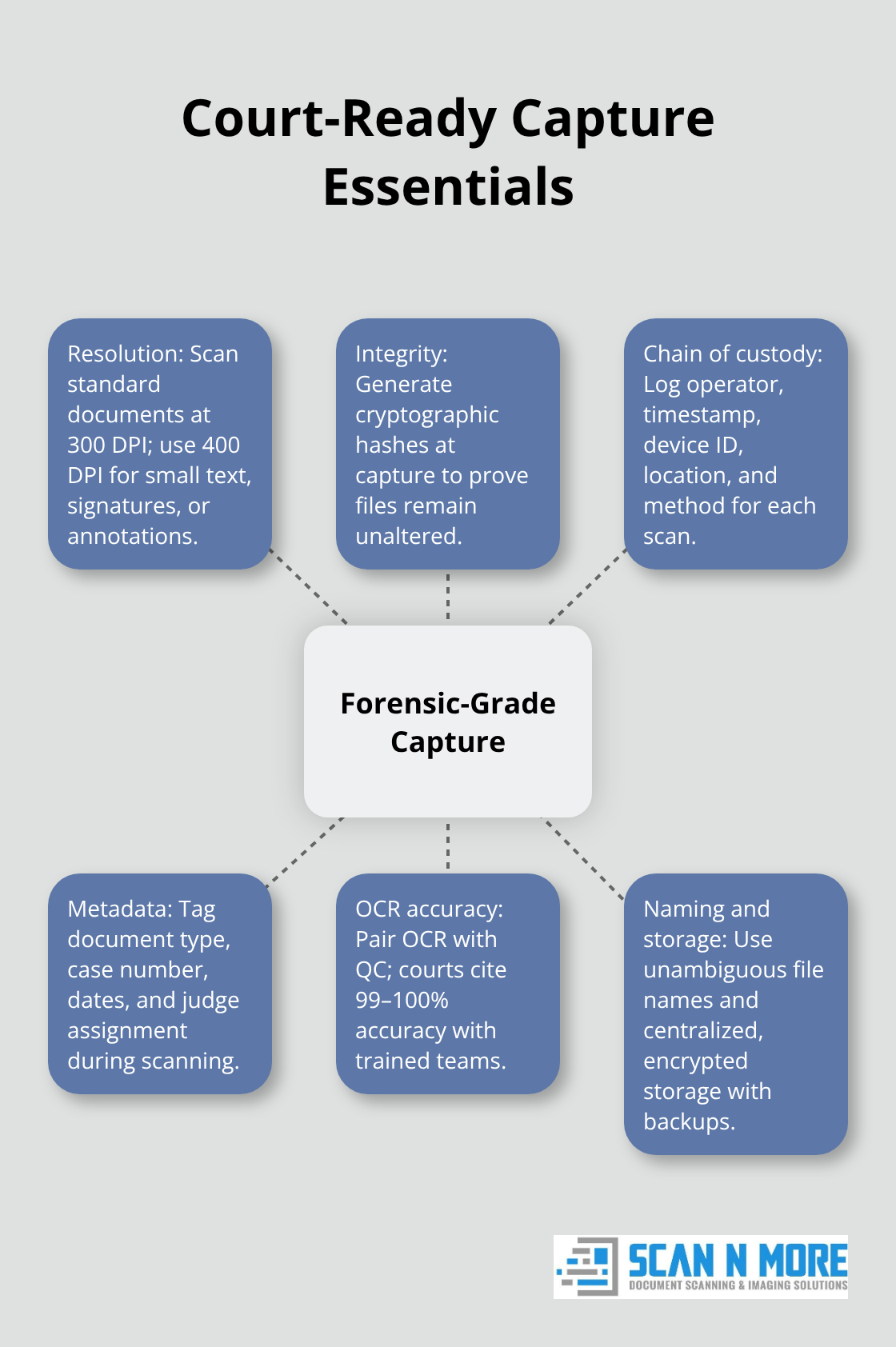
Scanning legal documents for court admissibility requires precision at every step. Courts expect minimum 300 DPI (dots per inch) for standard documents, but 400 DPI becomes necessary when records contain small text, signatures, or handwritten annotations that may face scrutiny during litigation. The Superior Court of California digitized 22.6 million pages using forensic-grade capture methods that sealed content and metadata at the moment of scanning, generating cryptographic hashes to verify file integrity from capture through courtroom presentation. This approach prevents tampering claims and strengthens legal standing. Courts reject blurry or degraded scans that require interpretation.
Building an Immutable Chain of Custody
ISO/IEC 27037, the international standard for digital evidence handling, defines four critical phases: identification, collection, acquisition with bit-for-bit copying and hash verification, and preservation. Your scanning workflow must document every step. When a document enters the scanner, record the operator’s name, timestamp, device ID, location, and scanning method. This creates an immutable chain of custody that survives legal challenge. Sealed records and confidential files demand role-based access controls throughout digitization, meaning only authorized personnel can handle sensitive case materials. Courts verify this through audit logs that show exactly who accessed what and when. Screenshots carry high legal risk unless captured with forensic-grade tools and sealed with timestamps and cryptographic hashes. If your workflow relies on screenshots, stop immediately and switch to certified capture methods.
Metadata Tagging During Capture, Not After
Organization determines whether courts can actually use your digital records. Metadata tagging must happen during scanning, not after. Assign document type (complaint, motion, deposition, exhibit), case number, filing date, and judge assignment while documents move through the scanner. Full-text OCR converts scanned images into searchable text, but quality varies dramatically. Courts in California processed 72 million juvenile case file images with document-level classification and backend quality control delivering 99–100% accuracy. That level of precision requires trained indexing teams, not automated systems alone.
File Naming and Storage Architecture
Develop a naming convention that eliminates ambiguity: use case number plus document type plus date rather than generic labels like file001.pdf. Store all files in a centralized location with encryption, multi-level access controls, and automated backup across geographically separated locations. Courts implementing onsite scanning achieved real-time e-file readiness by digitizing records at the courthouse itself, eliminating the transition period where cases sit between paper and digital systems.
Testing Retrieval Performance Before Launch
Test your retrieval system before going live. Conduct searches for documents by case number, party name, judge, and filing date. If any search takes more than five seconds, your indexing structure needs refinement. Courts cannot tolerate slow response times when handling thousands of daily inquiries and subpoena requests. Once your capture and retrieval systems perform reliably, the next challenge involves protecting those digital records against unauthorized access and ensuring they remain admissible across different legal jurisdictions.
Protecting Digital Records From Unauthorized Access and Tampering
Digital legal records require encryption that survives legal scrutiny. Courts accept 256-bit encryption as the standard for protecting sensitive case files, and anything less creates admissibility risk. When files sit in cloud storage or transit between systems, unencrypted data becomes vulnerable to interception and manipulation. The Superior Court of California implemented role-based access controls that restrict which personnel can view sealed records, juvenile files, and confidential materials. This segregation prevents accidental exposure and creates audit logs proving no unauthorized access occurred.
Encryption Standards That Courts Recognize
Courts verify encryption strength during evidence authentication, so weak security directly weakens your legal position. Implement encryption at rest and in transit, then document both methods in your chain-of-custody reports. Courts reviewing your security posture will examine whether you use industry-standard tools and validated encryption algorithms, not proprietary or outdated methods. The Federal Rules of Evidence require you to authenticate your security measures through witness testimony or distinctive technical characteristics. Weak encryption fails this test immediately.
Audit Trails That Withstand Cross-Examination
Every access to a digital legal record must generate an immutable timestamp and log entry showing who accessed what file and when. Courts demand this level of traceability because it proves records remained unaltered between capture and courtroom presentation. HIPAA-regulated documents demand additional scrutiny, requiring you to log not just access but also the business purpose for that access. If a court clerk opens a sealed juvenile record without documented justification, that violation becomes discoverable and damages your credibility.
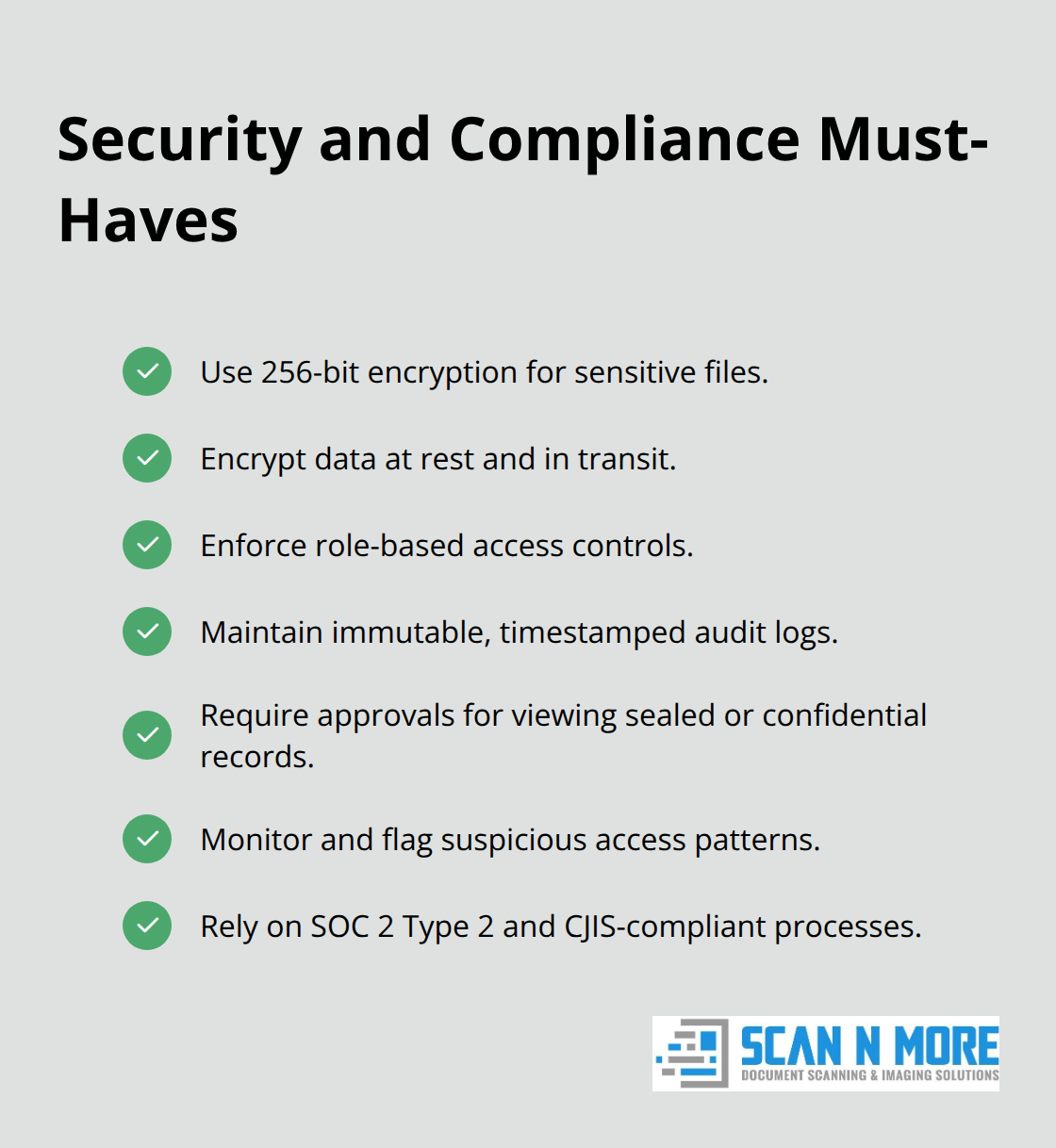
Federal agencies complying with OMB M-19-21 implement multi-level access controls where sensitive records require approval before viewing. Apply the same standard to court files. Your audit system should flag suspicious patterns, such as multiple failed access attempts or after-hours access to confidential materials. Courts treat incomplete or manipulated audit logs as evidence of negligence or intentional concealment. Professional-grade infrastructure (such as SOC 2 Type 2 and CJIS-compliant processes) delivers complete audit trails showing exactly how serious court-ready archiving requires investment in validated systems. Your internal IT team likely cannot match this level of compliance without significant resources.
Meeting Jurisdiction-Specific Standards Without Guesswork
Courts operate under different evidentiary rules depending on location. Federal courts apply Federal Rules of Evidence 901, requiring authentication through witness testimony or distinctive file characteristics. State courts may follow eIDAS standards if handling cross-border cases, which presume integrity when documents carry qualified electronic seals and timestamps. GDPR applies whenever archived records contain personal data of EU residents, imposing strict data minimization and purpose limitation requirements. Violating GDPR during evidence handling can result in exclusion from court and regulatory penalties.
The Budapest Convention governs cross-border digital evidence in many jurisdictions, requiring you to document acquisition methods and validate them against ISO/IEC 27037 standards. Courts reject evidence gathered through non-standard methods, even if the content itself remains unchanged. Conduct a jurisdiction audit for each court you serve, documenting which rules apply and how your security measures align. This audit becomes part of your authentication package presented in court. Do not assume your current scanning process meets these standards without verification.
Final Thoughts
Court-ready digital archives eliminate the operational friction that slows modern legal practices. When records transition from paper to certified digital systems, courts access case files immediately, retrieval times collapse from hours to seconds, and storage costs vanish. The Superior Court of California recovered $85,500 annually in lease savings after digitizing 22.6 million pages, demonstrating that investment in legal records digitization produces measurable returns within months.
Successful implementation requires three non-negotiable elements: capture records using forensic-grade scanning at 300–400 DPI with cryptographic hashing and immutable chain-of-custody documentation that satisfies ISO/IEC 27037 standards; implement 256-bit encryption, role-based access controls, and audit trails that prove no unauthorized access or tampering occurred between capture and courtroom presentation; and tag metadata during scanning rather than after, enabling full-text searchability and the data-driven dashboards that transform records into strategic assets for staffing and resource decisions. Courts across federal and state systems now demand this level of rigor, with OMB M-19-21 mandating electronic records compliance, eIDAS standards governing cross-border cases, and GDPR applying whenever archived files contain personal data.
Organizations attempting legal records digitization internally often underestimate the complexity of validated scanning, forensic-grade capture, and compliance documentation. Professional scanning services eliminate this risk by handling capture, indexing, encryption, and audit trail generation according to court-recognized standards. Scan N More delivers professional document scanning services with on-site and off-site options for legal documents, ensuring data security and compliance while producing the certified digital archives courts demand.