
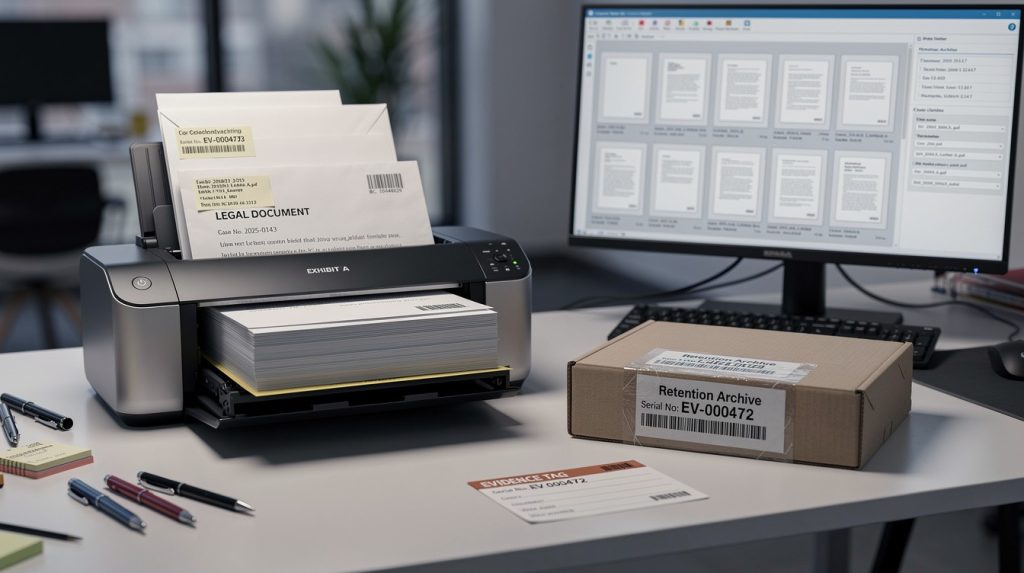
Legal documents are evidence. They prove what happened, when it happened, and who was involved. Yet many law firms still store thousands of pages in filing cabinets, risking loss, damage, or worse-being unable to find critical files when needed.
Legal document retention scanning solves this problem. At Scan N More, we help firms digitize their archives while maintaining the security and compliance standards the legal industry demands. Going paperless isn’t just about saving space-it’s about protecting your practice.
Why Legal Document Retention Matters
Federal Compliance Creates Non-Negotiable Deadlines
Federal law imposes strict retention timelines that firms cannot ignore. The IRS requires tax returns and payroll records for seven years. HIPAA demands healthcare records stay protected indefinitely. OSHA mandates personnel exposure records for 30 years after employment ends. EEOC, FLSA, and FMLA each impose their own timelines. Missing even one deadline exposes your firm to penalties, sanctions, and loss of client trust.
Many firms operate without written retention policies, treating document storage as an afterthought rather than a compliance obligation. This creates massive liability. When litigation arrives, opposing counsel requests documents under Federal Rules of Civil Procedure Rule 34. If you cannot produce them, courts assume the worst and may impose sanctions or default judgments. If you destroy documents after a litigation hold is issued, you face spoliation charges that can destroy your reputation and finances.
Physical Storage Compounds Risk and Waste
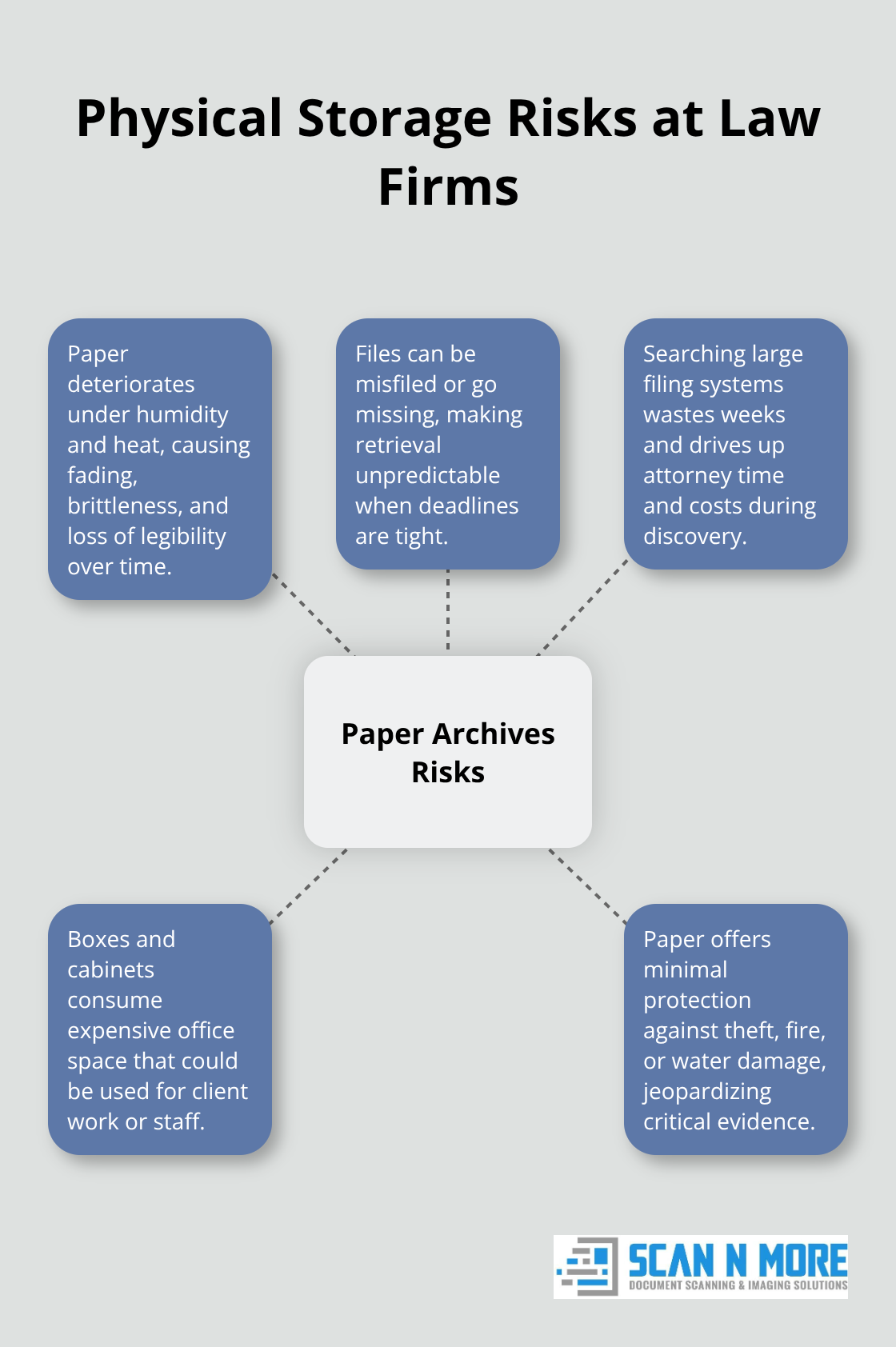
Paper deteriorates in humidity and heat. Files get misfiled or lost entirely. When you need a critical contract or correspondence in discovery, searching thousands of filing cabinets wastes weeks and costs thousands in attorney time. Physical archives consume valuable office space while offering minimal protection against theft, fire, or water damage.
Digital Scanning Eliminates Vulnerabilities
Scanned documents with OCR indexing become searchable in seconds, cutting discovery costs dramatically. Secure cloud storage with encryption and audit trails satisfies HIPAA, GLBA, and ABA guidelines simultaneously. Automated retention policies delete documents on schedule, preventing indefinite storage that invites litigation risk. When you scan with a provider experienced in legal workflows, chain-of-custody documentation protects evidence integrity and defensibility.
Firms that transition to digital retrieval access case files in seconds, collaborate across locations instantly, and respond to discovery demands weeks faster than competitors still buried in paper. This speed advantage compounds over time, transforming how your practice competes in the market.
How to Scan and Archive Legal Documents Effectively
The scanning service you choose determines whether your digitization project succeeds or fails. Most firms treat document scanning as a commodity service, comparing vendors solely on price per page. This approach backfires. Legal scanning demands specific expertise: maintaining chain-of-custody documentation, preserving metadata that proves document authenticity, integrating seamlessly with case management systems, and handling sensitive client information under HIPAA and ABA guidelines. A vendor experienced in legal workflows understands these non-negotiable requirements. When evaluating any scanning partner, verify they employ NAID-certified destruction protocols for original documents after digitization, maintain audit trails showing who scanned what and when, and deliver OCR-enabled searchable PDFs rather than simple image files. The difference matters immensely: searchable PDFs cut discovery time from weeks to hours, while non-searchable scans force manual review that wastes attorney time and increases costs.
Organize Scanned Files for Speed and Compliance
Once scanned, your digital archive lives or dies by its organization scheme. Dumping thousands of PDFs into a folder and hoping OCR search handles the rest guarantees chaos. Instead, establish a metadata tagging system before scanning begins.
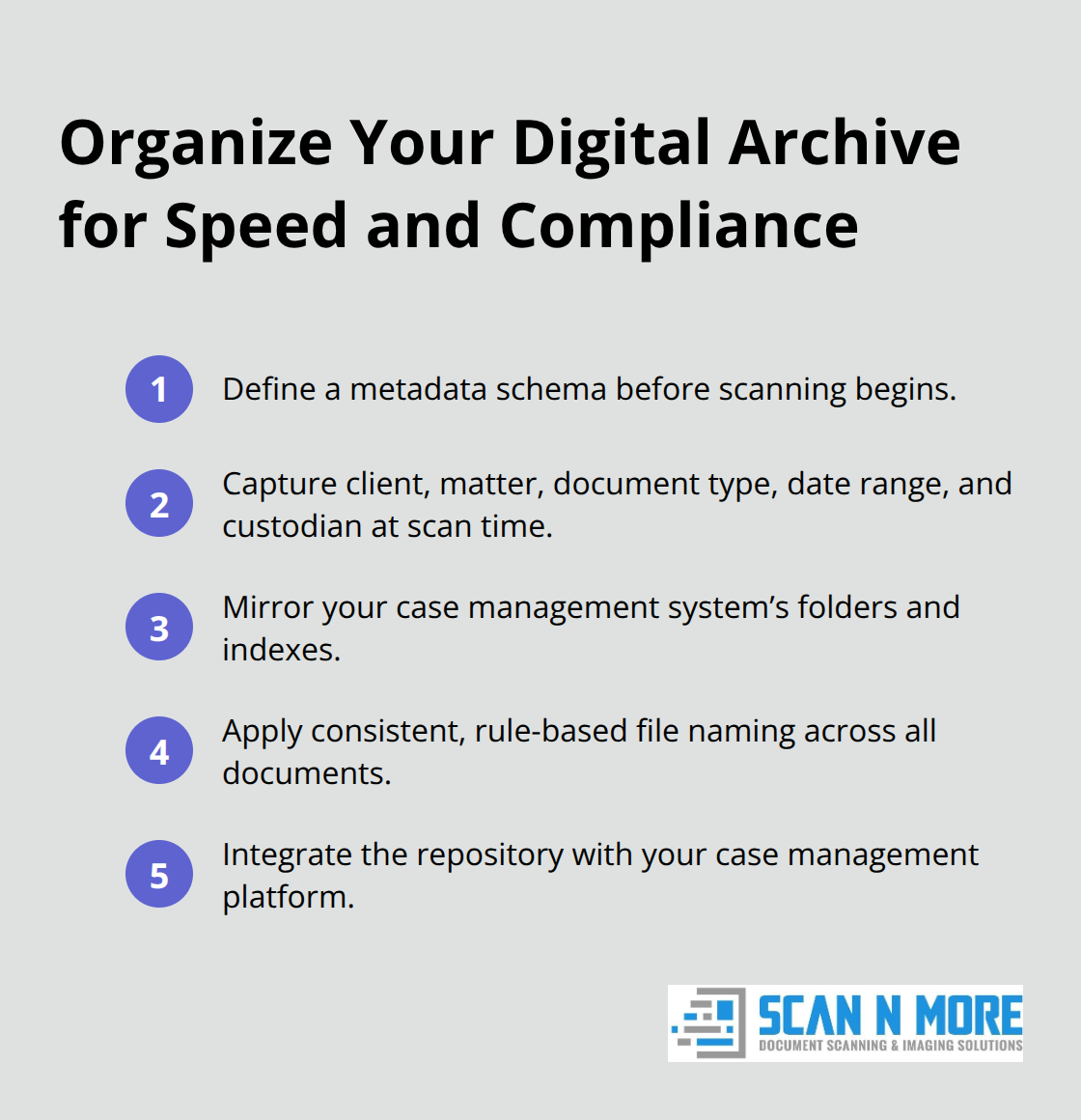
Develop a system to organize your documents by capturing client name, matter number, document type, date range, and custodian information during the scanning process itself, not afterward. This upfront discipline prevents confusion when you need to produce documents under Federal Rule of Civil Procedure Rule 34 and cannot locate them quickly. Implement indexing that mirrors your case management system so scanned documents flow directly into the appropriate matter folder without manual sorting. Use consistent naming conventions across all files (for example, client initials, matter year, document category, and date). This structure allows any attorney in your firm to locate a contract, deposition transcript, or correspondence in seconds rather than minutes. Integrate your scanned repository with your case management platform so attorneys see all evidence in one place, eliminating the need to search multiple systems and reducing version control errors that plague hybrid paper-digital firms.
Encrypt and Back Up to Prevent Catastrophic Loss
Secure cloud storage with military-grade encryption satisfies HIPAA, GLBA, and ABA confidentiality standards simultaneously. Implement multi-factor authentication so only authorized staff access sensitive files. More critically, establish a backup strategy that stores copies in geographically separate locations. A single cloud provider experiencing a data center outage or cyberattack should not threaten your entire practice. The Federal Rules of Civil Procedure require you to produce documents that are ordinarily maintained in their original form, which means your digital archive must survive hardware failures and security breaches without data loss. Maintain audit trails documenting who accessed each document and when. This transparency protects you during litigation by proving you did not alter or suppress evidence. Test your backup recovery process quarterly by actually restoring files from backup rather than simply assuming the system works. Firms that skip this verification step discover during an actual crisis that their backups are corrupted or incomplete, forcing expensive emergency recovery or destroying your credibility with the court.
Transition to Integrated Digital Workflows
Your scanned documents only deliver value when your team actually uses them. Attorneys must access case files instantly from desktops and mobile devices without hunting through multiple systems or returning to physical storage. Cloud-based case management platforms enable this seamless access, allowing remote work and real-time collaboration across office locations. Version control becomes automatic when all team members edit documents in a centralized digital repository, eliminating the confusion of multiple file versions circulating via email. Automated retention policies delete documents on schedule, preventing indefinite storage that invites litigation risk and wastes storage costs. This integration transforms how your practice operates, but it requires staff training and clear workflows that your team understands and follows consistently. The firms that succeed with paperless operations invest in comprehensive training on new tools and establish protocols that make digital-first work the path of least resistance rather than an additional burden.
How to Build Retention Schedules That Actually Work
Map Your Documents Before You Scan
Federal law, state law, industry regulations, and client needs rarely align perfectly. Most firms assemble retention policies from outdated templates or skip them entirely, then panic when litigation arrives. The solution is building a retention schedule before you scan a single document, not after.
Start by mapping what you actually keep. Tax returns, payroll records, and depreciation schedules require keeping records for 3 years from the date you filed your original return or 2 years from the date you paid the tax, whichever is later, under IRS guidelines. Personnel files require three years minimum, but OSHA exposure records demand 30 years after employment ends. Client engagement letters, contracts, and correspondence typically follow state bar rules requiring three to seven years. Legal ownership records like patents and trademarks stay indefinitely.
Most firms discover they’ve stored documents far longer than required, wasting thousands on physical storage while creating litigation risk through excessive retention. Work with your accountant and attorney to establish retention rules that meet compliance for each document category, then build this schedule into your scanning project before digitization begins. When your scanning vendor understands your retention policy upfront, they capture metadata during the scanning process that automates deletion on schedule. This prevents chaos during manual destruction and ensures compliance without constant oversight.
Establish Chain of Custody Documentation
Chain of Custody Documentation separates defensible digital archives from evidence that courts reject. Federal Rules of Civil Procedure Rule 34 requires you to produce documents in the form they are ordinarily maintained, which means your scanned files must prove they haven’t been altered since the original was scanned.
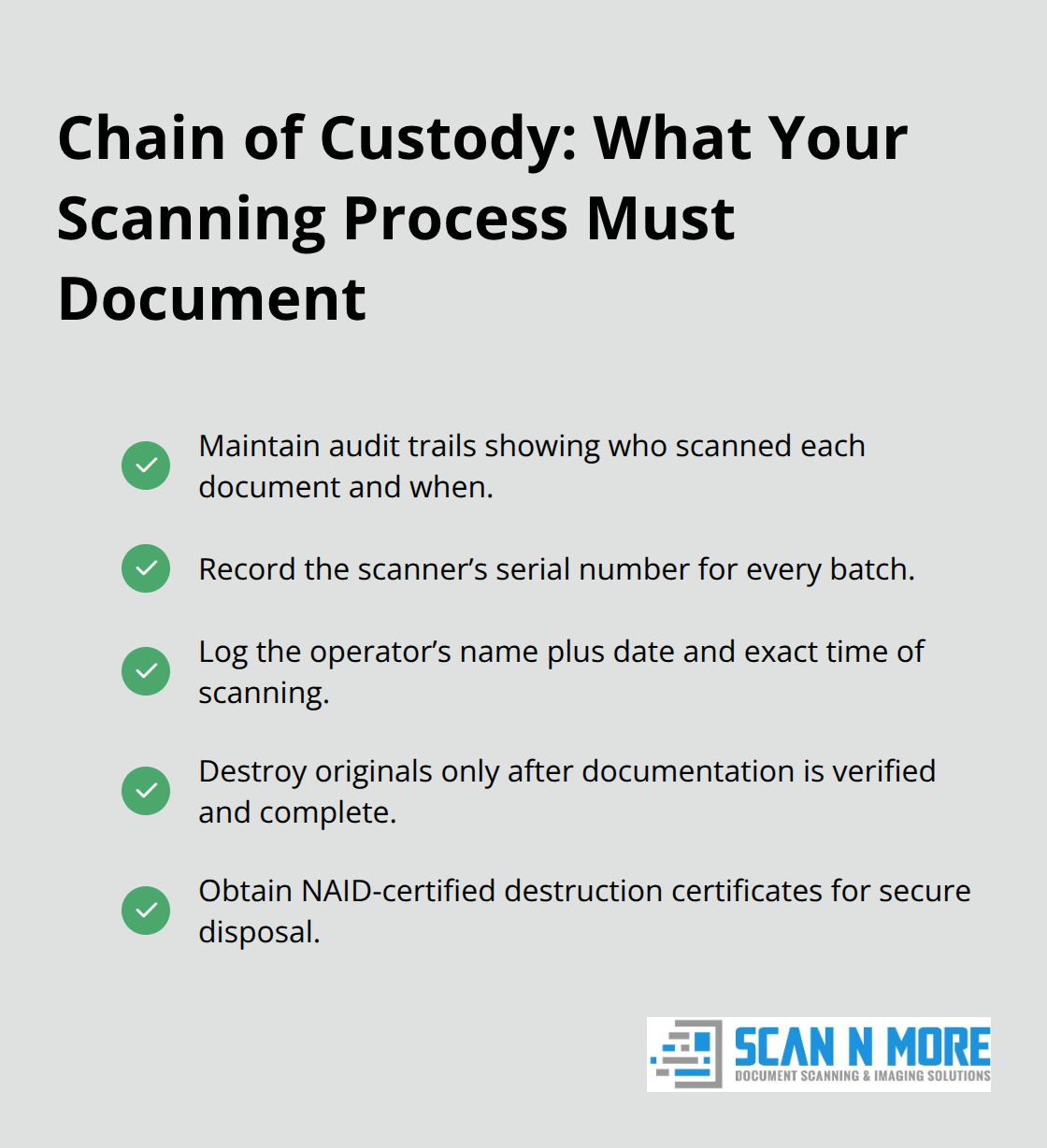
This demands audit trails showing who scanned each document, when it was scanned, and who accessed it afterward. Your scanning vendor must document the serial number of the scanner used, the operator’s name, and the date and time of scanning. Original paper documents should be destroyed only after this documentation is complete and verified. NAID-certified destruction vendors provide certificates proving secure destruction, creating an unbroken chain from paper to digital to disposal.
Train Staff on Retention Workflows
Staff training determines whether your firm actually follows these processes or treats them as bureaucratic theater. Attorneys must understand that accessing a document at 2 a.m. to review a deposition leaves a timestamped audit trail that proves you didn’t fabricate evidence. Paralegals need clear protocols for scanning new documents so metadata is captured consistently. Office managers require training on retention schedules so they don’t accidentally destroy documents still under retention.
Most firms underestimate how much training staff needs, rolling out new systems with a single email and wondering why compliance fails. Dedicate at least four hours to hands-on training, with follow-up sessions quarterly to reinforce processes as staff turnover occurs. Test your workflows monthly by having someone outside the process attempt to locate and retrieve a specific document, then verify the audit trail proves proper handling. This verification catches procedural gaps before litigation exposes them.
Final Thoughts
Legal document retention scanning transforms how law firms operate, but only when you commit to the full transition. Searchable digital archives cut discovery time from weeks to hours, automated retention policies prevent compliance violations that destroy reputations, and audit trails prove evidence integrity when courts demand it. Cloud access enables attorneys to work from anywhere without sacrificing security or confidentiality, while remote work becomes seamless when case files live in secure storage rather than locked filing cabinets.
The shift from paper to digital requires choosing the right scanning partner, establishing retention schedules before digitization starts, and training staff until digital workflows become automatic. Firms that complete this transition reduce physical storage costs by thousands annually, respond to discovery demands weeks faster than competitors, and eliminate the constant anxiety of losing critical documents to fire, water damage, or misfiling. Staff turnover causes less chaos when institutional knowledge lives in organized digital repositories instead of scattered paper files, and litigation holds become manageable because you can identify and preserve relevant documents in hours rather than days.
At Scan N More, we understand that legal document retention scanning demands more than commodity services. We maintain chain-of-custody documentation that courts accept, deliver OCR-enabled searchable PDFs rather than unsearchable images, and integrate seamlessly with your case management systems while handling sensitive client information under HIPAA and ABA guidelines. Start your legal document retention scanning project today and join the firms that have already transformed how they practice law.