
Paper documents lock your team out of information. Employees waste hours hunting through filing cabinets, remote workers can’t access what they need, and people with disabilities face unnecessary barriers.
Enhancing accessibility with document scanning removes these obstacles. At Scan N More, we’ve seen firsthand how digitizing documents transforms workplaces into spaces where everyone can work efficiently, regardless of location or ability.
How Your Team Actually Accesses Documents That Matter
The Accessibility Problem Paper Creates
Paper documents lock your team out of information. Remote employees hit a wall when files live in filing cabinets or storage boxes. Workers with mobility disabilities cannot physically reach documents on high shelves. Teams across departments duplicate effort searching for the same file in different locations. Research from IDC found that knowledge workers spend about 2.5 hours a day searching for information, and one in five documents gets lost or misfiled each year. That’s not a minor inconvenience-it’s a productivity crisis that affects every department.
How Digital Scanning Transforms Access
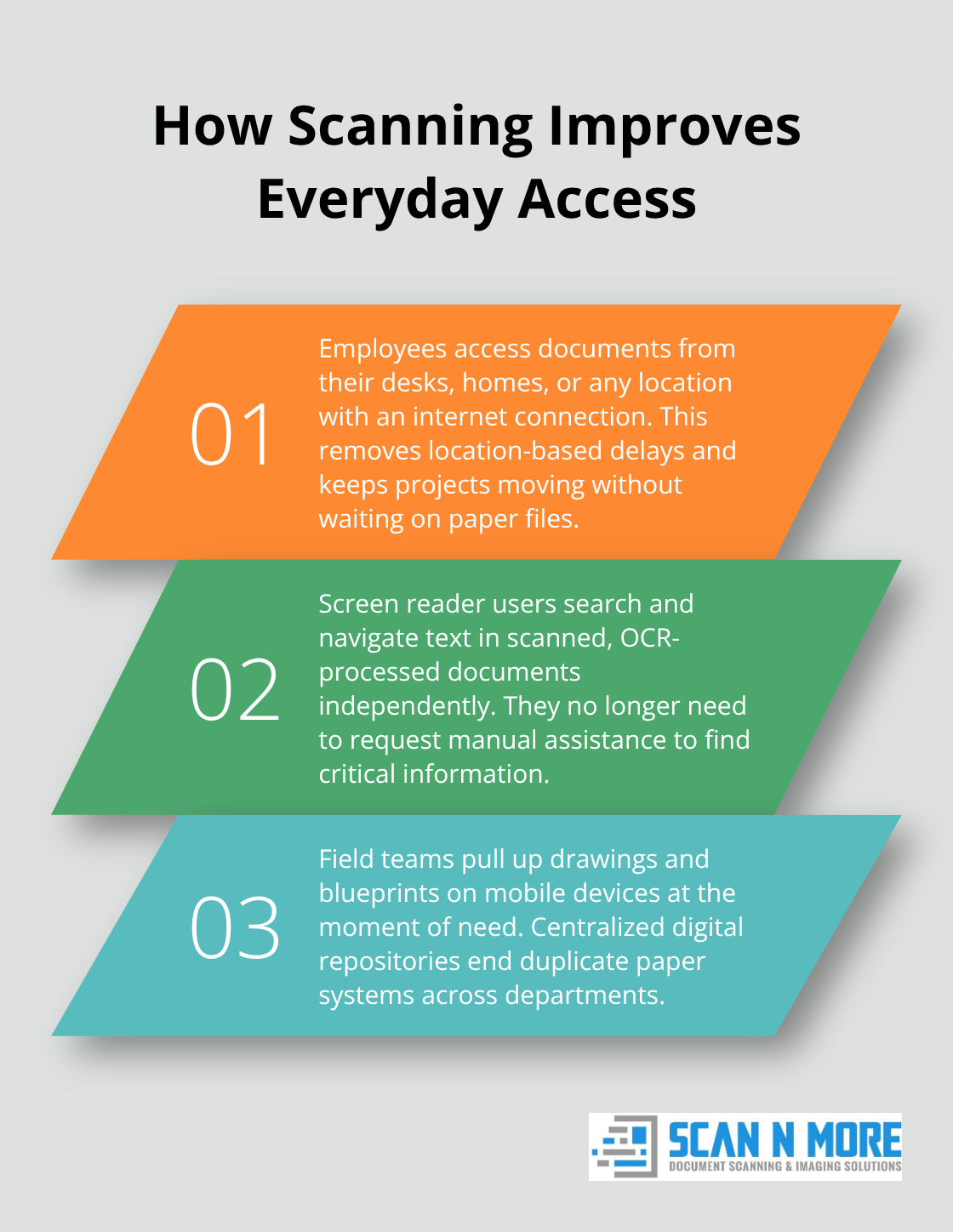
Digital scanning flips this problem entirely. Employees access what they need from their desk, from home, or from anywhere with an internet connection. Someone using a screen reader searches scanned documents instantly instead of requesting help from colleagues. A field technician pulls up blueprints on a mobile device without waiting for someone to mail a physical copy. Teams stop maintaining separate filing systems because everyone works from the same centralized digital location.
Research shows that removing paper from workflows improves customer response times by 300 percent. That’s not theoretical-that’s real time back in your day.
Information Retrieval That Actually Works
Scanned documents become fully searchable when paired with OCR technology. Optical character recognition reads text from images, turning a PDF of a contract into a document you can search by keyword. AI-powered OCR now achieves over 99% accuracy, even on old, faded, or handwritten documents. Your team recovers scanned files in seconds instead of hours. That speed matters in legal firms where case files need instant access, in healthcare where patient records determine treatment decisions, and in financial services where compliance audits demand rapid document retrieval. Proper indexing and metadata tagging multiply this benefit. Instead of searching through thousands of files, employees navigate organized digital systems with clear naming conventions and folder structures.
Removing Barriers for Workers with Disabilities
Physical accessibility barriers disappear when documents go digital. An employee using a wheelchair no longer needs someone to fetch files from a high shelf. A worker with a visual impairment uses screen reader software to navigate searchable text instead of handling paper. Someone with a mobility limitation accesses documents from an ergonomic workstation setup rather than bending, reaching, or lifting heavy binders. These aren’t minor conveniences-they’re the difference between full participation and exclusion from essential work tasks. Digital document management also supports neurodivergent employees who work better with organized, searchable information systems than with the chaos of paper-based workflows. When your company digitizes documents, you build a workplace where ability comes in many forms and everyone contributes at full capacity. That inclusive approach attracts talent that might otherwise work for your competitors, which makes the next step-actually implementing a scanning strategy-worth your immediate attention.
Where Document Scanning Delivers Real Industry Impact
Legal Firms Recover Hours Lost to Document Retrieval
Legal firms waste thousands annually on document retrieval delays. A partner needs a contract from three years ago, and paralegals spend hours digging through filing systems instead of billing clients. Scanning case files with OCR technology surfaces that same contract in seconds through full-text search. Searchable documents let lawyers find precedents faster, opposing counsel receives discovery materials on schedule, and depositions reference exact language without hunting through boxes. Compliance becomes measurable too. Law firms must retain documents for specific periods and produce them on demand during litigation. Digital systems with audit trails prove proper retention and appropriate file access-something paper filing cabinets cannot demonstrate.
Healthcare Providers Access Patient Information When It Matters Most
Healthcare providers face sharper consequences from paper-based records. A patient arrives at the emergency department, and clinicians need medication history, previous test results, and imaging reports instantly. Paper records scattered across multiple locations cost lives. Digitized patient information accessible from any terminal means treatment decisions happen faster. A radiology report scanned and indexed becomes available within minutes, not hours. Hospitals using digital document systems reduce readmission rates because discharge summaries reach primary care physicians immediately. HIPAA compliance strengthens through encrypted digital storage and access logs that show exactly who viewed which records when, creating accountability impossible with paper.
Financial Services Companies Meet Regulatory Demands Instantly
Financial services companies operate under relentless regulatory pressure. SEC rules, FINRA requirements, and SOX compliance demand that firms locate specific documents within days of an audit request. Paper-based systems fail this test consistently. Digitized financial records with intelligent indexing let compliance officers pull transaction documentation, client communications, and trade confirmations instantly. AI-powered OCR reads invoices and statements with high accuracy, eliminating manual data entry errors that trigger regulatory violations. Banks and investment firms also serve clients with disabilities, and digital document access supports accessibility standards under the ADA. A client using screen reader software accesses account statements and investment prospectuses from their home rather than requesting printed copies mailed to an office.
The Common Thread Across Industries
These three industries share a critical reality: document speed and accuracy determine business outcomes, regulatory standing, and client safety. Digital scanning stops being optional when competitors already operate with instant access to critical information. The next step involves understanding how to actually implement these solutions in your organization-and what practical barriers you’ll face along the way.
How to Start Your Scanning Project Without Getting Stuck
Identify Where Your Team Wastes Time on Documents
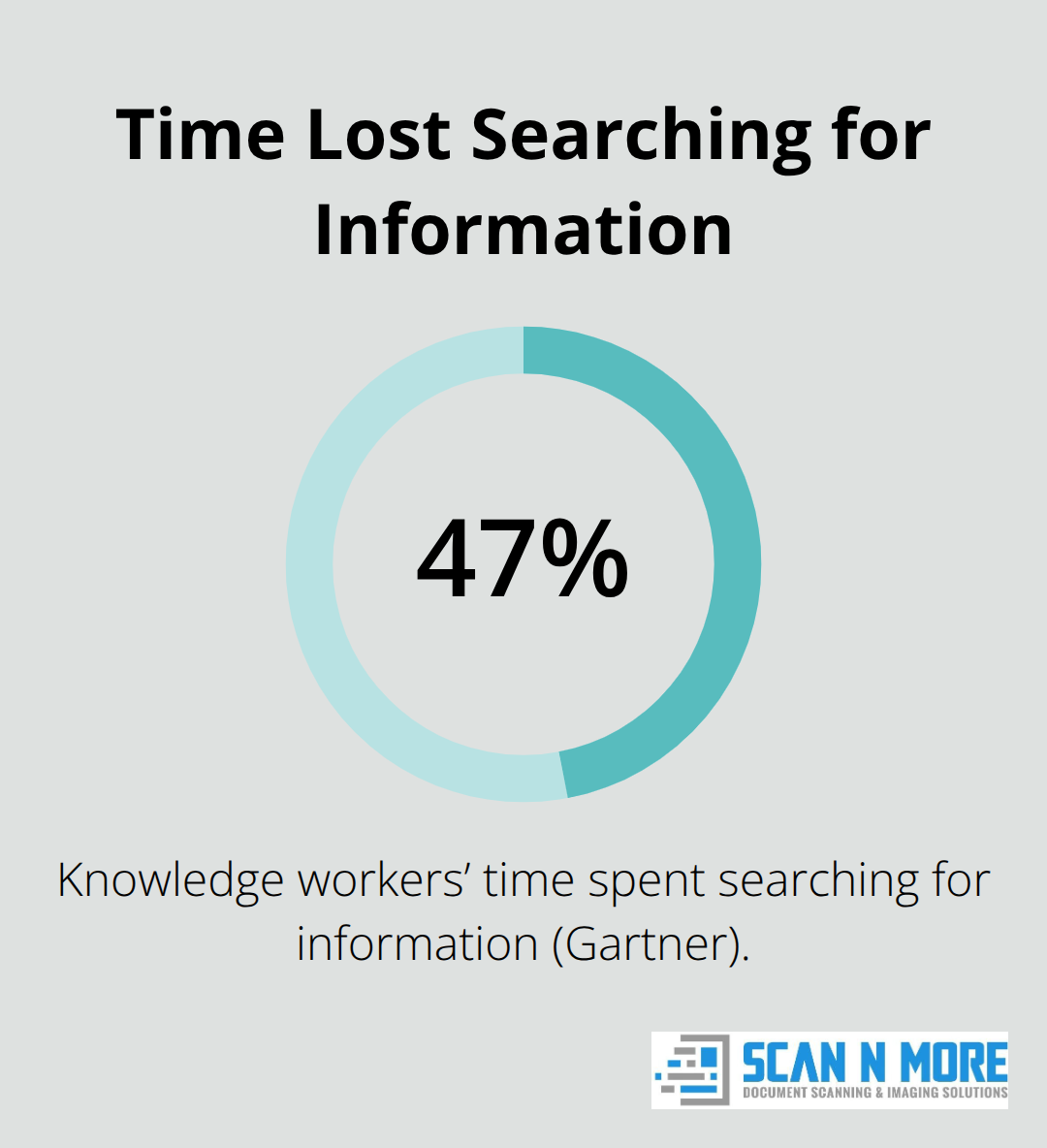
Before you commit to scanning thousands of documents, identify exactly which workflows are bleeding time and money. Pull your team together and ask them directly: where do you waste the most hours searching for information? Legal teams point to case file retrieval. Healthcare staff mention patient record delays. Finance departments cite compliance searches. Gartner data shows knowledge workers spend 47 percent of their time looking for information, and your organization likely mirrors that waste. Map the specific pain points by department, then quantify the cost.
If your legal team spends 10 hours weekly hunting documents and their loaded hourly rate is $250, that’s $130,000 annually disappearing into filing cabinets. This exercise shifts scanning from a nice-to-have into an urgent business priority with measurable ROI.
Document your current filing system too. Where do critical documents live? How many separate locations store the same information? Are retention policies actually followed, or do people keep everything indefinitely? This baseline assessment prevents you from building a digital system that replicates your paper chaos.
Choose On-Site or Off-Site Scanning Based on Your Priorities
On-site scanning keeps sensitive documents physically in your building throughout the process, which appeals to companies handling regulated content like HIPAA healthcare records or SOX financial documents. You maintain direct visibility and control. Off-site scanning works better for high-volume projects where speed matters more than physical proximity. Professional scanning centers process 50,000 to 100,000 pages daily with industrial-grade equipment that outperforms in-house scanners significantly. Outsourcing high-volume scanning delivers 30 to 50 percent cost savings compared to managing projects internally, according to industry benchmarks.
Build Your Digital Filing Structure Before Scanning Starts
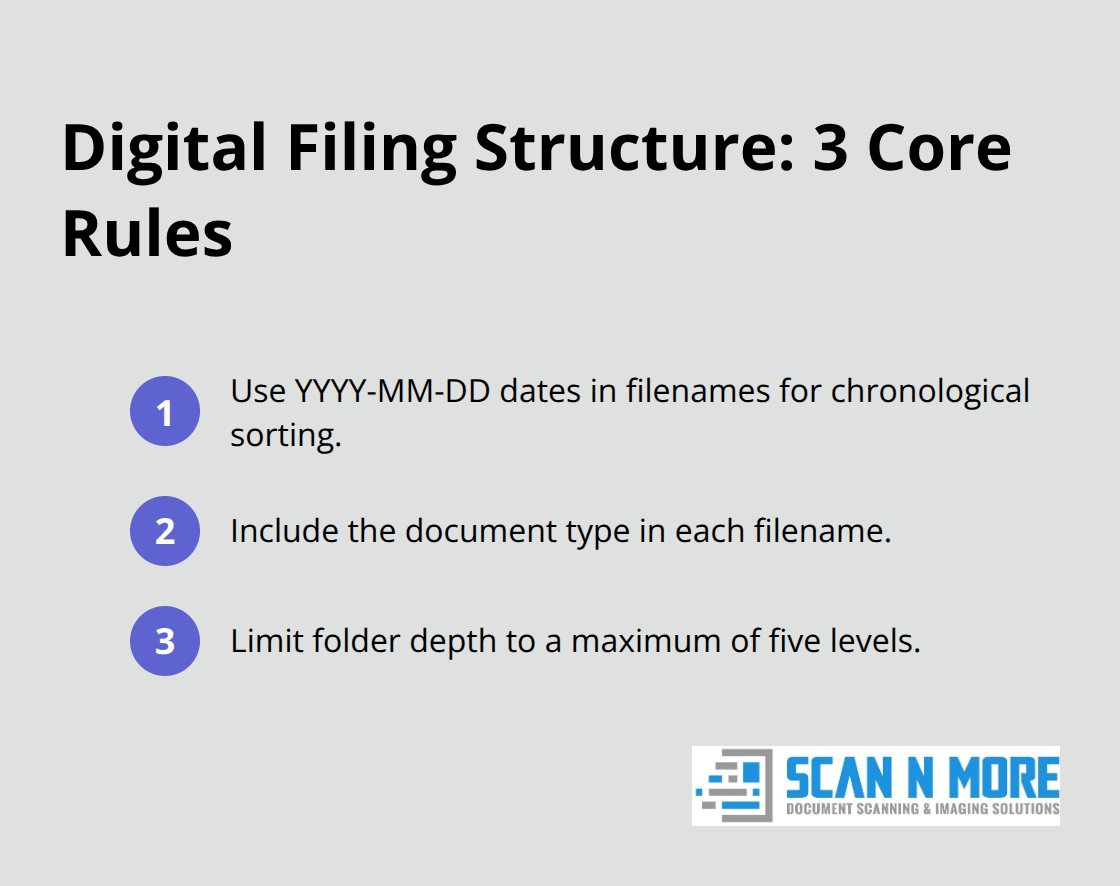
Once documents arrive digitally, establish a filing structure before the first scan completes. Inconsistent naming conventions and folder hierarchies defeat the entire purpose of digitization. Create clear naming standards: use YYYY-MM-DD date formats so files sort chronologically, include document type in the filename, and limit folder depth to five levels maximum so employees never dig through endless subfolders. This foundation prevents chaos from spreading into your digital environment.
Control Access and Enable Full-Text Search
Role-based access controls prevent employees from viewing documents outside their responsibilities, which strengthens data governance and compliance. Your finance team doesn’t need access to HR personnel files. Legal staff shouldn’t browse financial trading records. Implement these controls from day one rather than retrofitting them later (security gaps multiply when you delay). Pair your digital system with OCR technology so documents become searchable by content, not just filename. This transforms document management from a filing exercise into an information retrieval system that actually delivers the accessibility benefits you implemented scanning to achieve in the first place.
Final Thoughts
Enhancing accessibility with document scanning transforms how your organization operates, and the benefits compound over time. When documents become searchable and accessible from anywhere, your team stops wasting hours on retrieval delays. Gartner’s research shows knowledge workers spend 47 percent of their time hunting for information, but that number drops dramatically once digital systems replace paper chaos.
Workers with disabilities participate fully in your organization without requesting accommodations for basic document access, while remote employees work with the same efficiency as office-based staff. New hires onboard faster because they access training materials and procedures instantly. This inclusive environment attracts talent that competitors miss, and companies known for accessibility retain employees at higher rates and build stronger reputations in their industries.
Digital documents with audit trails prove proper retention and controlled access in ways paper never can. Legal firms demonstrate discovery compliance, healthcare providers show HIPAA accountability, and financial services companies satisfy regulatory audits (these aren’t theoretical benefits, they’re operational realities that reduce legal risk and audit costs). We at Scan N More help organizations move from paper-based chaos to digital efficiency through professional document scanning services that handle everything from initial assessment through secure storage and compliance management.