
Your business generates documents every day. Stacks of invoices, contracts, and records pile up, consuming space and slowing down operations.
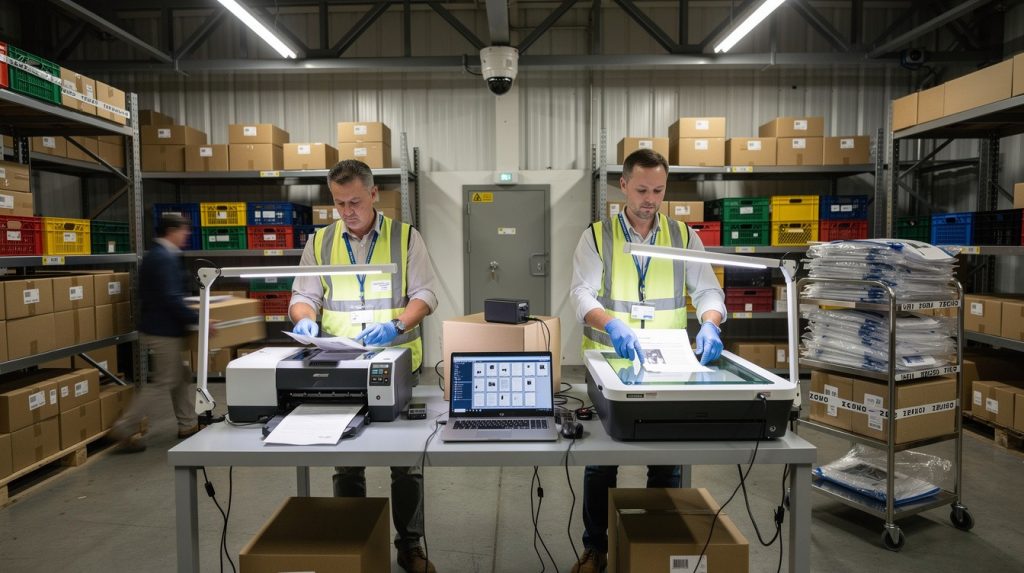
Offsite scanning services handle the heavy lifting, moving your paper burden to specialized facilities equipped to process high volumes quickly and securely. At Scan N More, we’ve helped businesses eliminate filing cabinets and access their documents digitally within days, not months.
Why Offsite Scanning Delivers Real Business Results
Offsite scanning removes the operational friction that in-house digitization creates. The document scanning services market reached $5.72 billion in 2026 and is projected to hit $8.09 billion by 2030, driven largely by organizations recognizing that outsourcing this work frees internal resources for higher-value tasks. When you process documents offsite, you access industrial-grade equipment that processes thousands of pages daily-far beyond what desktop scanners handle. A typical offsite facility runs high-speed document processors that digitize large document sets in weeks rather than months, which matters when you manage archives of invoices, contracts, or patient records spanning years.
The Cost Advantage of Outsourced Digitization
The cost advantage is substantial. Building an in-house scanning operation requires purchasing expensive equipment, hiring dedicated staff, maintaining climate-controlled storage, and managing quality control workflows. Offsite providers distribute these fixed costs across multiple clients, reducing your per-page digitization expense significantly. You avoid the hidden costs too: equipment downtime, staff training, and the opportunity cost of redirecting employees from their primary roles.
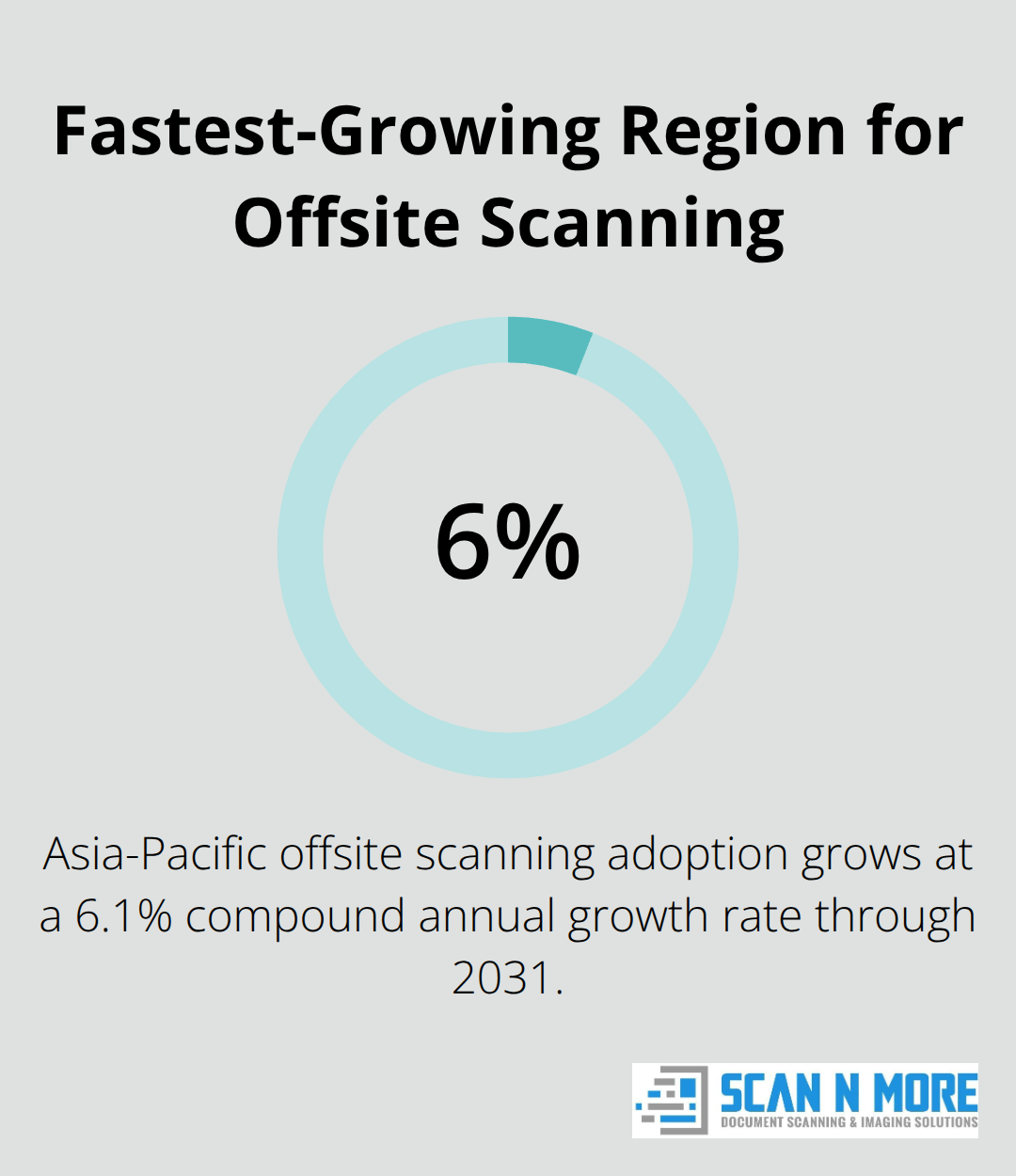
The Asia-Pacific region experiences the fastest growth in offsite scanning adoption at a 6.1% compound annual growth rate through 2031, as organizations across China, India, and emerging markets recognize that outsourcing digitization accelerates their digital transformation without infrastructure investment.
Specialized Equipment Handles What Your Office Cannot
Industrial scanning equipment processes bound books, large-format blueprints, medical X-rays converted to DICOM format, and laboratory notebooks-document types that standard office scanners simply cannot handle. Offsite facilities employ technicians trained in document preparation, handling fragile or aged records without damage, and performing quality control checks that catch scanning errors before digitized files reach your systems.
The workflow includes chain-of-custody logging at every step, from document intake through delivery, creating an auditable trail that satisfies compliance requirements in healthcare, legal, and financial sectors. When you select an offsite partner, prioritize providers with ISO 27001 certification, transparent security protocols, and client references from your industry.
Moving Forward with Security and Compliance
Your documents require specialized treatment that balances speed with protection. The next section explores how offsite scanning providers maintain the security standards and compliance frameworks your business demands throughout the entire digitization process.
Security and Compliance in Offsite Scanning
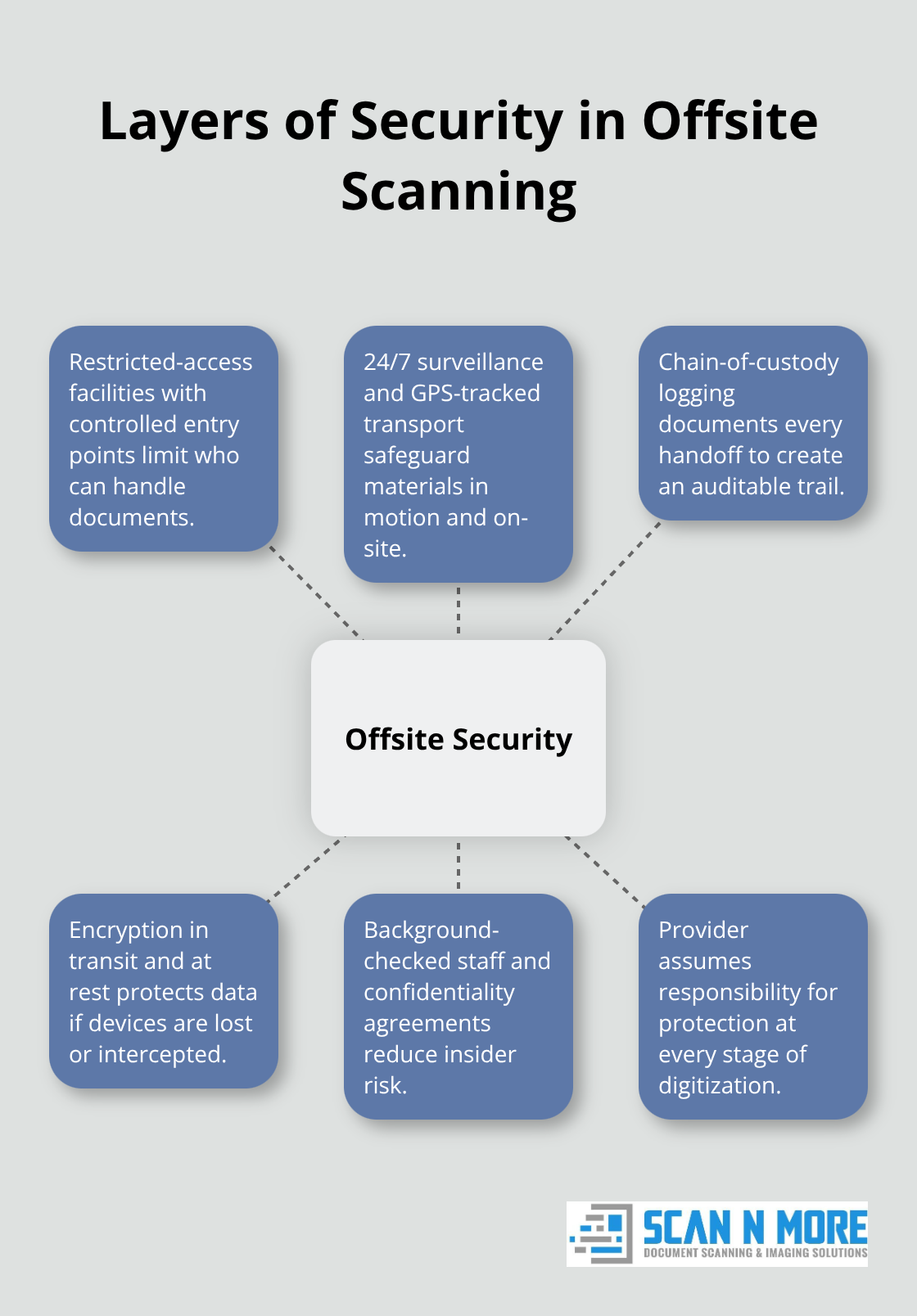
Offsite providers protect your data through facility controls that most businesses cannot replicate internally. Restricted-access environments, 24/7 surveillance, GPS-tracked transport vehicles, and background-checked staff handle your documents under strict confidentiality agreements. Chain-of-custody logging records every movement from document intake through digitized output, creating an auditable trail that regulators and internal auditors expect to see. When you hand documents to an offsite provider, that provider assumes responsibility for protecting them at every stage.
How Offsite Facilities Maintain Security Standards
ISO 27001 certification indicates the provider has implemented information security management systems tested against international standards. Data encryption in transit and at rest prevents unauthorized access if devices are lost or intercepted. These controls matter because data breaches cost organizations an average of $4.29 million, making security investment far cheaper than recovery. Offsite providers maintain restricted-access environments with controlled entry points, surveillance systems that monitor document handling, and secure storage areas that limit staff access to authorized personnel only. The combination of physical security measures and digital protections creates multiple layers of defense against theft, loss, or unauthorized disclosure.
HIPAA, Legal Privilege, and Regulatory Requirements
Healthcare organizations digitizing patient records must follow HIPAA privacy rules, which require that patient information remain private and secure throughout the scanning process. Legal firms handling attorney-client privileged documents need providers who understand that sensitive materials demand controlled handling under strict protocols. Financial institutions processing loan documents and account records face regulatory scrutiny around data residency and retention. Offsite providers address these requirements through compliant scanning workflows with documented procedures, encrypted storage options, and audit trails that demonstrate regulatory adherence.
Selecting a Provider Who Understands Your Compliance Needs
Verify that potential partners hold compliance certifications relevant to your industry and can articulate exactly how they handle your document type. Request specific examples of how they’ve managed similar projects and ask for client references from organizations in your sector who can speak to their security practices and responsiveness. The provider’s ability to explain their security measures clearly separates partners who take compliance seriously from those offering generic promises. A provider who can walk you through their chain-of-custody procedures, encryption protocols, and audit capabilities demonstrates the expertise your organization needs.
Your documents require specialized treatment that balances speed with protection. The next section explores how offsite scanning providers accelerate your digitization timeline while maintaining the security standards and compliance frameworks your business demands.
How Offsite Scanning Accelerates Your Digital Operations
When you move digitization offsite, your documents travel through purpose-built workflows designed for speed. Offsite facilities operate high-volume scanning equipment that processes thousands of pages daily-a capacity that internal teams rarely match. The global document scanning services market is estimated to be valued at USD 1.26 Billion in 2026, driven partly by organizations recognizing that offsite providers complete large projects in weeks instead of months. Your staff stays focused on revenue-generating work rather than managing document intake, quality checks, and file organization. Offsite scanning also eliminates the bottleneck created when employees coordinate around shared equipment or compete for IT resources to store and manage digitized files. An offsite team works around the clock, accelerating project completion without disrupting your normal business operations. This speed advantage becomes critical when you face regulatory deadlines, litigation holds, or merger integration timelines where delays cost money.
Indexing and Searchability Transform Document Access
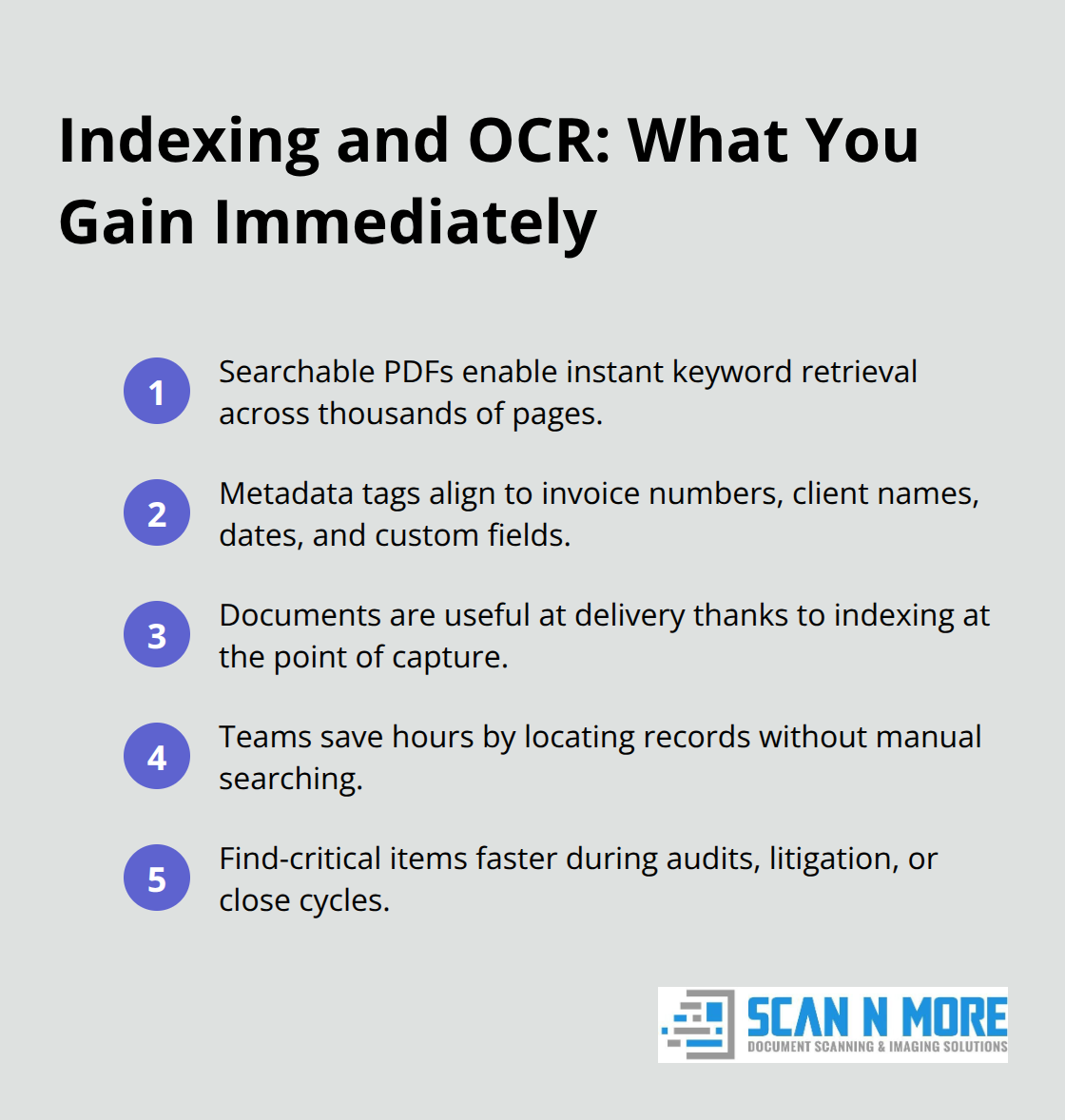
Raw scanning produces image files, but they become useless if your team cannot find what they need. Offsite providers apply optical character recognition to convert scanned documents into searchable PDFs, enabling keyword searches across thousands of pages in seconds. Metadata tagging during the scanning process means documents get indexed by invoice numbers, client names, dates, or custom fields that match your business logic. This indexing happens at the point of capture, not as an afterthought, ensuring that every digitized document becomes immediately useful. When your finance team searches for a specific invoice or your legal department locates all communications with a particular vendor, that metadata work done offsite saves countless hours of manual searching.
Quality Assurance Protects Your Digital Investment
Quality assurance workflows verify that OCR accuracy meets your standards and that indexing follows your specifications before files reach your systems. Offsite providers catch scanning errors-skipped pages, image distortion, or misaligned metadata-before delivery, preventing the common failure where organizations digitize everything then discover their digital files are harder to navigate than the paper originals ever were. This verification step (performed by trained technicians at the offsite facility) ensures that your digitized documents serve your business immediately upon arrival. Your team receives files that are ready to integrate with enterprise content management systems, eliminating rework and delays that plague rushed digitization projects.
Scalability Handles Archives of Any Size
Offsite facilities scale to millions of documents without straining your internal infrastructure. Whether you manage archives spanning decades or face a one-time project to digitize a merger’s combined records, offsite providers adjust their capacity to match your timeline and volume. This scalability means you avoid the capital expense of purchasing equipment that sits idle after your project completes. Offsite providers distribute their infrastructure costs across multiple clients, making large-scale digitization economically practical for organizations of all sizes.
Integration with Your Existing Systems
Offsite providers deliver scanned documents in standard formats-PDFs, searchable PDFs, or TIFF files-that integrate seamlessly with your existing business systems. Your IT team can ingest these files directly into document management platforms, accounting software, or case management systems without format conversion or data loss. This compatibility (combined with proper metadata tagging) means your digitized documents become functional assets within hours of delivery, not weeks of technical troubleshooting.
Final Thoughts
Offsite scanning services eliminate the operational complexity that keeps organizations tethered to paper. You gain access to industrial-grade equipment, specialized expertise, and security protocols that would cost far more to build internally. The speed advantage matters too-your documents move from filing cabinets to searchable digital files in weeks, not months.
Security and compliance become embedded in the process rather than an afterthought. Chain-of-custody tracking, ISO 27001 certification, encrypted storage, and auditable workflows satisfy regulatory requirements across healthcare, legal, and financial sectors. When you choose an offsite partner, you transfer both the operational burden and the responsibility for protecting sensitive information to specialists equipped to handle it.
Assess your document volume, identify your compliance requirements, and connect with a partner who can scale to your needs. Scan N More offers professional scanning solutions and customer support to transition your organization smoothly into a digital environment. Contact us today to discuss your digitization project and discover how offsite scanning services can free your team from paper management and accelerate your digital operations.