

Digital transformation isn’t optional anymore. Companies that move fast gain market share, cut costs, and keep customers happy. Those that lag behind face extinction.
At Scan N More, we’ve seen firsthand how digital transformation solutions separate thriving enterprises from struggling ones. This guide walks you through the strategy, obstacles, and wins that matter.
Why Your Enterprise Can’t Afford to Delay Digital Transformation
Customer Expectations Have Shifted Permanently
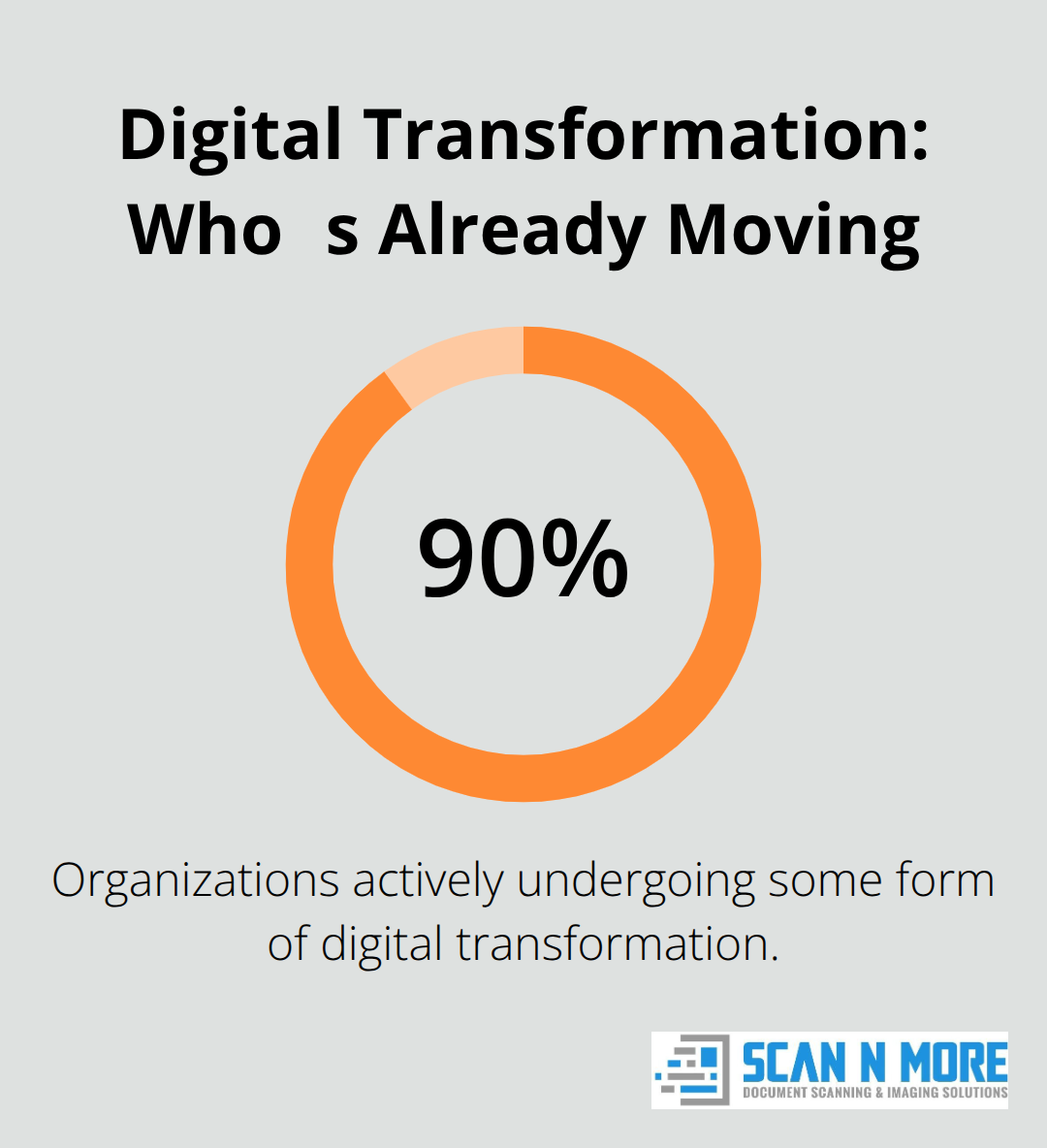
Customers now expect seamless digital experiences across every interaction. McKinsey reports that the digitization of customer interactions has accelerated by 3 to 4 years, fundamentally shifting how enterprises must operate. Ninety percent of organizations are actively undergoing some form of digital transformation, yet McKinsey found that those who launched transformation initiatives have realized only about one-third of expected revenue benefits. This gap exists because most enterprises treat transformation as a technology project rather than a business imperative.
Speed Determines Winners and Losers
The reality is stark: companies that move slowly lose customers to digital-native competitors who operate with 30 percent higher customer satisfaction and 20 percent better employee satisfaction, according to McKinsey research. Speed matters more than perfection. Organizations with fewer than 100 employees are 2.7 times more likely to succeed in digital transformation than those with more than 50,000 employees, primarily because smaller enterprises move faster and face fewer organizational silos. Your competitors aren’t waiting-36 percent of companies worldwide implemented AI technologies in 2023, with 49 percent piloting or considering AI adoption.
Automation Drives Immediate Financial Returns
Process automation alone produces tangible savings. Sixty-eight percent of companies cite modernization of operations (replacing manual or outdated processes) as their primary transformation driver. When you automate repetitive tasks, your teams shift focus to higher-value work that actually moves the needle on revenue and customer satisfaction. Technology investments drive profit gains exceeding 10 percent on average, according to KPMG research.
Legacy Systems Represent Compounding Risk
Data breaches now cost enterprises an average of 4.99 million dollars in 2026, with AI-driven attacks up 56 percent year-over-year. Legacy systems sitting in your data center represent compounding security risk and operational drag. Cloud migration reduces maintenance burden, improves uptime, and lets your team focus on innovation instead of infrastructure management. Sixty-three percent of organizations saw improved performance from digital transformation in the last two years, translating to measurable operational gains.
The Window for Action Is Closing
The enterprises winning right now aren’t the ones debating whether to transform-they’re the ones already capturing market share from their hesitant competitors. Your transformation strategy must address not just technology, but the organizational structure and employee capabilities that support it.
What Your Transformation Strategy Actually Needs
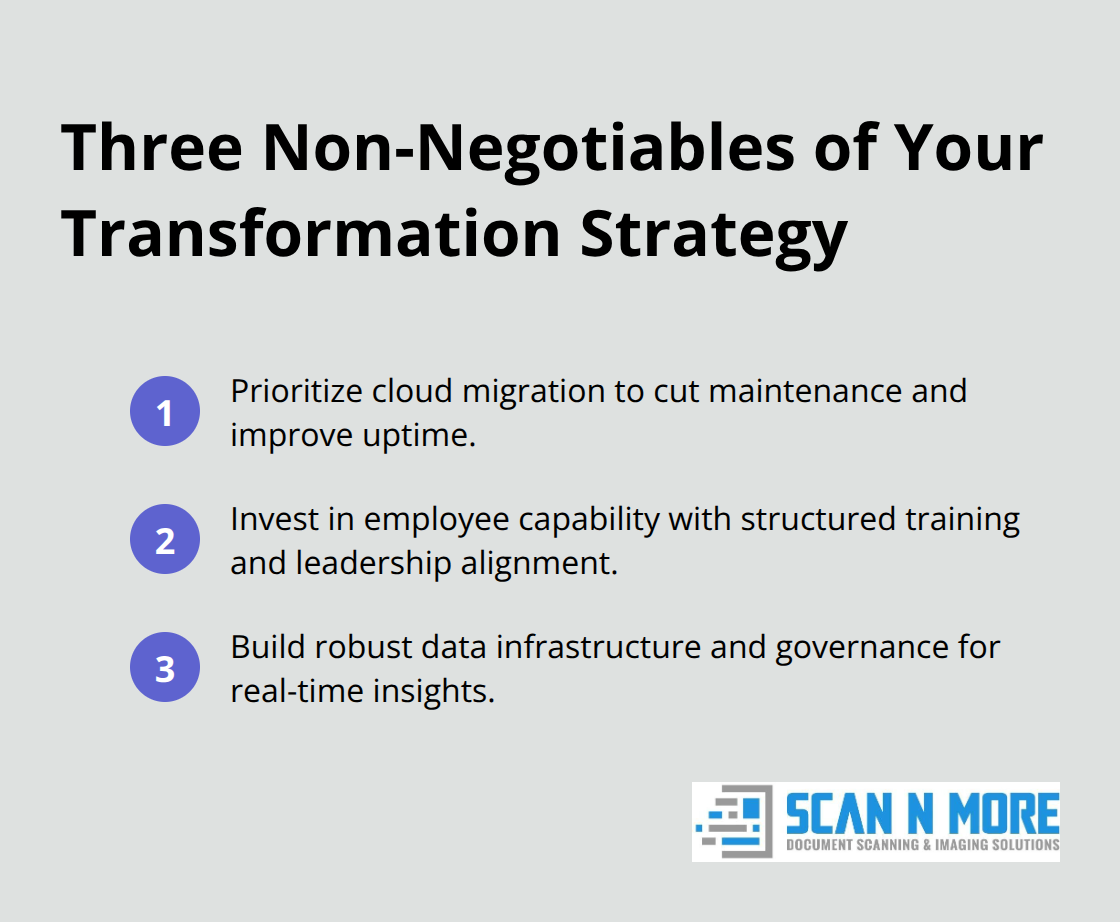
Building a digital transformation strategy means making three non-negotiable choices about where your money and effort go. Cloud migration, employee capability, and data infrastructure form the foundation that determines whether your transformation succeeds or stalls. Most enterprises fail because they treat these as separate initiatives instead of interconnected priorities that reinforce each other.
Cloud Migration Removes Infrastructure Burden
Moving to the cloud accomplishes what legacy systems cannot: it frees your team from maintaining physical infrastructure so they can focus on innovation. Ninety-two percent of leaders report their companies have adopted cloud technology, making cloud adoption standard practice across industries. The financial case is straightforward-cloud reduces data-center maintenance costs, improves system uptime, and gives you the flexibility to scale resources up or down based on actual demand rather than capacity planning guesses. When you move workloads to cloud infrastructure, you deploy new applications and updates faster than competitors still managing on-premises systems. The security advantage matters too. A remarkable 94% of businesses report significant online security improvements after migrating their data to the cloud, and migrations to modern cloud platforms reduce your attack surface compared to aging legacy systems still vulnerable to emerging threats.
Your Workforce Determines Transformation Outcomes
Technology alone never drives transformation-people do. Ninety-three percent of workers say digital savviness is essential to perform well, yet most enterprises underinvest in training during transformation initiatives. Structured training programs must address three distinct audiences: technical teams who build and maintain systems, operational staff who use new tools daily, and leadership who must understand transformation benefits well enough to champion cultural change. Organizations using OKRs as a transformation framework report that 71 percent conduct regular check-ins during change initiatives, and 91 percent hold retrospectives to apply learnings-this discipline produces measurable results. The resistance to change that derails most transformations stems from unclear communication and inadequate training, not from employees opposing progress. When people understand why systems are changing and receive hands-on training before rollout, adoption accelerates dramatically. Fifty-four percent of organizations report that silos and collaboration problems hamper transformation success, and training programs that break down departmental barriers yield faster wins than technology deployments alone.
Data Infrastructure Separates Winners from Laggards
Sixty-one percent of companies are implementing big data and analytics on some scale, yet most capture only a fraction of the insight their data contains. Your transformation strategy must include a data governance framework that defines who owns data, how it flows between systems, and what security controls protect sensitive information. Real-time data analytics enable faster decision-making across operations, customer service, and product development-companies without this capability operate on yesterday’s information. When you connect cloud infrastructure, trained employees, and analytics capabilities, you create a system where data flows seamlessly across departments and informs decisions at every level. The enterprises winning market share right now aren’t just using more data-they’re structuring their organizations so data accessibility and quality become competitive advantages rather than afterthoughts. Your next challenge involves identifying which obstacles will most likely derail your specific transformation effort and building countermeasures before resistance takes hold.
What Really Stops Digital Transformations from Succeeding
Organizational Resistance Runs Deeper Than Communication
Organizational resistance to change kills more transformation initiatives than budget constraints ever will. When McKinsey studied digital transformation failures, they found that 52 percent of organizations cite resistance to change as a major blocker, yet most enterprises treat this as a communication problem rather than a structural one. The truth is harsher: resistance emerges because transformation threatens existing power structures, job security, and established workflows that people have mastered over years. Fifty-four percent of companies report that silos and collaboration problems hamper transformation success, and these silos exist because departments have built walls to protect their turf.
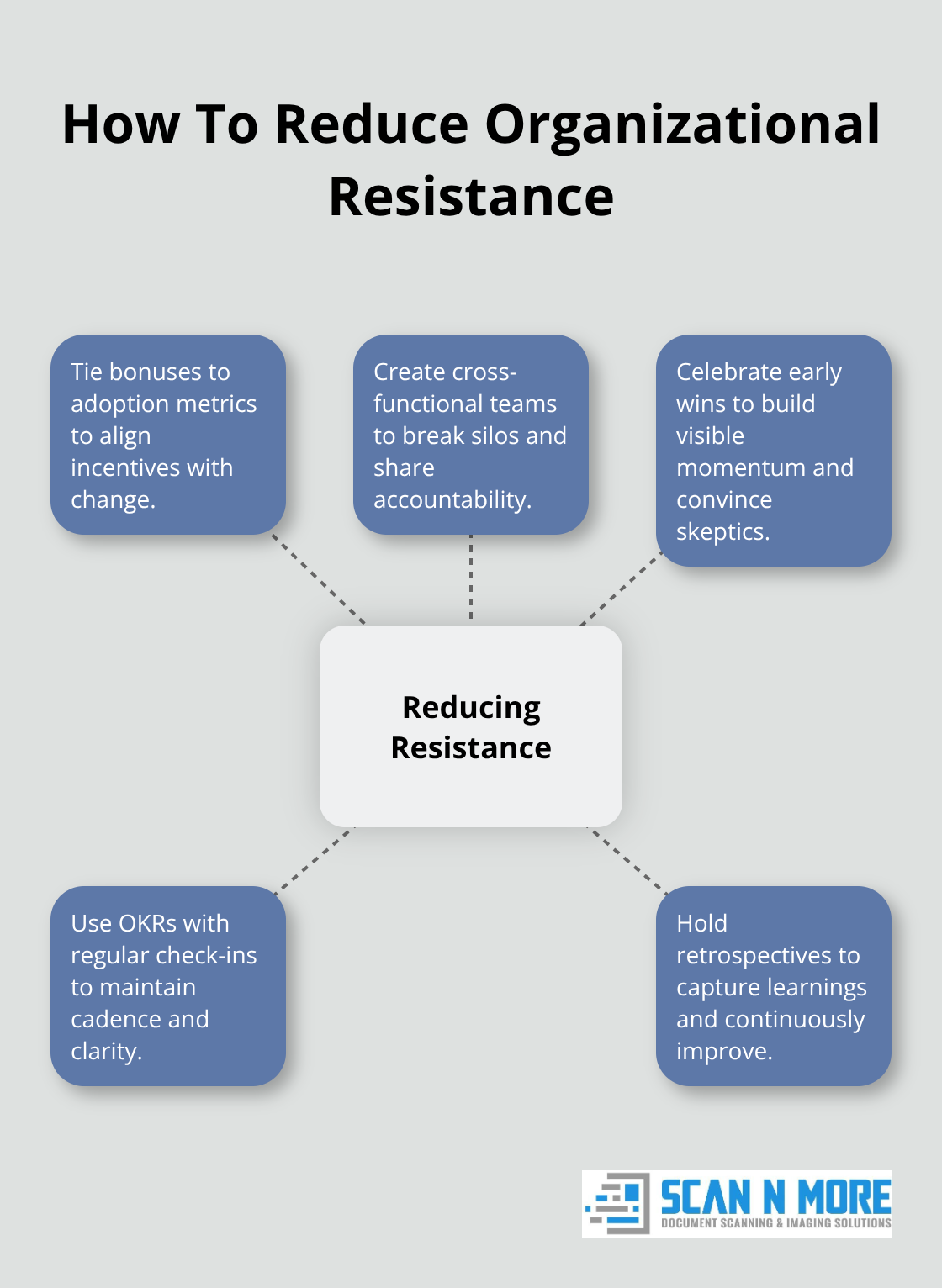
Your finance team resists cloud migration because they fear losing control over infrastructure spending. Operations teams push back against new software because the current system, however clunky, works predictably. Middle managers worry that automation eliminates their positions. None of these concerns disappear through better PowerPoint presentations or town halls. They dissolve only when you restructure incentives so people benefit from transformation outcomes rather than suffer from them.
This means tying bonuses to adoption metrics, creating cross-functional teams that break departmental silos, and publicly celebrating early wins so skeptics see tangible results. Organizations using OKRs as a transformation framework report that 71 percent conduct regular check-ins and 91 percent hold retrospectives to apply learnings, which creates accountability and visibility that reduces resistance significantly.
Budget Constraints Hide Deeper Cost Miscalculations
Budget constraints and ROI concerns represent real constraints, but they often mask a deeper problem: enterprises underestimate transformation costs because they focus only on technology spending while ignoring change management, training, and process redesign. GenAI ROI meets or exceeds expectations in about 75 percent of advanced initiatives according to Deloitte’s 2025 data, but the enterprises capturing that value invested heavily in workforce capability alongside technology.
Start transformation with high-impact, low-cost initiatives that generate quick wins and build internal momentum rather than launching expensive enterprise-wide rollouts that take years to show returns. When you automate a single high-volume process that your team repeats daily, you free hours per week immediately, making the ROI obvious within weeks rather than quarters.
Skills Gaps Compound Without Deliberate Knowledge Transfer
Skills gaps compound without deliberate knowledge transfer, and this obstacle compounds over time. Ninety-three percent of workers say digital savviness is essential to perform well, yet most enterprises hire external consultants for technical implementation while their internal teams watch from the sidelines rather than building capability. This approach guarantees failure because consultants leave once the system launches, and your team inherits software they don’t understand and can’t modify.
Instead, structure transformation as a teaching engagement where consultants work alongside your staff, documenting decisions and transferring knowledge continuously. Technical training must start before system launch, not after, because people learn new tools faster when they understand why the tool exists and what problems it solves. The enterprises winning right now treat transformation obstacles not as problems to overcome through willpower, but as predictable friction points that require structural solutions built into your initiative design from day one.
Final Thoughts
Digital transformation isn’t a one-time project you complete and move past-it compounds competitive advantage over years as you modernize legacy systems, automate repetitive work, and train your team to operate in a digital environment. The enterprises winning right now have already invested in their people and built data infrastructure that informs every decision, and your competitors are doing the same. Sixty-three percent of organizations saw improved performance from digital transformation in the last two years, with those gains accelerating as systems matured.
Your transformation strategy must address technology, people, and organizational structure simultaneously because each reinforces the others. Cloud migration alone means nothing without trained employees who understand how to use new systems, and data analytics capabilities sit dormant without a workforce equipped to interpret insights and act on them. Start with one high-impact process your team repeats daily, automate it completely, and tie compensation to transformation outcomes so people benefit from change rather than suffer from it.
The document scanning and digitization services at Scan N More accelerate your transition to digital operations by transforming paper-based processes into secure digital solutions that eliminate the infrastructure burden of managing physical records. Their on-site and off-site scanning services handle all document formats while maintaining compliance and data security, giving your digital transformation solutions the foundation they need to succeed. Your long-term competitive advantage depends on moving faster than competitors trapped in legacy systems, so start your transformation journey now.