

Most businesses face a tough choice: scan documents offsite for convenience or handle it onsite for complete control. We at Scan N More know this decision shapes how fast you can access files and how secure your data stays.
This onsite scanning benefits comparison breaks down what actually matters when choosing between these approaches. Speed, security, and oversight aren’t theoretical trade-offs-they directly impact your bottom line.
Why Onsite Scanning Delivers Speed Without Compromise
Eliminate delays built into offsite workflows
Onsite scanning removes the friction that slows down offsite operations. Your documents stay in-house, so no shipping time eats into your schedule, no external processor queue delays your work, and no back-and-forth coordination with third-party vendors interrupts your timeline. Businesses that switch to onsite scanning report processing times that drop by 40 to 60 percent compared to offsite methods. A legal firm scanning case files onsite can have digitized documents ready for review the same day, while an offsite operation might wait three to five business days. This speed matters when you’re billing hourly, managing discovery deadlines, or responding to regulatory requests. Your team controls the scanning schedule, not someone else’s capacity constraints.

Quality control happens in real time
Onsite scanning gives you immediate oversight of every page. You spot quality issues before they become problems-a misaligned document, a missed page, or poor image clarity gets corrected instantly rather than discovered after the fact. This direct quality assurance cuts rework by 25 to 35 percent, according to document management studies tracking internal scanning operations. Your staff verifies that sensitive pages receive proper handling, that nothing gets lost in transit, and that the final files meet your exact standards. You solve problems in minutes rather than waiting for a quality report to arrive days later. Healthcare providers handling patient records particularly benefit here, since HIPAA compliance requires documented chain of custody-something onsite scanning provides automatically through direct supervision. Financial services firms protecting account statements and transaction records face similar compliance demands, and onsite scanning eliminates the risk of documents sitting in an external facility where access logs become harder to maintain.
Access your files the moment scanning finishes
The instant scanning completes onsite, your digitized files belong entirely to you. No retrieval requests delay you, no download delays from cloud servers managed by third parties slow you down, and no waiting for someone else to ship your files back interrupts your workflow. This immediate access means a healthcare provider pulls up a patient’s imaging records in seconds, a legal team references a contract during a client call without delay, and financial analysts access historical documents for audits without scheduling retrievals. The data stays in your infrastructure from start to finish, reducing the window where files exist in transit or in someone else’s hands.
Data security and chain of custody remain unbroken
Onsite scanning keeps sensitive documents under your direct control throughout the entire process. Documents never leave your facility, which means you maintain complete visibility over who handles them and when. This continuous oversight proves essential for industries managing confidential information (legal firms with case files, healthcare providers with patient records, and financial services protecting account data). The chain of custody remains documented and verifiable because your staff supervises every step. External scanning operations introduce multiple handoff points where documents pass between couriers, processors, and storage facilities-each transition creates a potential security gap. Onsite scanning eliminates these vulnerable transitions entirely.
Customization and flexibility adapt to your specific needs
Onsite scanning lets you tailor the process to match your exact requirements without negotiating with external vendors. Your team decides which documents scan first, how files organize in your system, and what quality standards apply to each batch. You adjust workflows on the fly when priorities shift or new projects emerge. Offsite operations lock you into their standard processes and timelines, forcing your business to adapt rather than the other way around. This flexibility proves especially valuable for industries with complex compliance requirements or rapidly changing document volumes.
The speed and control advantages of onsite scanning create a foundation for better decision-making across your organization. Yet the choice between onsite and offsite approaches involves more than just processing time and oversight-cost structures, security protocols, and hidden fees often determine which option truly serves your business best.
How Onsite and Offsite Scanning Compare on Security, Costs, and Control
Offsite scanning creates security vulnerabilities at every handoff
Offsite scanning operations expose your documents to multiple security risks. When documents leave your facility, couriers transport them, external processors handle them, storage facilities warehouse them, and couriers return them. Each handoff creates a documented access point, but documentation alone doesn’t prevent unauthorized viewing or loss. Onsite scanning eliminates these intermediate steps entirely.

Your documents never leave your building, which means access remains limited to your vetted staff under your direct observation.
For legal firms managing privileged communications or healthcare providers handling HIPAA-protected records, this distinction carries real compliance weight. Financial services firms face similar pressures-regulators increasingly scrutinize third-party document handling as a risk factor during audits. The offsite model forces you to trust external vendors’ security protocols, staff training, and facility standards. Onsite scanning removes that dependency and gives you verifiable control over the entire process.
Hidden fees inflate offsite scanning expenses significantly
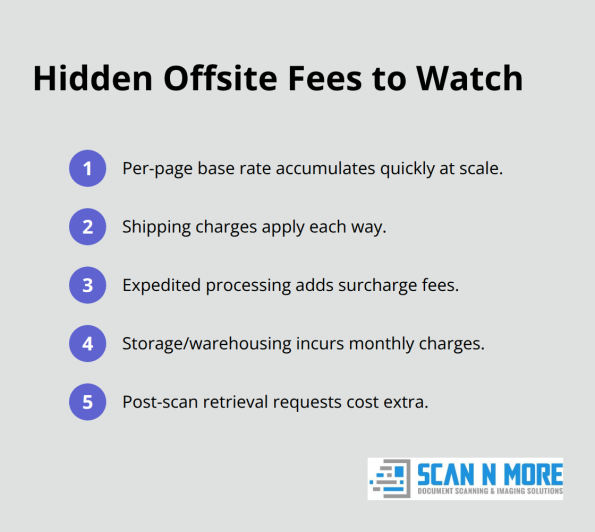
Cost comparisons between onsite and offsite scanning rarely account for hidden fees that inflate offsite expenses. Offsite vendors typically charge per-page rates that appear reasonable initially, but shipping costs, expedited processing fees, storage charges, and retrieval requests add to the base price. A mid-size legal firm scanning 50,000 pages monthly pays approximately 2 to 3 cents per page offsite, which totals $1,000 to $1,500 monthly. Add shipping ($200 to $400 each way), expedited processing ($150 to $300 per project), and retrieval requests ($50 to $100 each), and the actual monthly cost approaches $2,500 to $3,500.
Onsite scanning involves upfront equipment investment and staff time, but those costs remain predictable and internal. A departmental scanner costs roughly $8,000 to $15,000 initially, plus $200 to $400 monthly for supplies and maintenance. The payback period drops below six months for organizations processing high document volumes.
Onsite scanning grants flexibility that offsite operations cannot match
Onsite scanning gives you complete flexibility to adjust scanning priorities without renegotiating contracts or paying rush fees. Your team scans urgent materials first, batches routine documents efficiently, and handles unexpected spikes without external constraints. Offsite operations force you into their scheduling windows, which means your urgent work waits in queue behind other clients’ projects. When priorities shift or new projects emerge, your staff adjusts workflows on the fly rather than requesting exceptions from vendors (who often charge premium rates for such changes).
This operational control proves especially valuable during peak periods. A healthcare provider managing a sudden influx of patient records processes them immediately onsite, while an offsite operation would queue them with other clients’ work. Financial services firms handling year-end audits or legal teams managing discovery deadlines face similar time pressures that onsite scanning addresses directly.
Industries with strict compliance requirements benefit most from onsite control
Legal firms, healthcare providers, and financial services organizations face regulatory scrutiny that makes onsite scanning the safer choice. These industries cannot afford chain of custody gaps or security incidents traced to third-party vendors. Onsite scanning provides the documented oversight and verifiable control that compliance officers and auditors expect. The cost savings and speed advantages become secondary benefits compared to the regulatory protection that onsite operations provide.
The security, cost, and flexibility advantages of onsite scanning create a compelling case for organizations handling sensitive information. Yet the decision ultimately depends on your specific document volumes, compliance requirements, and available resources-factors that vary significantly across industries and business sizes.
Which Industries Need Onsite Scanning Most
Legal firms cannot compromise on confidentiality and chain of custody
Legal firms handle documents that demand absolute confidentiality and verifiable chain of custody. When a law firm manages discovery materials, attorney-client privileged communications, or settlement agreements, documents cannot pass through external facilities where access logs depend on vendor honesty rather than direct observation. Offsite scanning requires legal teams to trust third-party staff with information that could determine case outcomes or expose client strategies.
A mid-size litigation practice processes 100,000 pages during active discovery, with deadlines measured in weeks, not months. Waiting three to five business days for offsite scanning to return files means missing filing deadlines or paying rush fees that exceed $500 per project. Onsite scanning eliminates this risk entirely. The firm scans materials immediately, maintains unbroken chain of custody documentation, and controls exactly which staff members access each file. This control proves non-negotiable for compliance with legal ethics rules that require attorneys to protect client information from unauthorized access.
Healthcare providers face severe penalties for patient record breaches
Healthcare providers face HIPAA penalties reaching $1.5 million annually per violation category according to the U.S. Department of Health and Human Services. Patient records contain not just medical information but insurance details, payment history, and social security numbers that create liability if exposed during offsite handling. A hospital scanning 500,000 patient records annually cannot afford security gaps at courier handoffs, external processor facilities, or storage warehouses.
Onsite scanning keeps records in secure facilities where access remains limited to HIPAA-trained staff under direct supervision. Clinical workflows also demand speed that offsite operations cannot match. Emergency departments need patient history instantly, not after retrieving files from external vendors. Onsite scanning is specifically designed for healthcare organizations managing sensitive patient information with compliance requirements.
Financial services organizations must demonstrate complete regulatory control
Financial services organizations protect account statements, loan documents, and transaction records under intense regulatory scrutiny. Regulatory audits increasingly scrutinize third-party document handling as a compliance risk factor. Banking institutions must demonstrate complete chain of custody for records spanning years, and offsite storage creates documentation gaps that regulators view unfavorably.
Onsite scanning provides the verifiable control that compliance officers require during examinations. These three industries share a common reality: the cost and speed advantages of onsite scanning matter far less than the regulatory protection and security guarantees it provides. For organizations where a single breach creates liability exceeding six figures, onsite scanning becomes the only defensible choice.
Final Thoughts
Onsite scanning delivers the speed and control that offsite operations simply cannot match. The onsite scanning benefits comparison reveals a clear winner for organizations handling sensitive information: keeping documents in-house eliminates security vulnerabilities, reduces hidden costs, and gives your team immediate access to digitized files. Legal firms managing confidential case files, healthcare providers protecting patient records, and financial services organizations safeguarding account data all face the same reality-regulatory compliance and data protection demand onsite oversight.
Speed and security work together rather than compete against each other. Your team processes documents faster because nothing leaves your facility, and your data stays secure because access remains under direct supervision. The cost advantage emerges over time as hidden fees from offsite vendors disappear and your staff controls the workflow without paying rush charges or retrieval requests.
We at Scan N More recognize that transitioning to digital processes requires a partner who understands your specific compliance needs and security concerns. Contact Scan N More to explore how professional document scanning services can transform your paper-based processes into secure digital solutions that give you complete control over your most sensitive information.