
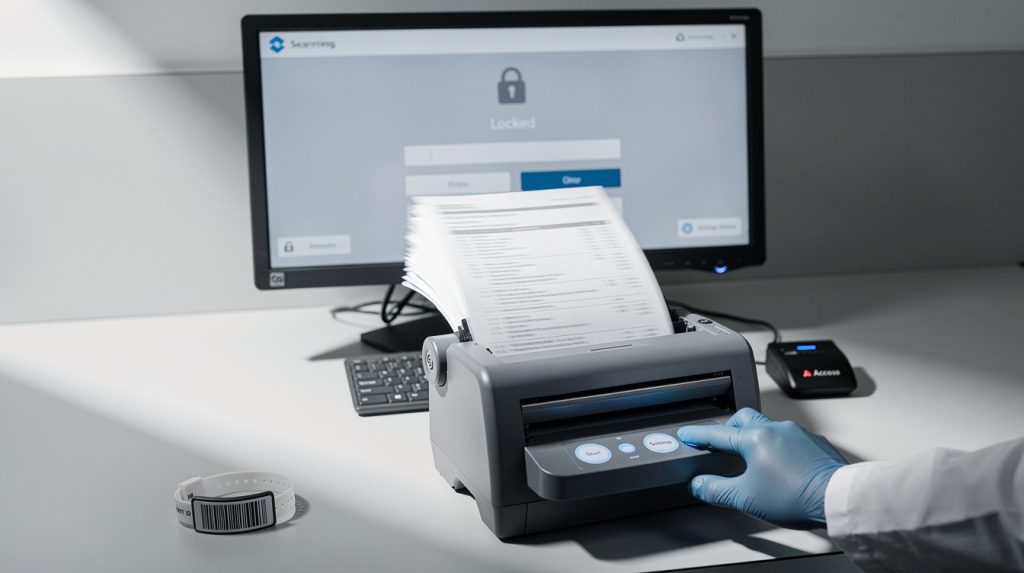
Healthcare organizations handle some of the most sensitive information in existence. A single data breach can expose patient records, destroy trust, and trigger hefty fines under federal law.
At Scan N More, we know that HIPAA compliant scanning isn’t optional-it’s a foundation for protecting your patients and your organization. This guide walks you through what matters most when securing your document workflows.
Why HIPAA Compliance Protects Your Bottom Line
The Real Cost of Breaches
The Office for Civil Rights reported that healthcare organizations faced over 700 HIPAA breaches affecting more than 35 million patient records between 2009 and 2023. Each breach carries real financial consequences. The average cost of a healthcare data breach reached 10.93 million dollars in 2023, according to IBM’s Cost of a Data Breach Report, and those figures exclude regulatory penalties. OCR investigators impose civil penalties ranging from 100 dollars to 50,000 dollars per violation, with some enforcement actions totaling millions.
A single scanning project mishandled-an employee accessing records without authorization, unencrypted files transmitted over email, or third-party vendors lacking proper Business Associate Agreements-can trigger an audit that exposes years of noncompliance. Your organization absorbs notification costs, forensic investigations, legal defense, and reputational damage on top of fines. When a breach occurs, you must notify affected patients within 60 days, coordinate with regulators, and potentially halt services while investigations proceed. Staff spend weeks responding to OCR requests instead of serving patients.

Patient Trust Drives Referrals and Revenue
Patients choose healthcare providers partly on perceived security. A 2022 Deloitte survey found that 76 percent of healthcare consumers consider data security and privacy a critical factor in selecting a provider. When word spreads that your organization suffered a scanning-related breach-papers left unattended in a vendor facility, mobile devices with unencrypted patient data lost in transit, or scanned files stored without proper access controls-patient confidence erodes.

Referral patterns shift, and reputation recovery takes years.
Demonstrating HIPAA-compliant scanning practices builds loyalty. Transparent audit trails, encryption at rest and in transit, and documented chain-of-custody procedures show patients their information receives serious protection. Providers who invest in proper scanning infrastructure and vendor vetting communicate that patient privacy ranks above convenience or cost-cutting.
Compliant Workflows Accelerate Care Delivery
HIPAA compliance and workflow efficiency reinforce each other rather than conflict. Secure scanning accelerates record retrieval, reduces on-site storage, and enables faster patient care. When scanned documents include robust indexing, full-text search, and role-based access controls aligned with HIPAA requirements, clinicians locate critical information in seconds rather than hours. Audit trails automatically document who accessed which records and when, eliminating manual logging and the human errors it introduces.
Disaster recovery procedures-regular backups, tested restoration protocols, and 72-hour recovery capability-protect against data loss from equipment failure or ransomware. Organizations that treat HIPAA compliance as a technical requirement bolted onto existing processes waste resources and remain vulnerable. Those that embed compliance into scanning design from the start gain speed, auditability, and operational resilience. This foundation positions your organization to address the specific features that distinguish compliant scanning solutions from inadequate alternatives.
What Makes HIPAA Scanning Solutions Truly Secure
Encryption Protects Data at Every Stage
Encryption safeguards patient data in two critical moments: when files sit on servers and when they move between locations. At rest, HIPAA-compliant systems use encryption with FIPS 140-2 approval, the standard recommended by NIST to protect ePHI. In transit, TLS/SSL protocols encrypt data between your facility, mobile devices, and storage systems so intercepted files remain unreadable. The HIPAA Security Rule mandates both protections, yet many healthcare organizations implement only one. A scanning provider that encrypts files at rest but transmits them over unencrypted email or standard FTP leaves your patient records exposed during the handoff. End-to-end encryption across scanning workflows (including secure SFTP transfers and encrypted drives for physical transport) prevents data protection from breaking down between steps.
Access Controls Enforce the Minimum Necessary Standard
Role-based access controls determine who can view specific records based on job function. A billing clerk accesses claims and EOBs but never psychiatric notes. A clinician treating a patient needs their current medications and allergies but not their insurance details. HIPAA’s minimum necessary standard requires scanning systems to enforce these boundaries automatically rather than rely on staff discipline. Audit trails record every access with who, what, when, and location data, creating tamper-evident logs that survive breach investigations. The HIPAA Security Rule requires these logs maintained for at least six years. When OCR investigators examine a breach, they review audit trails to determine whether access was authorized and whether staff followed protocols. A system without granular access controls or audit logging cannot prove compliance even if no breach occurred. Two-factor authentication is now mandatory for accessing ePHI, meeting current HIPAA compliance requirements that regulators enforce actively.
Physical Safeguards Close the Paper Loop
Scanning does not eliminate paper; it transforms how you handle it. After validation confirms scanned images match originals, physical documents require secure destruction, not dumpster disposal or office shredding. A documented chain of custody tracks every movement from your facility to the scanning provider to the destruction vendor, creating accountability at each step. Certificates of destruction from certified shredding companies provide proof that originals were pulped or incinerated, not lost or resold. Many breaches originate not from digital systems but from discarded paper left in unlocked bins or sold to recyclers. The HIPAA Security Rule treats physical safeguards with the same weight as encryption and access controls, yet this area receives less attention.
Backup and Recovery Procedures Prevent Data Loss
Disaster recovery procedures protect scanned files from ransomware and hardware failure. Automated backups run on a schedule (full and incremental) and store data in original format for reliable restoration. Organizations test backup restores annually to catch configuration gaps before a real emergency forces improvisation under pressure. The HIPAA Security Rule requires restoration capability within 72 hours, a timeline that demands advance planning rather than reactive scrambling. Contingency plans document emergency PHI access procedures and backup scheduling so staff know exactly how to respond when systems fail. This infrastructure separates organizations that treat HIPAA compliance as a technical requirement bolted onto existing processes from those that embed compliance into scanning design from the start.
Where Healthcare Scanning Fails
Healthcare organizations invest in scanning infrastructure yet still expose patient data through preventable mistakes. These errors cluster around three areas where good intentions collide with operational reality: staff who lack specific training on scanning workflows, vendors selected without verification of HIPAA compliance, and security audits that happen too infrequently to catch drift. Each mistake independently creates risk; combined, they form the conditions for breach investigations and regulatory penalties.
Inadequate Training Leaves Staff Unprepared
The HIPAA Journal reports that workforce training failures account for a substantial portion of OCR enforcement actions, yet many organizations treat HIPAA education as a checkbox task completed once during onboarding rather than ongoing reinforcement. Texas requires HIPAA training delivery within 90 days of hire, but training completion rates drop sharply when staff rotate to new roles or scanning processes change. A billing clerk trained on paper chart handling five years ago lacks the framework to understand encrypted SFTP transfers or mobile device security. When that employee scans EOBs or CMS-1500 claims without grasping why certain files cannot travel over standard email, compliance becomes fragile.
Training must address your specific adequate training on scanning workflows, not generic HIPAA principles. Staff need to know why they cannot email unencrypted patient records, how to verify two-factor authentication works correctly, and what chain-of-custody procedures mean in practice. Simulation exercises and just-in-time reminders at the moment staff perform high-risk tasks translate knowledge into behavior change far more effectively than annual video training. Generic HIPAA training videos satisfy documentation requirements but do not alter how employees handle sensitive information.
Unvetted Vendors Create Liability You Cannot Escape
Third-party vendors present an even sharper risk because your organization remains liable for their violations. The HIPAA Security Rule requires Business Associate Agreements with any scanning provider, data center, or shredding company that touches ePHI, yet many healthcare organizations sign standard contracts without confirming the vendor’s actual security posture. A vendor may claim HIPAA compliance but lack encrypted backups, fail to enforce access controls, or store ePHI on devices with outdated firmware.
OCR investigators hold covered entities accountable for vendor negligence if the covered entity knew or should have known of non-compliance. This means your organization cannot simply check a box stating the vendor is HIPAA-compliant; you must audit their processes, review their SOC 2 Type II reports, verify their encryption methods meet FIPS 140-2 standards, and confirm they maintain audit trails for six years. Request documentation of their security practices before signing any agreement.
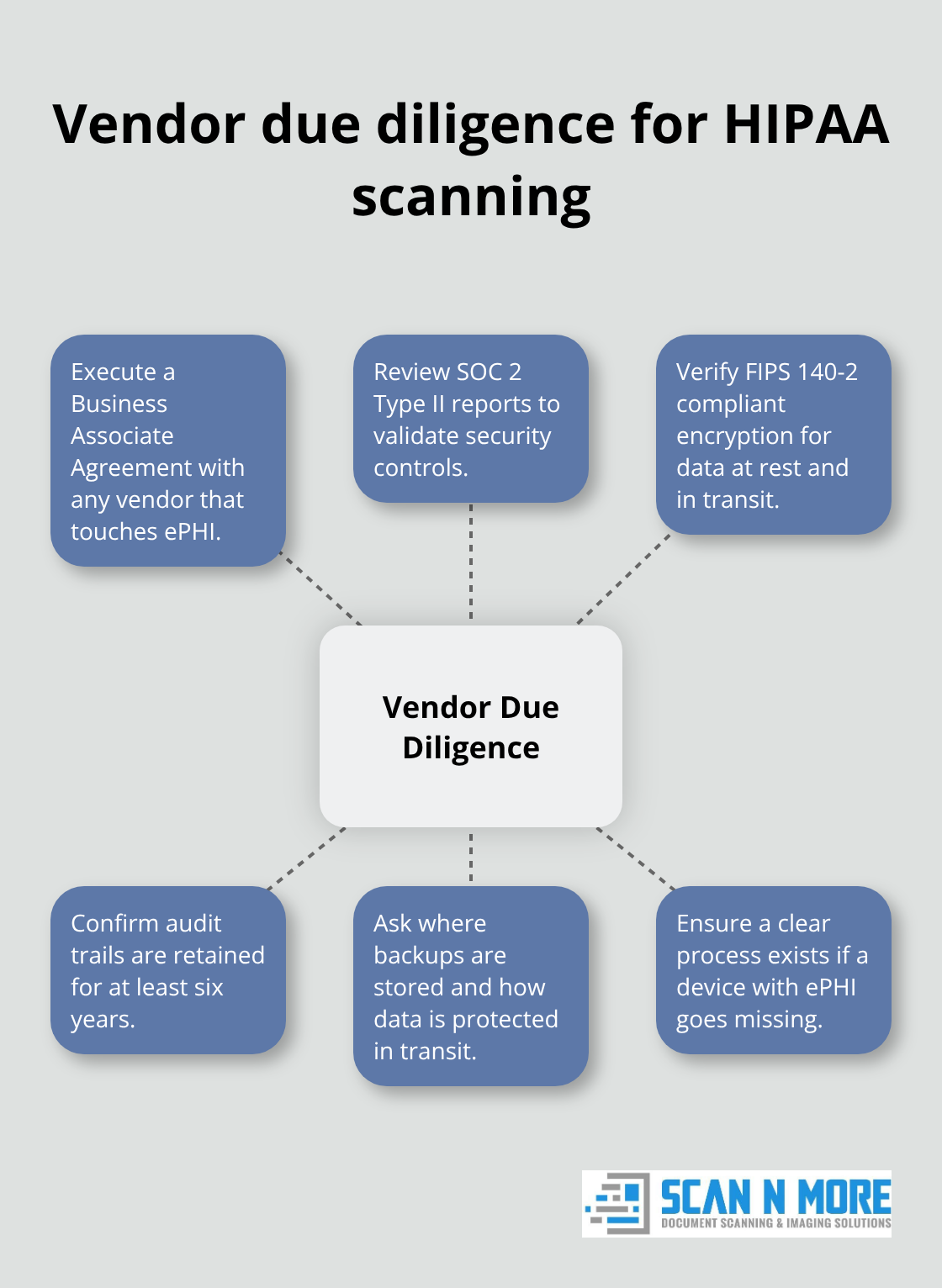
Ask how they handle data in transit, where they store backups, and what happens if a device containing ePHI goes missing. Vendors who cannot answer these questions directly should not touch your patient records.
Infrequent Security Audits Miss Critical Gaps
Security audits of your own scanning operations suffer from similar neglect. Many organizations conduct a single risk assessment during implementation, then assume compliance persists indefinitely. Mobile devices accumulate unpatched firmware, encryption keys age without rotation, staff access patterns drift from documented policies, and new scanning workflows bypass established safeguards.
Security audits of scanning operations require documented risk analyses, remediation actions, and system activity reviews stored for at least six years. Annual audits at minimum catch configuration gaps, unauthorized access patterns, and backup failures before OCR investigators discover them during breach investigations. Organizations that treat audits as annual checkbox tasks rather than continuous monitoring miss the window to remediate problems quietly and remain exposed when breaches occur. Test your backup restoration procedures annually to confirm you can recover ePHI within the required 72-hour window. Review audit logs monthly to spot unauthorized access attempts or unusual activity patterns. Update your risk assessment whenever scanning processes change or new technology enters your workflow.
Final Thoughts
HIPAA compliant scanning transforms how healthcare organizations protect patient data while accelerating care delivery. Breaches expose millions of records, trigger millions in fines, and erode patient trust that takes years to rebuild. Yet compliance strengthens operations, speeds record retrieval, and demonstrates genuine commitment to patient privacy rather than imposing burden.
Audit your current scanning workflows against the HIPAA Security Rule requirements: encryption at rest and in transit, role-based access controls, audit trails maintained for six years, and documented chain of custody for physical documents. Establish ongoing security monitoring through annual risk assessments, monthly audit log reviews, and annual backup restoration tests that catch configuration drift before breaches occur. Partner with scanning providers who demonstrate genuine HIPAA compliance through SOC 2 Type II audits, documented security practices, and transparent communication about how they handle ePHI.
At Scan N More, we understand that healthcare organizations need scanning partners who treat patient data protection as non-negotiable. Our professional document scanning services transform paper-based processes into secure digital solutions with on-site and off-site scanning for all formats, including medical records. Your commitment to patient data protection starts with choosing partners who share that commitment.