
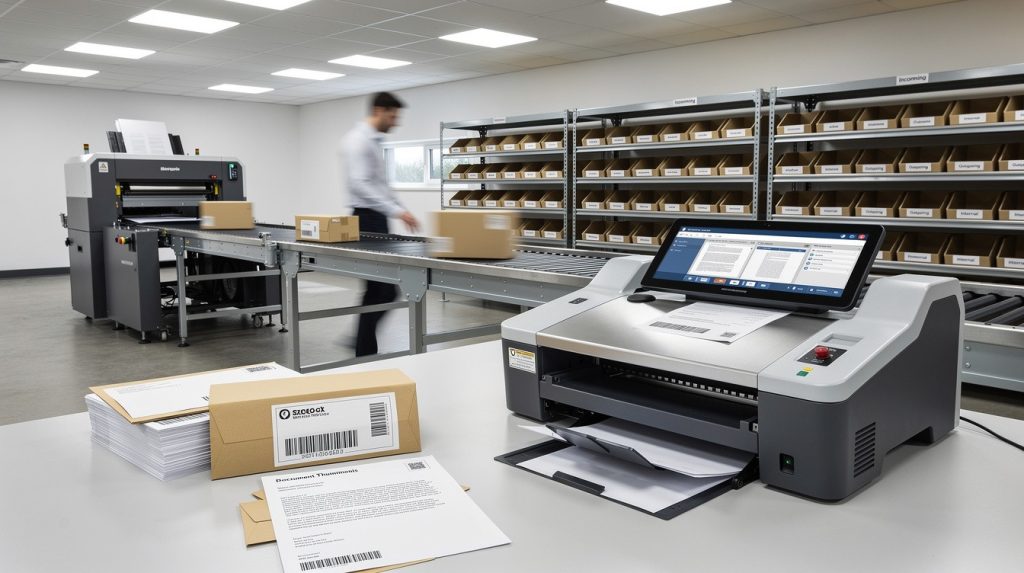
Most companies still process incoming mail manually, wasting hours on data entry and routing. We at Scan N More know that automation in mail scanning changes this entirely-cutting processing time from days to hours while slashing labor costs by up to 60 percent.
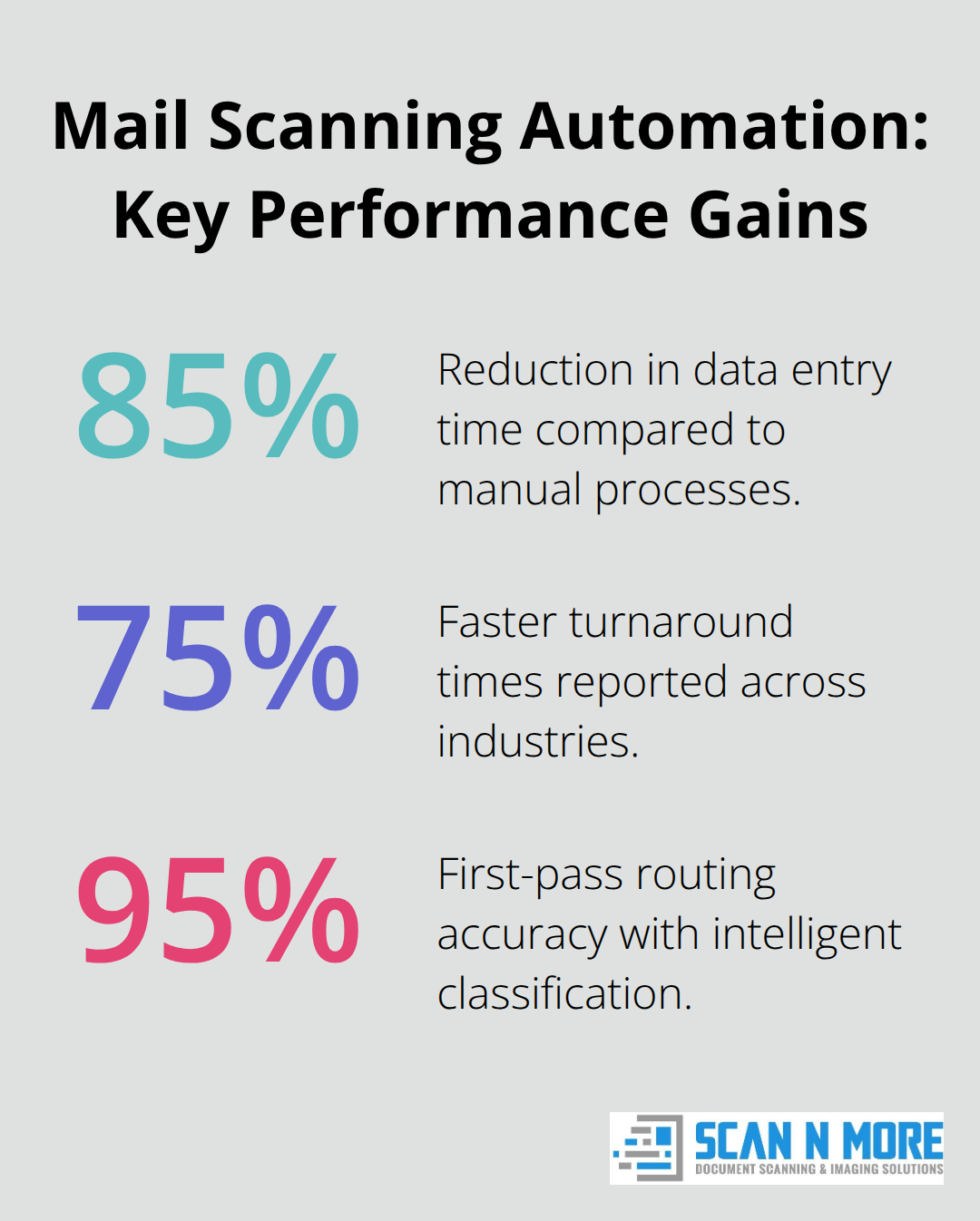
The results speak for themselves. Law firms, healthcare providers, and financial services companies are already seeing 75 percent faster turnaround times and accuracy rates above 99 percent.
What Automation Actually Changes in Your Mail Room
Automation rewires how mail moves through your operation from the moment it arrives. Instead of staff opening envelopes, sorting by department, and typing data into systems, automated mail scanning captures everything in minutes. Optical character recognition extracts text directly from documents, eliminating the tedious keyboard work that consumes hours daily. A financial services firm processing 500 pieces of mail per day can cut manual data entry time from 8 hours to under 2 hours using automation. The speed gain matters less than what it enables: staff shift from repetitive data entry to handling exceptions and complex cases that actually require human judgment.
Accuracy improves when machines replace manual entry
Accuracy improves because machines don’t misread addresses or transpose numbers the way tired employees do at 4 PM. Studies from industry reports show automated mail scanning delivers dramatic efficiency improvements, with organizations reporting 85% reduction in data entry time compared to manual processes.
A single transposed invoice number or misrouted claim costs time and money to correct. Automation eliminates these errors at scale, which compounds savings across thousands of documents monthly.
Labor costs drop because automation handles volume, not because it eliminates jobs
A 60 percent reduction in labor costs sounds dramatic until you understand what drives it. One person operating a modern mail scanning system processes what previously required three people working full days. You don’t necessarily fire those two employees; you redeploy them to customer service, compliance review, or other high-value work where human attention matters. A healthcare provider might move scanning staff into patient record verification, where their domain knowledge creates real value. The math works because scanning equipment costs far less than annual salaries. A quality scanning system pays for itself within 18 months for mid-sized operations handling 10,000-plus mail pieces monthly.
Processing speed transforms cash flow and response times
Processing time compressed from days to hours means invoices reach accounting faster, reducing payment cycles and improving cash flow. Insurance claims move through faster because documents reach adjusters immediately rather than sitting in intake queues. Faster document arrival accelerates every downstream decision, from approval workflows to client communication.
Routing decisions happen automatically, not in someone’s head
Intelligent document classification routes mail to the correct department without manual sorting. A legal firm receives contracts, discovery documents, and client correspondence in the same mailbag. Automation reads the document type and sends contracts to the contracts team, discovery materials to litigation support, and client letters to the intake department. This routing happens in seconds across hundreds of documents daily. Integration with your existing systems means scanned documents appear in your case management software, ERP, or document repository automatically (no manual logging into multiple systems or duplicate record creation). Departments receive what they need immediately, decisions happen faster, and client response times improve measurably. These operational changes set the stage for understanding which specific features make this transformation possible.
The Three Technologies That Actually Work
Modern mail scanning automation rests on three core capabilities that directly impact your operation. Document classification systems read what arrives and route it instantly to the right department without human intervention. Optical character recognition extracts text from paper documents so data flows into your systems automatically rather than requiring manual typing.
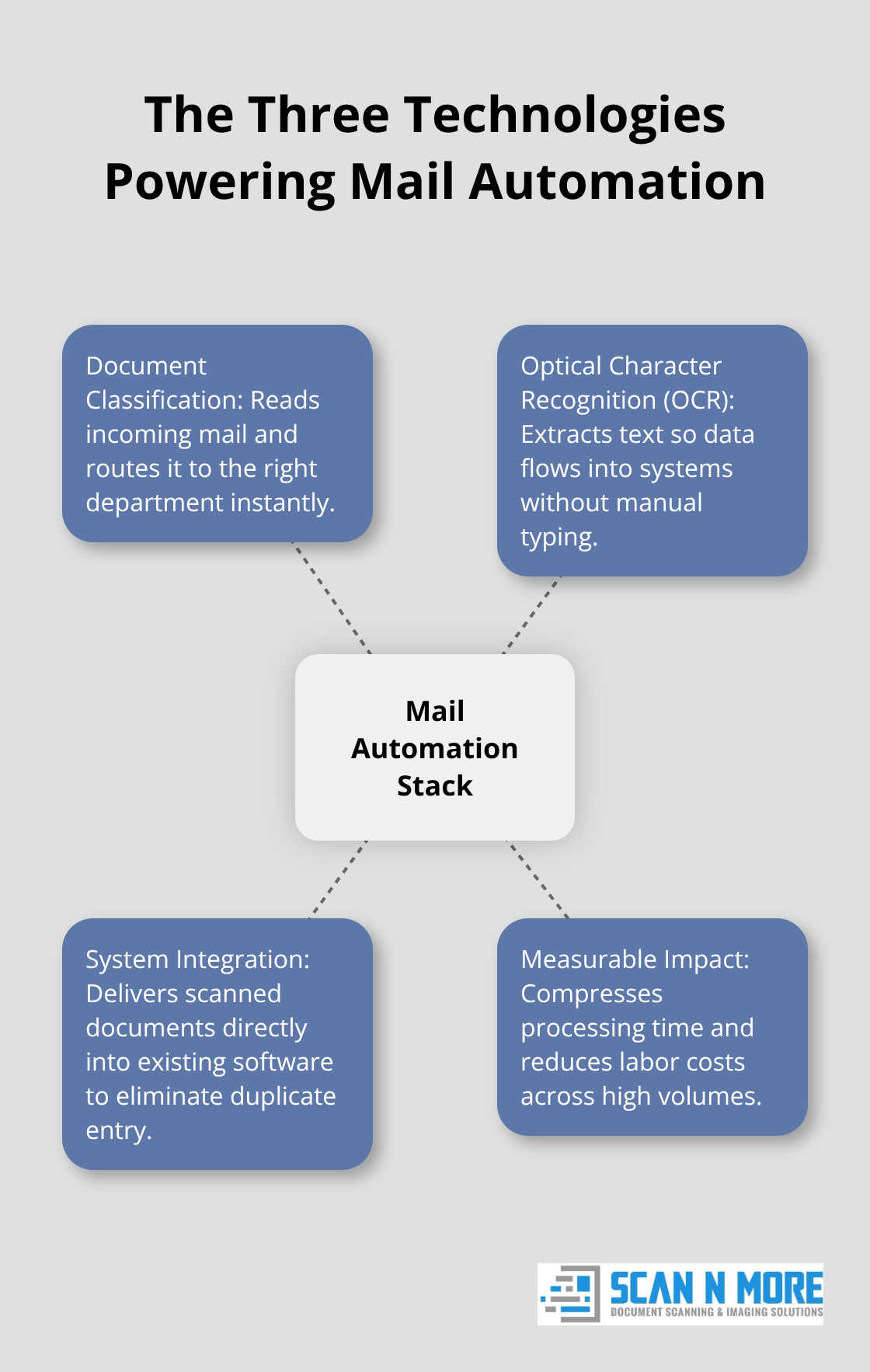
Integration with your existing software means scanned documents appear where your team already works, eliminating the need to log into separate platforms or create duplicate records. These aren’t theoretical features-they’re the practical mechanisms that compress processing time and cut labor costs measurably.
Classification systems learn your business rules and apply them consistently
Document classification software analyzes incoming mail and assigns it to predefined categories within seconds. A financial services firm receives invoices, statements, payment confirmations, and account inquiries in the same batch. The system identifies invoice documents and routes them to accounts payable, statements go to reconciliation, and inquiries route to customer service. This routing happens automatically across hundreds of documents daily without staff intervention. Misrouted documents create bottlenecks and delays downstream, so accuracy matters enormously. Organizations using intelligent classification report 95 percent first-pass routing accuracy according to industry assessments, meaning almost no documents require manual rerouting. Your team defines the routing rules once during setup, and the system applies them consistently every single day. This consistency eliminates the human error that occurs when tired staff members make judgment calls at volume.
Text extraction removes the keyboard from your workflow
Optical character recognition technology reads printed and handwritten text from scanned documents and converts it into digital data your systems can process. A healthcare provider receives patient intake forms, insurance cards, and authorization documents. Instead of staff manually typing patient names, dates of birth, and policy numbers into the electronic health record, OCR extracts this information automatically. The extracted data flows directly into your database, reducing data entry time by 80 to 90 percent based on real-world implementations across mid-market organizations. Handwritten documents present more challenges, but modern systems handle legible handwriting with reasonable accuracy. Fewer people spend time staring at screens typing information, which reduces both fatigue-related errors and the monotony that drives turnover in mail rooms.
System integration eliminates duplicate data entry and manual handoffs
Integration capabilities determine whether automation actually simplifies your workflow or creates new friction points. When scanned documents connect directly to your enterprise resource planning system, case management software, or document repository, information flows without manual intervention. A law firm receives client correspondence and automatically indexes it in their case management system with the correct matter number and attorney assignment. Staff access the document where they already work rather than navigating to a separate scanning portal. This integration prevents the common problem where scanned documents sit in an imaging system nobody checks regularly. Real implementations show that direct system integration reduces the time between document arrival and staff access from hours to minutes. Integration also eliminates duplicate data entry-information extracted by OCR populates your systems automatically without requiring a second person to manually retype what the scanner already captured.
Choosing the right automation partner matters more than the technology itself
The three technologies work only when implemented correctly for your specific operation. A mail scanning solution that works perfectly for a law firm may not fit a healthcare provider’s compliance requirements or a financial services firm’s security standards. Your implementation partner needs to understand your existing systems, your document types, and your workflow bottlenecks. They should customize routing rules to match your actual business processes rather than forcing you into generic templates. The quality of your scanning hardware, the accuracy of your OCR engine, and the depth of your system integrations all depend on selecting a partner who invests in getting these details right. This foundation determines whether automation delivers the processing improvements and labor cost reductions that leading organizations now achieve.
How Automation Delivers Measurable Results
Law firms compress intake timelines and accelerate client service
A mid-sized law firm handling 2,000 documents monthly reduced their intake processing time from 4 hours to 25 minutes per case after deploying automated mail scanning with intelligent routing. This reduction matters because client matters now reach attorneys faster, enabling quicker case assessments and faster client communication. The firm’s intake staff shifted from spending significant time scanning and sorting documents to handling exceptions and managing complex routing scenarios that required judgment. Processing speed improved because documents no longer waited in intake queues for manual sorting decisions; the system classified and routed incoming mail correctly on the first pass, eliminating rework cycles that consumed hours weekly.
Healthcare providers achieve accuracy rates that manual processes cannot match
A healthcare provider processing patient intake forms, insurance authorizations, and medical records achieved accuracy in data extraction after implementing OCR-based automation. This accuracy rate matters more than the headline number suggests because healthcare systems cannot tolerate the compliance violations and patient safety risks that manual transcription errors create. When staff members manually typed patient dates of birth, policy numbers, or medication information into electronic health records, error rates typically ranged between 2 and 5 percent depending on volume and staff fatigue levels. The provider discovered that automated extraction followed by staff verification of edge cases reduced errors significantly, which exceeded their quality standards and eliminated costly corrections.
Financial services firms recover automation investments within months
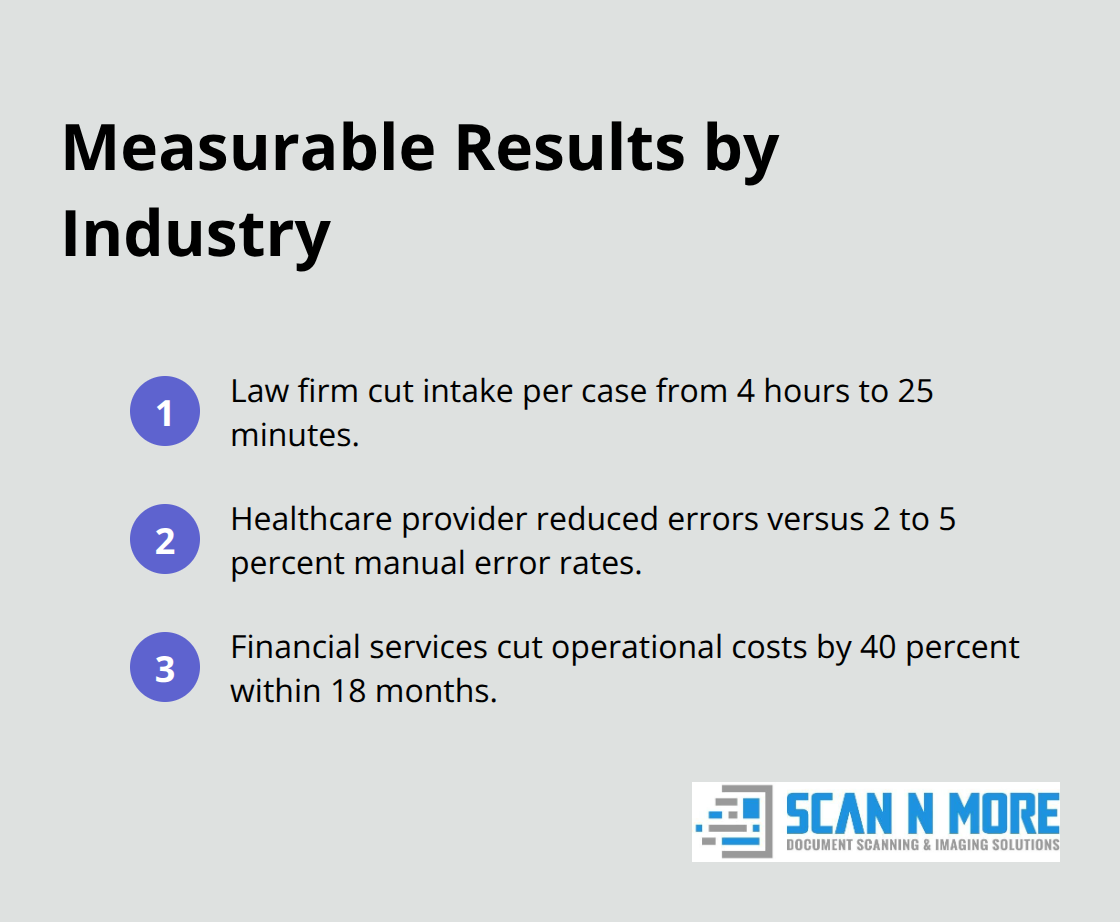
A financial services firm processing 15,000 invoices and statements monthly decreased their operational costs by 40 percent within 18 months of deploying automation. The firm’s accounts payable department previously required five full-time staff members performing data entry, routing, and exception handling. After automation, the same volume moved through the system with three employees, allowing the firm to redeploy two staff members to vendor management and payment optimization work that generated measurable value. The scanning system cost approximately $35,000 annually in licensing and maintenance, which meant the firm recovered their investment within the first year through labor savings alone (roughly $70,000 in reduced payroll costs). Beyond the first year, every dollar spent on automation became pure operational savings because the system required minimal ongoing investment while continuing to process the same high document volume with consistent accuracy and speed.
Final Thoughts
Automation in mail scanning delivers measurable results that your financial statements will reflect immediately. Law firms compress intake timelines from days to hours, healthcare providers achieve accuracy rates that manual processes cannot match, and financial services firms recover their entire automation investment within 18 months through labor cost reductions alone. A mid-sized operation processing 10,000 mail pieces monthly spends roughly $70,000 annually on staff performing manual data entry, sorting, and routing-a quality scanning system costs a fraction of that amount while handling the same volume with greater accuracy and speed.
The real value extends beyond cost reduction because speed gains compound across your entire operation. Invoices reach accounting faster, improving cash flow; insurance claims move through faster, improving customer satisfaction; client correspondence reaches attorneys immediately, enabling faster case assessments. These operational improvements create competitive advantages that cost savings alone cannot capture, transforming how your team works with documents from the moment mail arrives.
We at Scan N More help organizations transform paper-based mail processes into efficient digital workflows through our Mail Scanning Service, which handles on-site and off-site scanning for all document formats while maintaining the security and compliance standards your industry demands. Whether you process legal documents, medical records, or financial statements, we integrate your scanned documents seamlessly with your existing systems. Contact us to discuss how automation in mail scanning can work for your operation.