

Data breaches cost companies an average of $4.45 million per incident in 2024, according to IBM’s latest research. That’s why we at Scan N More believe data security protection strategies aren’t optional anymore-they’re fundamental to running a business.
Your organization faces threats from multiple angles: hackers, compliance violations, and the erosion of customer trust. This guide walks you through proven strategies to fortify your defenses.
Why Data Breaches Hit Harder Than Ever
Data breaches cost companies an average of $4.88 million in 2024, with projections reaching higher in 2026, according to industry reports. The financial impact alone demands immediate action. Organizations with strong incident response capabilities cut breach costs by $1.49 million and resolved incidents 54 days faster than those without formal response plans. That speed matters because every day of exposure multiplies regulatory fines, customer notifications, and operational disruption.
Compliance violations add another layer of expense. GDPR enforcement actions totaled EUR 1.2 billion in fines during 2024, with individual penalties reaching hundreds of millions. Ireland’s Data Protection Commission fined Meta approximately USD 1.3 billion for GDPR violations in May 2023. CCPA, HIPAA, and PCI DSS carry similar penalties, with fines calculated as percentages of annual revenue or flat amounts reaching millions. These aren’t theoretical risks anymore-they’re happening to companies across sectors right now.
Identity-Based Attacks Now Lead the Breach Landscape
Identity-based intrusions account for roughly 30 percent of all breaches, according to IBM’s X-Force Threat Intelligence Index. Attackers exploit weak access controls and stolen credentials far more often than they breach firewalls. Your team’s authentication hygiene directly determines breach likelihood.

Public-facing applications present another frequent vulnerability, with approximately 25 percent of breaches exploiting publicly accessible endpoints.
AI-driven attacks increased 56 percent in 2026, making traditional defenses obsolete. This shift demands immediate attention to access controls, multi-factor authentication implementation, and regular permission audits. Organizations that enforce least-privilege access and retire unused accounts reduce their exposure significantly. The cost of neglecting this single area manifests within months, not years.
Reputation Collapse Happens Instantly
Customer trust evaporates after a breach announcement. Companies lose contracts, face customer churn, and struggle to hire talent after public security failures. Regulatory bodies now require breach notifications within specific timeframes-typically 30 to 72 hours depending on jurisdiction-leaving no time to control the narrative. Media coverage amplifies damage, and social media spreads details faster than any internal communication can contain.
Organizations with documented incident response plans and tested recovery procedures emerge from breaches with less reputational harm because they communicate clearly and restore service quickly. This isn’t about public relations; it’s about operational resilience. The organizations that invest in data security today avoid the catastrophic combination of financial penalties, customer loss, and recruitment difficulties that plague breached companies for years afterward.
Why Access Controls Determine Your Risk Level
Your organization’s access control strategy determines whether attackers succeed or fail. Weak authentication creates the pathway for breaches. Multi-factor authentication, least-privilege access policies, and regular permission reviews form the foundation of effective defense. Companies that implement these controls systematically reduce their breach costs and recovery time significantly. The next section explores the specific strategies that transform your security posture from reactive to proactive.
Building Access Controls That Actually Stop Attackers
Multi-Factor Authentication Stops Credential-Based Attacks
Multi-factor authentication reduces breach risk dramatically because attackers with stolen credentials hit an authentication wall. The difference between single-factor and multi-factor authentication directly correlates to breach outcomes. Companies handling sensitive documents need layered verification at every access point. Implement MFA across all systems that touch customer data, employee records, or financial information. Start with email and administrative accounts first, then expand to all user logins within 90 days.
Least-Privilege Access Limits Attacker Movement
Enforce least-privilege access policies so employees access only the data required for their specific roles. Conduct permission audits quarterly to identify and revoke unnecessary access. Organizations that enforce this principle systematically reduce insider threat incidents and limit attacker lateral movement after initial compromise. This approach (combined with regular account reviews) prevents orphaned accounts from becoming security gaps that attackers exploit months or years after employees leave.
Vulnerability Testing Reveals Hidden Weaknesses
Regular security audits catch misconfigurations and abandoned accounts that create security gaps. Schedule vulnerability assessments at least twice yearly and immediately after major system changes. Penetration testing reveals how attackers would exploit your environment in real conditions. Companies that conduct annual penetration tests identify an average of 15 to 25 significant vulnerabilities before attackers find them. Document every finding and remediate critical issues within 30 days.

This discipline transforms security from a compliance checkbox into operational practice.
Security Awareness Training Changes Behavior Faster Than Technology
Security awareness training changes employee behavior faster than any technology deployment. Companies with strong security training programs reduce phishing attack success rates by 50 to 70 percent. Conduct mandatory training quarterly, not annually, because threats evolve constantly and employee memory fades. Simulate phishing emails monthly and track which employees click malicious links, then target additional training to those groups. Make training specific to your industry and role rather than generic compliance content. Medical staff face different threats than finance teams, so customize messaging accordingly. Test employees on data handling policies specific to your organization’s systems and document retention requirements. Measure training effectiveness through incident reports and near-miss tracking. Organizations that treat security awareness as continuous improvement rather than annual obligation see measurable reductions in successful attacks within six months.
With access controls, audits, and training in place, your organization creates a human and technical defense system that stops most attackers before they cause damage. The next chapter explores the tools and technologies that detect threats your defenses miss and recover your data when incidents occur.
Tools That Detect What Your Defenses Miss
Encryption and access controls form your first line of defense, but they cannot stop every attack. Organizations need a second layer: detection systems that catch intrusions your preventive measures miss. Encryption protects data at rest and in transit by rendering it unreadable without decryption keys, yet attackers still penetrate networks through unpatched systems, social engineering, and compromised credentials. This is why encryption alone fails without complementary detection capabilities.
Encryption Requires Proper Key Management
Organizations must implement encryption across all sensitive data stores and communication channels, then layer monitoring systems that identify suspicious access patterns and unauthorized data movement. Start encryption deployment with databases containing customer information, financial records, and employee data. Use AES-256 encryption for data at rest and TLS 1.2 or higher for data in transit. Require secure key management through centralized systems rather than scattered encryption keys across departments. Many organizations encrypt critical data but fail to manage keys properly, creating situations where encrypted data becomes inaccessible during legitimate recovery operations. Test your encryption and key recovery procedures quarterly to confirm decryption works when needed.
Immutable Backups Resist Ransomware Attacks
Backup and disaster recovery systems separate organizations that recover from breaches within days from those that suffer weeks of downtime and data loss. Immutable backups resist ransomware attacks because attackers cannot modify or delete backup copies even after compromising primary systems. Implement geographically distributed backups stored in separate physical locations so a single facility failure does not eliminate recovery options. Test backup restoration monthly on non-production systems to confirm data integrity and recovery speed. Organizations that conduct quarterly full restoration tests identify issues before actual incidents occur.
Threat Detection Systems Identify Attacks in Progress
Threat detection systems using Security Information and Event Management platforms monitor network traffic, endpoint activity, and user behavior patterns to identify attacks in progress. These systems correlate alerts across multiple data sources so security teams distinguish genuine threats from false positives that waste investigation resources. Implement monitoring across endpoints where employees work, cloud services where data resides, and network segments where data flows between systems. AI-driven threat detection identifies anomalous patterns like unusual login times, access to restricted files, or data transfers to unknown locations. Organizations deploying advanced threat detection with behavioral analytics reduce incident detection time from days to hours, enabling faster response before attackers extract sensitive information. Configure alerts to trigger automatically when detection systems identify suspicious activity, routing critical alerts directly to security teams for immediate investigation.
Layered Defense Creates Operational Resilience
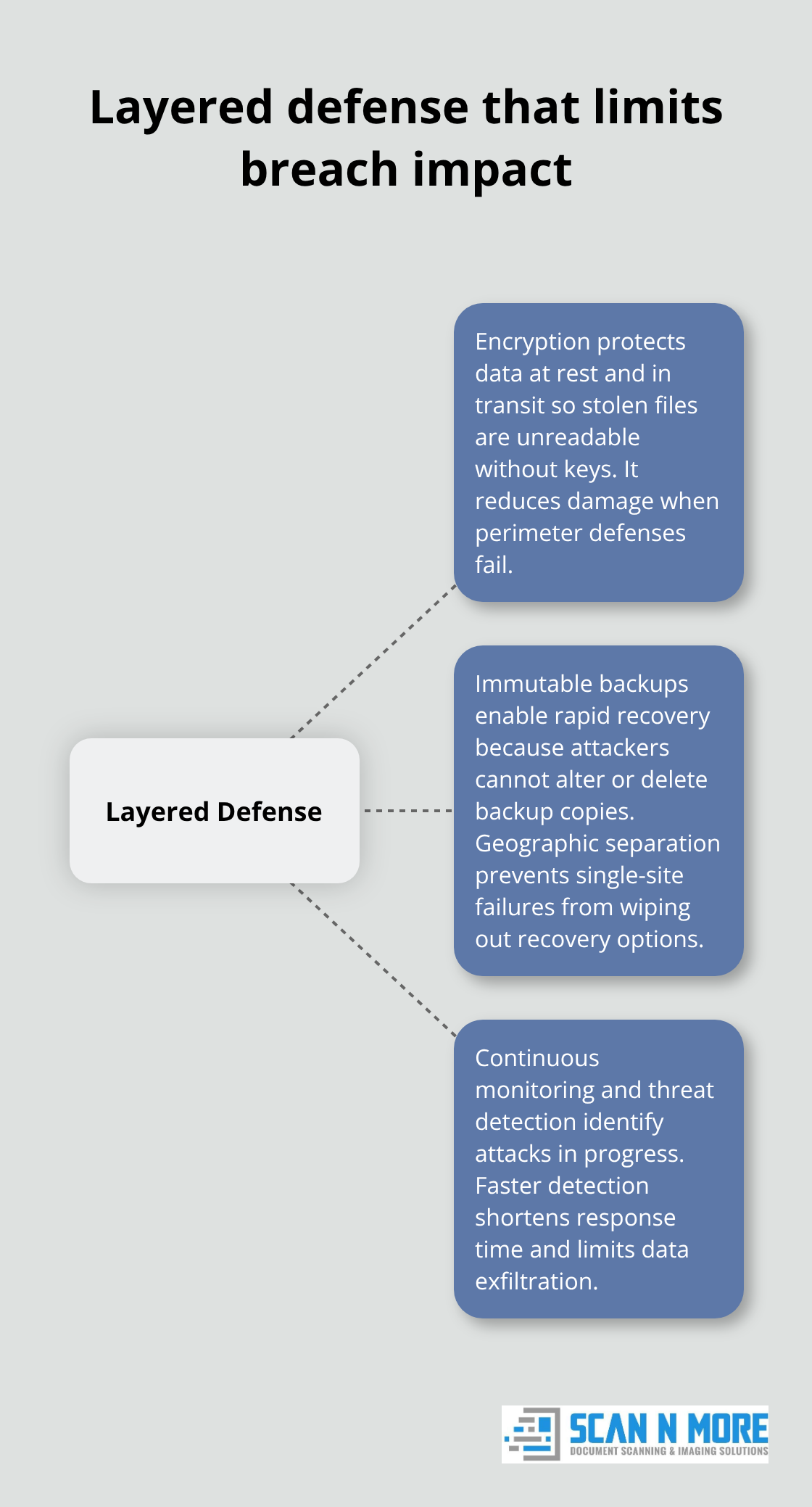
The combination of encryption preventing unauthorized viewing, immutable backups enabling rapid recovery, and continuous monitoring detecting attacks creates a defense architecture that stops most threats and limits damage when breaches occur despite preventive measures. This integrated approach transforms your security posture from reactive incident management to proactive threat prevention.
Final Thoughts
Your organization needs three interconnected actions to build a strong data security foundation. First, implement the core strategies outlined in this guide: multi-factor authentication, regular vulnerability testing, and continuous security awareness training that stop most attackers before they penetrate your systems. Second, deploy detection and recovery systems that catch threats your preventive measures miss and restore operations quickly when incidents occur, with encryption, immutable backups, and threat monitoring creating the resilience that separates organizations recovering from breaches within days from those suffering weeks of disruption. Third, treat data security protection strategies as ongoing operations, not one-time projects, since threats evolve constantly and your defenses must adapt through quarterly permission audits, regular penetration testing, and monthly backup restoration drills.
Your next step depends on your current security maturity. Organizations without formal incident response plans should develop and test one immediately, since companies with documented response procedures cut breach costs by $1.49 million and resolve incidents 54 days faster than those without them. Teams lacking multi-factor authentication should deploy it across all systems touching sensitive data within 90 days, while those without immutable backups should implement geographically distributed backup systems that resist ransomware attacks.
We at Scan N More understand that data security extends beyond digital systems to physical documents containing sensitive information. Our professional document scanning services transform paper-based processes into secure digital solutions with guaranteed compliance and data protection, whether you need on-site scanning for legal documents, off-site services for high-volume digitization, or hard drive destruction to eliminate physical data risks. Contact Scan N More to discuss how professional document management strengthens your overall data security posture.