
Most organizations still rely on manual mailroom processes that drain budgets and create bottlenecks. Papers get lost, packages end up in the wrong departments, and staff spend hours sorting instead of handling strategic work.
Mailroom management digitization transforms this chaos into efficiency. At Scan N More, we’ve seen firsthand how automated sorting and real-time tracking eliminate the costly mistakes that plague traditional mailrooms.
Why Manual Mailrooms Drain Your Budget
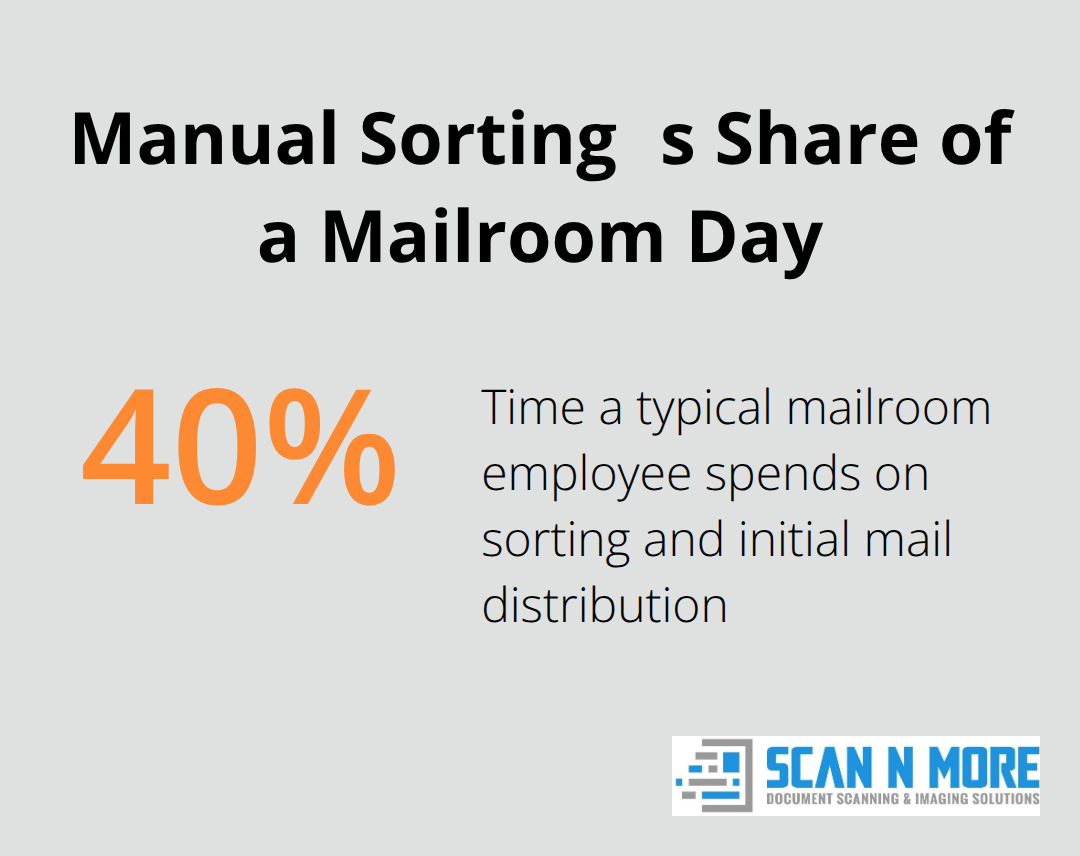
Manual mailroom operations consume far more resources than most organizations realize. A typical mailroom employee spends roughly 40 percent of their day on sorting and initial mail distribution, according to industry workflow analyses. When you calculate that across a team of three to five people, you’re looking at the equivalent of one to two full-time staff members dedicating their entire workday to organizing papers. Labor costs compound quickly, especially when high-volume periods like invoice processing cycles or benefits enrollment seasons arrive.
Beyond wages, organizations pay for physical infrastructure: filing cabinets, storage space, climate control, and the real estate that houses it all. Many organizations don’t track these indirect costs until they run a proper audit, and the numbers shock them. Companies typically spend 15 to 20 percent of their mailroom budget on storage and space alone-money that evaporates without generating any business value.
Misrouted Documents Create Real Consequences
Lost and misdirected mail isn’t just an inconvenience. When an invoice reaches the wrong department, payment cycles extend by days or weeks, damaging vendor relationships and potentially triggering late fees. A single misrouted customer check can delay cash processing and throw reconciliation into chaos. Insurance claims sent to the wrong desk mean denied coverage deadlines slip past, creating compliance headaches and customer service nightmares. Medical records filed incorrectly expose organizations to HIPAA violations and regulatory fines. These errors force staff to spend additional hours tracking down documents, re-sorting materials, and manually correcting downstream data entry mistakes. The rework alone can triple the original processing time for that single document. Organizations that process thousands of inbound items monthly experience dozens of these incidents weekly, creating a constant firefighting culture where staff react to problems instead of completing their actual job responsibilities.
Sorting Steals Time from Strategic Work
Staff trapped in sorting workflows cannot focus on analysis, customer communication, or process improvement. When someone spends three hours daily on mail handling, that represents 15 hours weekly that could go toward exception handling, vendor management, or compliance verification. The mental fatigue of repetitive sorting also reduces accuracy on the tasks that matter most. Employees make mistakes when they switch between monotonous physical work and decision-making activities. This context-switching cost is real but invisible in most budgets. Traditional mailrooms also create bottlenecks that ripple across the entire organization. If accounts payable must wait for the mailroom to sort invoices before processing begins, the entire payment cycle slows. If customer service cannot access documents until mail staff locate and deliver them, response times suffer. The hidden cost of these delays shows up in customer satisfaction scores, days payable outstanding metrics, and employee retention problems as staff tire of inefficient workflows.
These operational failures point to a fundamental truth: manual mailrooms don’t just waste time and money-they actively prevent organizations from functioning at their best. The solution lies in automation that transforms how inbound mail moves through your organization.
How Digitization Transforms Inbound Mail Processing
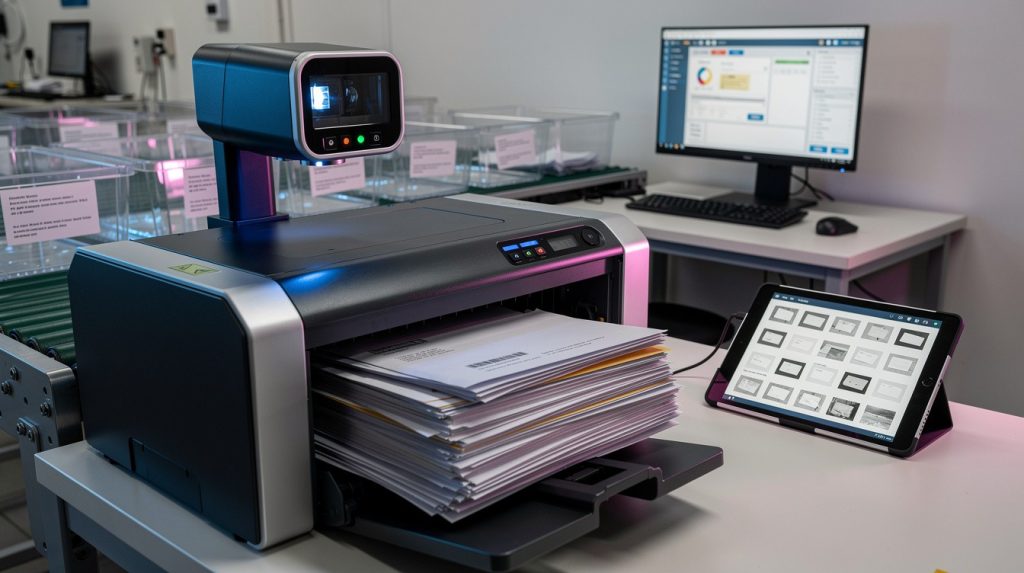
Mailroom digitization replaces manual sorting with automated systems that scan, classify, and route documents in minutes instead of hours. High-speed scanners process documents at rates of at least 40 pages per minute, converting physical mail into searchable digital files immediately upon arrival. AI-powered classification systems read document content and metadata to automatically categorize invoices, claims, checks, enrollment forms, and other common mailroom items without human intervention.
Automation Eliminates the Sorting Bottleneck
This automation removes the sorting bottleneck entirely. Instead of staff physically handling each piece of mail multiple times, documents move through the system once, get captured with high-quality imaging, and proceed directly to the next step. Real-world data shows organizations reduce initial processing time from hours to minutes using this approach. The system validates data quality during capture, catching missing fields or poor-quality scans before documents reach downstream teams.
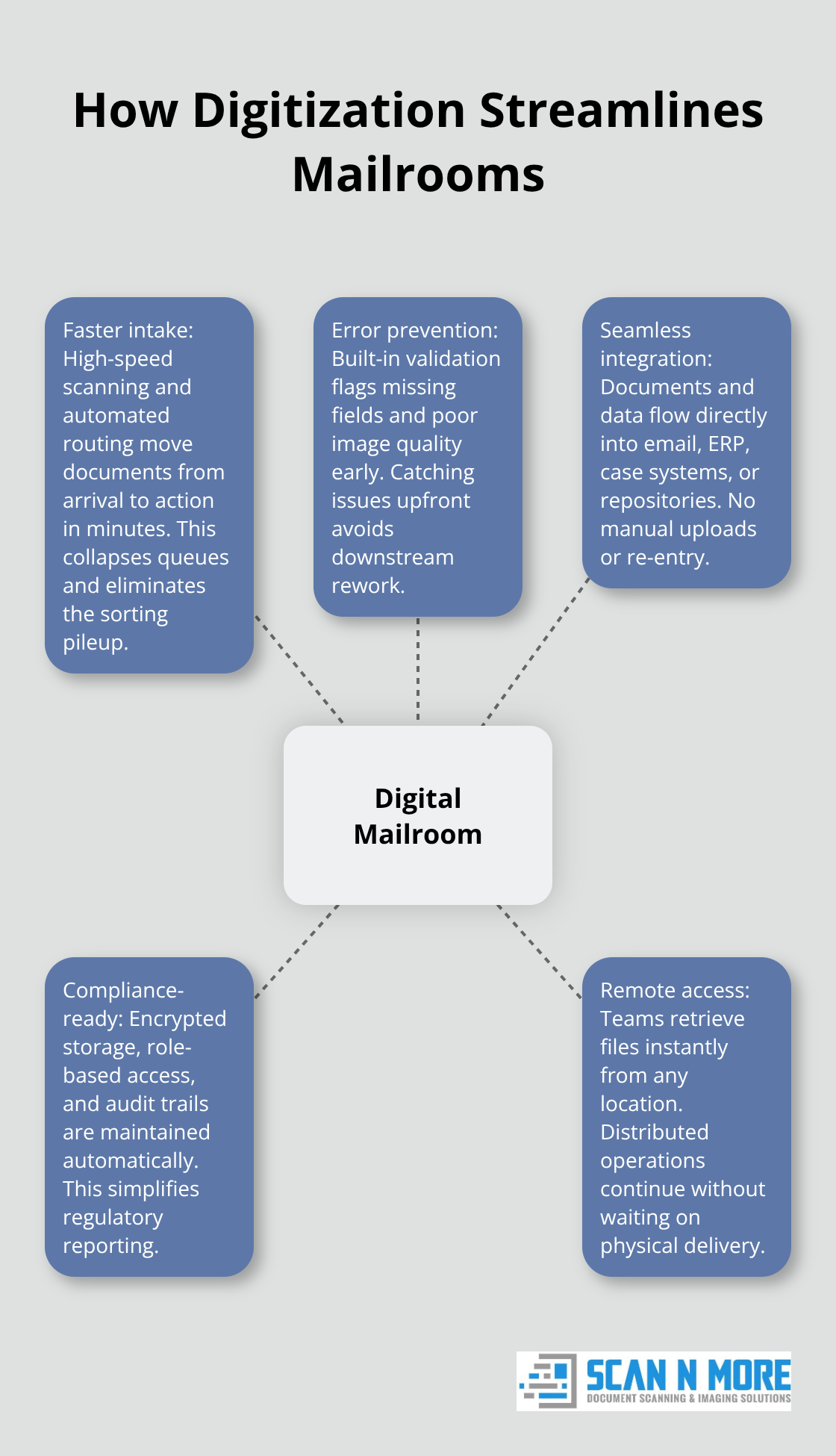
This early validation prevents rework that typically adds 20 to 30 percent to total processing time.
Integration Creates End-to-End Automation
The real power emerges when digitized mail connects directly to existing business systems. Documents extracted from the mailroom automatically route to email inboxes, ERP platforms, case management systems, or document repositories without manual uploads or data re-entry. An invoice scans and immediately appears in accounts payable software with extracted line items, vendor codes, and amounts pre-populated. A customer check arrives and automatically feeds banking reconciliation systems. Insurance claims enter case management platforms with metadata already attached.
Seamless Data Transfer Reduces Errors
This seamless integration eliminates handoff delays and reduces errors that occur during manual data transfer. Organizations typically experience a 40 to 50 percent reduction in days payable outstanding when invoice processing becomes fully automated. The system maintains encrypted storage with role-based access controls, audit trails, and activity logging throughout the entire workflow. This creates compliance documentation automatically rather than requiring staff to manually record who accessed what documents and when.
Remote Access Enables Distributed Operations
Remote access to digitized documents means teams work from any location without waiting for physical mail delivery or internal courier services. Staff can retrieve documents instantly from anywhere, enabling continuity across multiple office locations and supporting flexible work arrangements. This distributed capability becomes especially valuable during high-volume periods or when unexpected disruptions affect normal operations. The foundation is now in place for organizations to understand how digitization works-but the real question becomes how these systems deliver measurable business results.
What Numbers Show About Digital Mailrooms
Processing Speed Accelerates Cash Flow
Organizations that digitize mailroom operations typically cut processing time by 60 to 80 percent within the first three months of implementation. A manufacturer processing 5,000 invoices monthly reduced their payment cycle from eight days to three days after deploying automated capture and routing. That acceleration alone freed up working capital and improved cash flow visibility significantly. Labor costs drop substantially because staff no longer spend hours on repetitive sorting and filing.
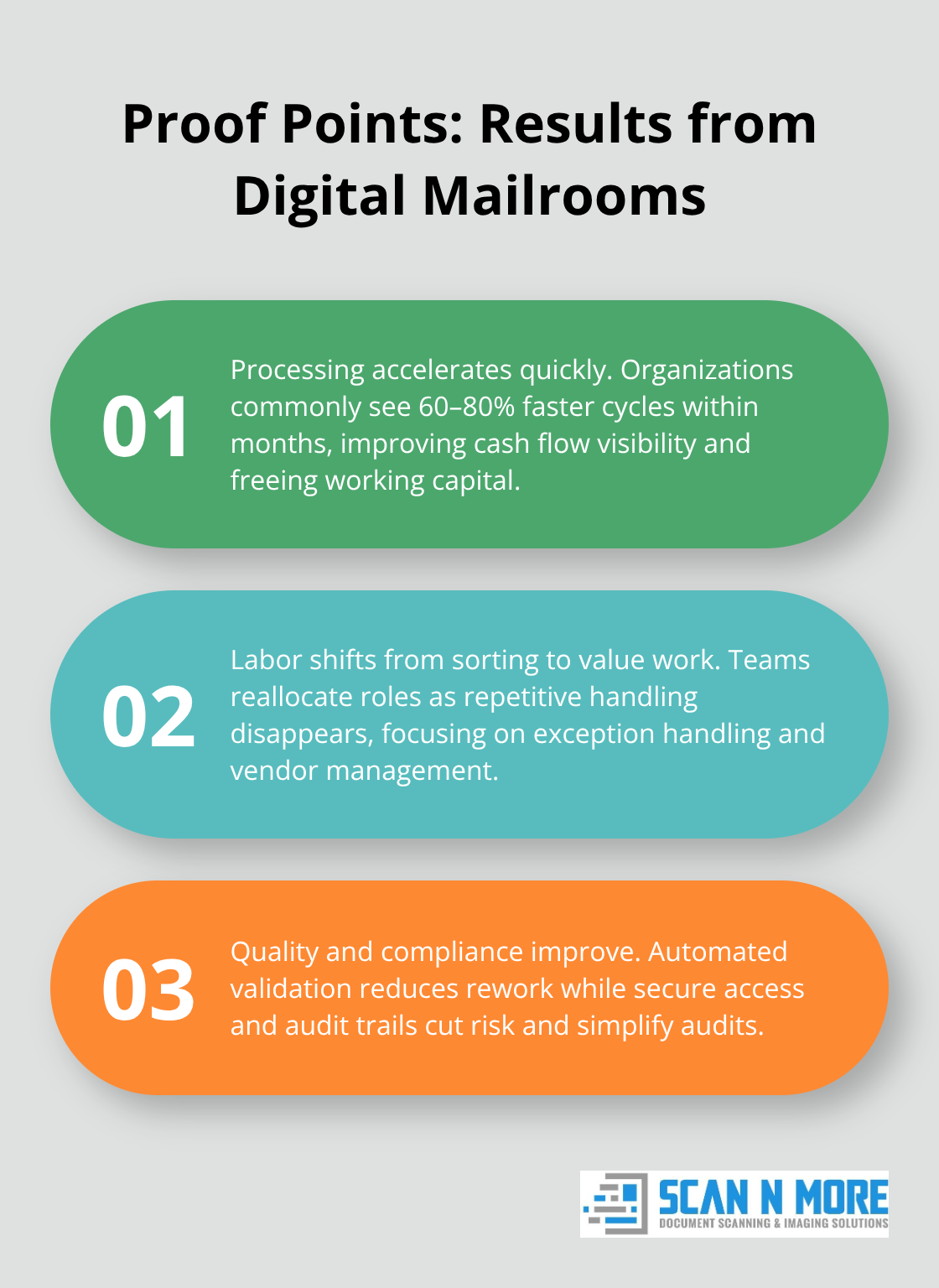
One financial services firm reduced mailroom staffing from five full-time employees to two within six months, reallocating three people to accounts payable exception handling and vendor management.
Automation Cuts Data Entry Expenses
Whereas manual data entry costs $1.00 to $1.60 per document in direct labor alone, AI data entry costs $0.07 to $0.29 per document depending on volume. Healthcare organizations see particularly strong returns because HIPAA-compliant storage and audit trails are built directly into digital systems rather than requiring separate compliance infrastructure. Insurance companies processing claims report 35 to 45 percent fewer rework cycles after implementing automated validation because the system catches missing information before documents reach adjusters. This early detection prevents costly downstream delays where a single missing field might require retrieving a physical file and contacting the claimant again.
Security and Compliance Reduce Risk Exposure
Organizations using encrypted digital storage with role-based access controls reduce unauthorized document access incidents to near zero compared to physical mail environments where anyone walking through the mailroom can see sensitive information. Audit trails automatically log every document access, viewing, and download, creating compliance documentation that satisfies regulatory requirements without manual effort. A legal firm using digital mailroom systems satisfied their entire document retention and audit requirements in one afternoon, whereas their previous manual process required three days of staff time quarterly. Financial institutions report that digital systems enable them to meet strict data residency requirements because on-premises scanning and storage keep sensitive information inside the firewall rather than requiring external processing. The cost of a single compliance violation typically exceeds 50,000 dollars in fines and remediation, making the compliance benefits alone worth the digitization investment.
Customer Service Transforms Through Instant Access
Document retrieval speed transforms customer service operations because staff locate files in seconds instead of hours. Insurance adjusters responding to customer inquiries access complete claim files instantly, enabling them to answer questions and authorize payments without callbacks or delays. This speed directly improves customer satisfaction scores and reduces the follow-up work that consumes support staff time.
Final Thoughts
Mailroom management digitization delivers measurable returns that extend far beyond the mailroom itself. Organizations eliminate sorting bottlenecks, reduce processing time by 60 to 80 percent, and free staff to focus on work that actually drives business value. The financial case is straightforward: lower labor costs, faster cash flow, fewer errors, and compliance documentation that builds itself automatically.
Honest assessment of your current state reveals the true cost of manual processes. How many hours weekly does your team spend sorting mail? What percentage of documents arrive at the wrong destination? How much rework happens because of missing data or misdirected items? These questions justify the investment in automation and show where digitization creates the fastest returns.
We at Scan N More help organizations transform paper-based processes into digital solutions through professional document scanning services. Whether you need on-site or off-site scanning for legal, medical, or standard business documents, our mail scanning service handles the digitization while maintaining strict data security and compliance standards. Contact Scan N More to discuss how mailroom management digitization can work for your organization.