
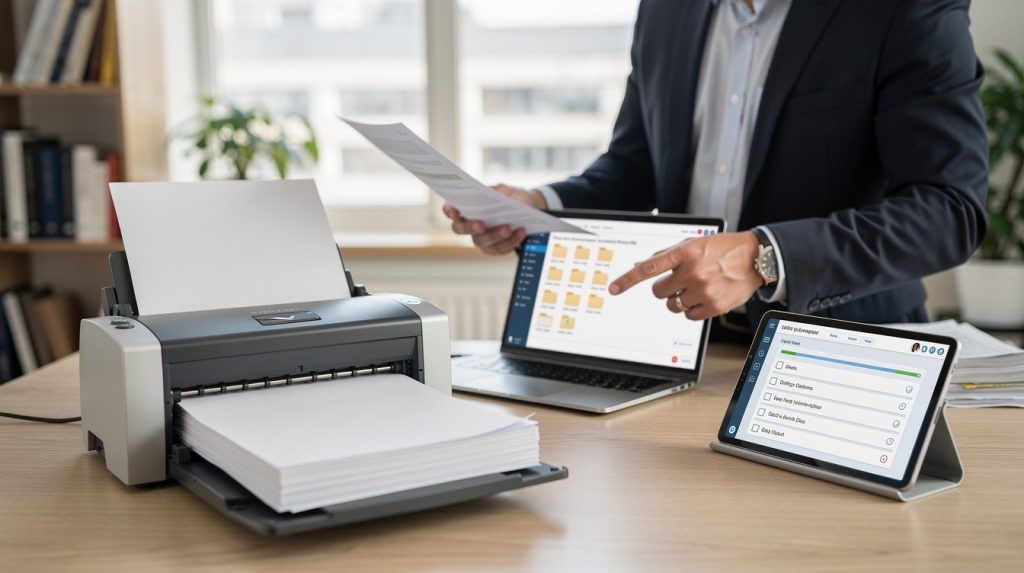
Paper still dominates most business operations, and it’s bleeding money. Companies waste thousands annually on manual document handling, storage, and retrieval.
At Scan N More, we’ve seen firsthand how digitization process improvement transforms operations. Businesses that move away from paper cut processing time in half, reduce errors dramatically, and gain real compliance advantages.
Why Digitization Stops Wasting Your Money
The Hidden Cost of Paper Operations
Paper processes drain operational budgets in ways most businesses never fully quantify. Document storage costs approximately $20 per filing cabinet annually, yet companies typically underestimate how many cabinets they actually maintain. When you factor in retrieval time, manual data entry errors, and the staff hours spent searching for misplaced documents, the real cost multiplies. McKinsey research shows that digitizing processes cuts operating costs by 20-30%, and that figure reflects only the direct savings from eliminating physical storage and manual handling. Most organizations lose far more through hidden inefficiencies: an employee spending 15 minutes daily hunting for a single document type represents nearly 65 hours per year wasted on one task alone. Multiply that across your workforce and the financial bleeding becomes undeniable.
How Digital Systems Eliminate Waste Immediately
Digital systems stop this waste right away. When documents live in a searchable, centralized system, retrieval happens in seconds instead of minutes. Data entry errors plummet because information moves directly from source to system without manual transcription. These aren’t theoretical gains-they’re measurable outcomes that show up in reduced cycle times and lower labor costs within weeks of implementation. Employees reclaim hours each week that paper-based searching consumed. Accuracy improves as automation removes the human transcription step entirely. The financial impact compounds as these efficiencies stack across your entire operation.
The Compliance Risk Paper Cannot Solve
Paper-based operations create compliance nightmares that digital systems solve outright. Regulatory bodies increasingly demand audit trails, version control, and proof that documents haven’t been altered or lost. Paper cannot provide this. A single misfiled document in a regulated industry can trigger penalties.

Healthcare organizations face HIPAA violations ranging from $100 to $50,000 per violation. Legal firms risk sanctions. Financial institutions encounter regulatory fines. Digital systems maintain immutable records with timestamped access logs, automatically satisfying compliance requirements that would require expensive manual documentation otherwise.
Security Advantages Digital Delivers
Security improves dramatically with digitization. Paper gets stolen, damaged by fire or water, or simply walks out the door. Digital documents encrypt at rest and in transit, with access controls that restrict who views sensitive information. Data breaches from physical theft become impossible. These aren’t optional upgrades-they’re foundational protections that paper environments simply cannot match. Organizations that transition to digital systems eliminate entire categories of risk that plague paper-dependent operations. This security foundation positions your business to meet today’s regulatory demands and tomorrow’s stricter requirements. With compliance and security locked in, your operation can focus on the next critical step: selecting the right tools and partner to execute your digitization strategy effectively.
How to Start Your Digitization Strategy Without Wasting Time or Money
Identify the Right Process to Digitize First
The mistake most businesses make is jumping straight to software selection before understanding what they actually need to digitize. You cannot fix a process you haven’t mapped. Start by scoring your existing workflows using a simple framework: rate each process on Frequency, Manual touch time, Error cost, Handoff count, and Stability, then subtract Volatility. Any process scoring above 18 points is a strong candidate. High-frequency, unglamorous processes typically deliver the fastest wins-client intake, purchase approvals, employee onboarding, and month-end close routines consistently rank at the top. A manufacturing company that digitized its quality check process cut cycle time by 40% within six weeks because the process ran daily across multiple departments with numerous handoffs. That’s not luck; that’s targeting the right process first.
Once you’ve identified your top three candidates, map the baseline: document every step, every person involved, every decision point, and every handoff. This baseline becomes your measurement standard. Without it, you cannot prove ROI later. Spend two to three weeks on this mapping phase. Most organizations skip it and regret it immediately.
Define Your Process Before Selecting Software
The second critical mistake is buying software before defining how the process will actually work. Most digitization projects simply copy old paper workflows into new systems, which wastes 60% of the potential efficiency gain. Define the process first, digitize it second, automate it third. That sequence matters. During definition, align your team on one version of the process everyone agrees to follow. Disagreement at this stage explodes into chaos during implementation.
Once the process is locked, you can evaluate platforms. Avoid vendor lock-in by choosing solutions with open, interoperable formats-proprietary systems become expensive liabilities when providers exit markets or your needs evolve. After go-live, process drift is nearly inevitable; keep your documented process and system execution synchronized in one place with version history. Assign a named owner to each digitized process and establish quarterly reviews to catch divergence before it becomes chaos.
Plan Your Timeline and Budget Realistically
Realistic timelines prevent project failure. A typical first-cycle digitization follows this pattern: two weeks to select the process, two to three weeks to map baseline workflows, three to four weeks to build and pilot the solution, then rollout and adoption over four to eight weeks depending on workforce size. Rushing the mapping and pilot phases guarantees expensive rework later.

Budget should include software licensing, training, process redesign consulting if you lack internal expertise, and contingency for data cleanup-legacy data is always messier than expected. Digitization projects delivering strong productivity gains typically invest in both technology and talent development simultaneously. Employee resistance kills more digitization efforts than technical problems; involve staff early, communicate measurable benefits clearly, and provide hands-on training before go-live.
Measure impact with practical metrics: cycle time, touch time, first-time-right rate, exception rate, and time to competence for new employees. These numbers tell you whether the investment is working. With your timeline and budget locked in, the next critical step involves handling your existing paper documents and ensuring they transition cleanly into your new digital environment.
How Real Operations Changed When Companies Went Digital
Manufacturing: Speed and Accuracy Gains Compound Fast
Manufacturing environments prove digitization’s value fastest because their processes run at high frequency with multiple handoffs across teams. A mid-sized automotive parts supplier implemented document digitization for quality checks and supplier approvals, reducing cycle time from 8 days to 3.5 days within the first month. The operation started with a scoring framework and identified quality inspection forms as the top candidate-they ran 40 times daily across three departments with an average retrieval time of 12 minutes per document set.
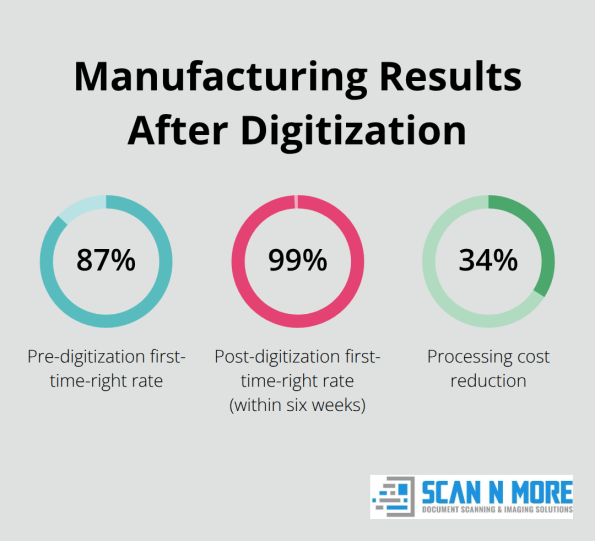
Once digitized, inspectors accessed forms in seconds and eliminated manual transcription errors that previously cost $8,000 monthly in rework. Decision cycles compressed dramatically. The manufacturer measured first-time-right rates before and after, proving accuracy jumped from 87% to 99% within six weeks. This concrete operational change freed two full-time employees for higher-value work while cutting processing costs by 34%.
Healthcare: Administrative Overhead Shrinks Measurably
Healthcare organizations face uniquely brutal economics around administrative overhead. A 200-bed regional hospital digitized patient intake and insurance verification workflows, which previously consumed 18 staff hours daily across billing and registration departments. The baseline mapping revealed 23 separate handoffs and 11 decision points in a process that should have required 4 hours of actual work.
After digitization, the same workflow compressed to 8 handoffs and 3 decision points, cutting processing time from 6 hours per patient to 90 minutes. The hospital reclaimed 2.5 full-time-equivalent positions without layoffs-staff shifted to denial management and patient outreach functions that generate revenue. Administrative costs per admission dropped 26% within four months.
Legal Services: Client Response Times Accelerate Competitive Advantage
Legal practices report dramatic improvements in client service response times when they digitize matter intake, document assembly, and billing workflows. Firms that previously required 3 business days to generate engagement letters and cost estimates now deliver them within 4 hours, creating measurable competitive advantage in client acquisition. This speed advantage translates directly into higher win rates during the critical early stages of client relationships.
Final Thoughts
The evidence proves that digitization process improvement delivers measurable returns across your entire operation. Manufacturing plants cut processing time in half, healthcare systems reclaim thousands of administrative hours annually, and legal firms win more clients through faster response times. These outcomes repeat predictably when you target the right processes, map them rigorously, and implement systematically rather than rushing into software selection.
Your next move matters more than waiting for perfect conditions. The businesses winning right now start with one high-impact process and prove ROI within 90 days-that proof funds your next digitization wave and compounds savings across departments. Every day your team spends searching for documents, re-entering data, or chasing manual approvals costs money that digitization eliminates immediately.
We at Scan N More transform paper-based operations into digital solutions that work from day one. Our professional document scanning services convert your paper backlog into searchable, secure digital assets, and our Mail Scanning Service plus Hard Drive Destruction capabilities keep your transition compliant and cost-effective. Start your digitization journey with Scan N More and partner with a team that guarantees fast, reliable results.